Distinguish Correlation, Causation and Context
Distinguish Correlation, Causation, and Context
Spotting patterns in data is useful, but it’s critical not to assume that just because two things happen together, one causes the other. Correlation means two things happen together; causation means one thing actually causes the other. Confusing the two leads to mistakes and false conclusions.
For example, if grades improve after a new study app is introduced, it’s tempting to credit the app. But maybe students also started group study, or the exam was easier, or the semester schedule changed. Careful analysis helps you avoid these traps and focus on what really drives outcomes.
Identifying Outcome Drivers
Most outcomes have multiple causes, but people often prefer simple explanations. Instead, list all possible factors—called a factor inventory—before drawing conclusions. If class attendance rises, consider new class times, reminders, weather, or changes in transportation.
Remember that timing matters: Did the supposed cause happen before the effect? If assignment submissions increased after a new deadline policy, that supports causation. But if submissions were already rising, look for other explanations.
Consider interaction effects in your analysis. Sometimes two small changes together have a big impact, or one cancels out another. For example, imagine a school tries two changes to boost attendance: sending reminder emails and offering free breakfast. On their own, each increases attendance by 5%. But when both are done together, attendance jumps by 20%. The interaction of the two variables lead to a measurable difference in impact.
Finally, confounding variables are hidden factors that make two things look related when they aren’t. For example, imagine a school notices that students who bring umbrellas to class tend to get better grades. It might seem like carrying an umbrella improves grades, but the real reason could be that students who are more prepared (and bring umbrellas when it rains) are also more likely to study and do well. Always ask, "What else was happening that could explain this?"
Logic Tests for Causation
You don’t need advanced statistics to test causal claims. Focus on these simple logic checks:
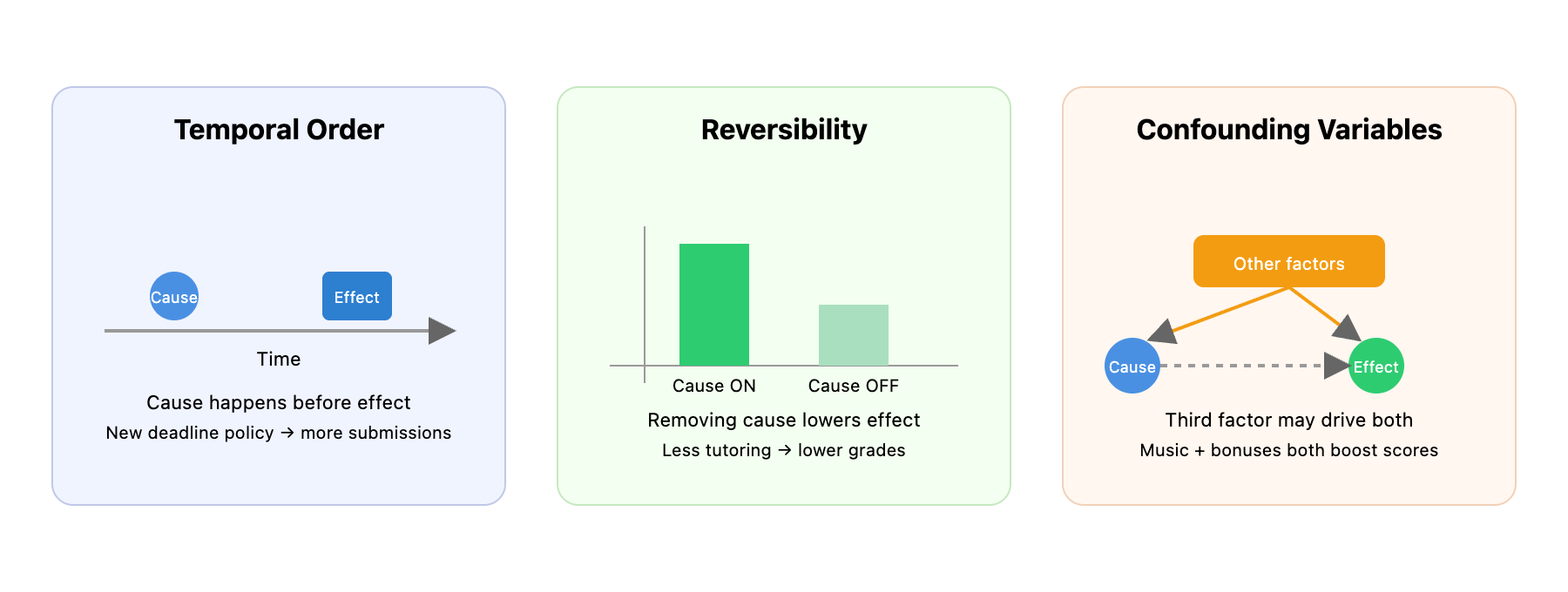
Here’s how these logic tests play out in a real conversation:
- Natalie: Dan, our customer service scores went up 30% after we started playing background music in the call center. The music is definitely making our reps happier and more helpful!
- Dan: That's interesting, Natalie. But let me ask—when did we start playing the music?
- Natalie: Three weeks ago, right at the beginning of the month.
- Dan: Wasn't that also when we hired five new reps who finished their training? And didn't we just implement that new bonus structure for high satisfaction scores?
- Natalie: Well, yes, but I really think it's the music. The atmosphere feels better.
- Dan: Maybe we should test it. What if we turn off the music for one week and see if scores drop? Or we could check if the night shift, which doesn't have music, shows different patterns. That would help us know if it's really the music or something else driving the improvement.
Notice how Dan guides Natalie through the logic tests without dismissing her observation. He checks the timing (temporal order), identifies possible confounding variables (new hires, bonus structure), and suggests a reversibility test (turning off the music). This collaborative approach transforms a simplistic causal claim into a more nuanced investigation of what's really driving improved performance.
Mastering these logic tests doesn't make you a skeptic who believes nothing, it makes you a critical thinker who believes claims supported by evidence and logic. This skill is valuable whenever you need to evaluate claims, make decisions based on data, or determine whether a change truly caused an observed outcome.
In the upcoming role-play session, you'll practice these analytical skills by engaging with a colleague who's convinced that a recent change directly caused an observed improvement. You'll ask probing questions to explore confounding variables, apply logic tests to evaluate the causal claim, and guide the conversation toward a more nuanced understanding of what's really driving the outcomes you're seeing. This practical application will strengthen your ability to distinguish correlation from causation in real workplace situations where such clarity drives better decisions and prevents costly mistakes based on false assumptions.
