Scaling Enterprise Agility
Scaling Without Losing What Makes You Agile
Once agile practices hold inside one team and the culture around them is sound, the next challenge is multiplying that without recreating the bureaucracy agility was meant to escape. Scaling is where most transformations quietly revert: more teams means more dependencies, more coordination, and a strong temptation to reimpose control. This unit is about scaling so that coordination rises while agility stays intact.
Choosing a Scaling Framework for Your Context
The first decision people reach for is which framework to adopt, and the first mistake is treating that choice as cosmetic. SAFe (Scaled Agile Framework) brings heavy structure: synchronized planning across many teams, defined roles, and portfolio layers. It coordinates large numbers of teams and reassures governance-heavy environments, but its weight can smother the autonomy you fought to build. LeSS (Large-Scale Scrum) goes the other direction, scaling a single Scrum with the fewest additions possible; it stays lean but demands real agile maturity and a willingness to flatten roles.
The Spotify model is the one most copied and most misunderstood. Squads, tribes, chapters, and guilds were a snapshot of one company's culture at one moment, not a blueprint, and lifting the org chart without the underlying culture is textbook cargo cult. None of these is "best." The right choice depends on your context: how many teams need to coordinate, how dense the dependencies are, how much regulatory load you carry, and how mature your existing agile practice actually is.
Coordinating Teams While Preserving Agility
Whatever framework you land on, the real work is coordinating teams without recreating the dependency tangle. Two ideas should guide your design. Conway's Law observes that systems end up mirroring the communication structures of the organizations that build them: if four teams build a compiler, you get a four-pass compiler.
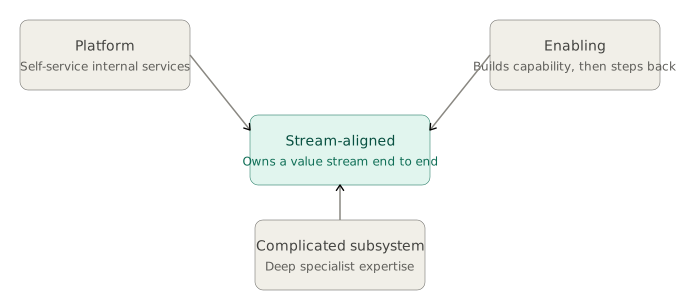
Team Topologies, from Matthew Skelton and Manuel Pais, turns that into a tool: organize around stream-aligned teams that own a flow of value end to end, supported by platform, enabling, and complicated-subsystem teams, with explicit interaction modes between them.
- Dan: Every release we wait two weeks on the payments team to expose an endpoint. It's killing our cadence.
- Nova: That's a Conway's Law problem. The handoff exists because we split the work across a boundary that doesn't match the flow.
- Dan: So we just merge the teams?
- Nova: Not necessarily. Treat payments as a platform team and give them a clear contract: a stable API with contract tests, so you integrate without waiting on a human.
- Dan: Then we self-serve against the interface instead of queuing for their attention.
- Nova: Exactly. You remove the dependency by designing the boundary, not by adding coordination meetings.
Notice the move: redesign the boundary rather than bolt on more synchronization. What lets teams work in parallel are integration enablers, chiefly a shared Definition of Done so "done" means the same thing everywhere, and contract tests that let one team confirm it still honors another's interface without a live handoff.
Aligning the Portfolio and Balancing Standardization with Autonomy
Coordination at the team level collapses if the money above it still flows in annual project cycles. Aligning portfolio management with agile delivery means funding durable products and value streams rather than fixed-scope projects, reviewing investment against outcomes on a short cadence, and letting teams persist long enough to learn. When funding follows outcomes, teams can reprioritize as they discover; when it follows projects, every change becomes a budget fight.
That leaves the question every scaling effort eventually fights over: what to standardize and what to leave to teams. The principle is to standardize the interfaces, not the interiors. Align on the few things that let teams interoperate, such as a shared cadence, a common Definition of Done, comparable outcome metrics, and release and security standards. Then let each team own how it works inside that boundary: its ceremonies, practices, and tools. A thin standard layer enables coordination; standardizing everything just rebuilds the command-and-control machine under an agile label.
The takeaway: scale by designing for flow and standardizing only the interfaces, so coordination grows without agility shrinking. This is where it gets concrete. First a quick self-check to test whether you can match a framework to its context, then you'll write a framework recommendation you could actually hand to a leadership team, and finally you'll defend the standardization line live, negotiating with a PMO over what teams must share and what stays theirs to decide.
