Sustaining Agile Transformation
Keeping the Change Alive
A transformation that worked last year is not a transformation that survives this one. Once teams are agile, scaled, and culturally supported, the quiet risk shifts from adoption to erosion: practices ossify, rituals lose their meaning, and the organization slowly drifts back toward the comfort of control. Sustaining agility is less about installing anything new and more about building the immune system that keeps it honest. This unit covers how to spot decay, wire improvement into the way the organization actually runs, and grow the internal capability that makes the whole thing self-correcting.
Spotting Cargo Cult Before It Calcifies
The most dangerous failure mode in a mature transformation is not visible resistance, it is cargo cult agile: teams performing the ceremonies while none of the underlying intent survives. The term comes from islanders who built mock runways hoping planes would return. The form is faithfully reproduced, the function is gone. You'll recognize it when a standup becomes a status report to the manager, when a retrospective surfaces the same three complaints every fortnight with nothing acted on, or when velocity becomes a target the team games rather than a forecasting aid.
These anti-patterns share one tell: the activity continues but the outcome it was meant to produce has quietly disappeared. The intervention is never "do the ceremony harder." It is to trace each practice back to the problem it exists to solve and ask whether that problem is still being solved. If standups exist to surface blockers and no blocker has been raised in a month, the ritual is theater. Naming the gap between form and function, then redesigning or retiring the practice, is how you stop agility from decaying into compliance.
- Jake: Our retros run like clockwork. Every team holds one, every sprint.
- Nova: And how many action items from the last three actually changed anything?
- Jake: Honestly? People raise the same dependency complaint, we nod, and nothing moves.
- Nova: Then the meeting is happening but the function isn't. A retro that never changes the system is just scheduled venting.
- Jake: So the fix isn't a better template, it's making sure one thing gets owned and closed.
- Nova: Right. Measure retros by what changes afterward, not by attendance.
Notice that Nova diagnoses by outcome, not by whether the ritual occurred.
Wiring Improvement Into the Operating System
Continuous improvement only lasts when it stops depending on individual enthusiasm and becomes structural. That means feedback loops at two altitudes. At the team level, the retrospective is the engine: a regular, blameless look at how the work works, producing a small number of changes the team genuinely commits to and revisits. At the organizational level, you need a parallel loop for the transformation itself, typically a quarterly review that gathers real data (team health, delivery metrics, business outcomes), celebrates genuine progress, and adjusts the approach where the evidence says it isn't working.
The connection between the two is what matters most. Team retrospectives surface recurring impediments no single team can fix, things like a slow procurement process or a release gate that bottlenecks everyone. The transformation feedback loop is where those systemic signals get aggregated and acted on.
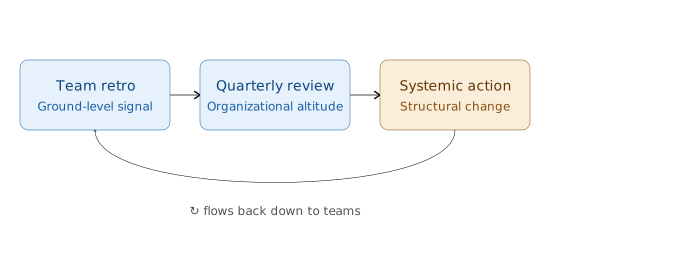
Without it, teams keep raising the same structural complaint into a void, which is precisely how cargo cult sets in. Treating the transformation as a product you keep iterating, rather than a project you finished, is what builds improvement into the organizational DNA.
Growing Coaches From Within
The final piece is self-sufficiency. A transformation propped up by external consultants or one or two heroic champions has a single point of failure: when they leave, the capability leaves with them. Durable agility requires growing your own coaches and facilitators, people embedded in teams who can run a sharp retrospective, hold a difficult conversation, and coach toward self-organization without being told.
For you as a product manager, this is partly modeling and partly deliberate succession. You build facilitation capability by rotating who runs ceremonies, by pairing less experienced facilitators with stronger ones, and by treating coaching as a skill to be taught rather than a title to be hired. The aim is an organization where the practices outlast any individual's departure because the capability is distributed, not concentrated.
The throughline of this unit: sustaining agility means building the organization's capacity to catch its own drift, through honest diagnosis, structural feedback loops, and homegrown coaching. Three practices put that to work. First you'll diagnose signs of fake agile in a real context and propose root-cause fixes, then you'll design a quarterly transformation review you could actually run, and finally you'll defend the value of retrospectives live to a skeptical senior leader who treats them as wasted time.
