Creating Agile Culture
Building the Culture That Makes Agile Stick
You can diagnose readiness perfectly, build a coalition, and run a clean transformation, then watch the new practices quietly erode the moment leadership attention moves elsewhere. That happens because practices live or die by the culture around them. Standups, retrospectives, and experiments are only the visible layer; underneath sit the beliefs, structures, and incentives that either nourish those practices or starve them. This unit is about that deeper layer, the environment you have to shape so agility outlasts the rollout.
Safety to Speak and Permission to Fail
The foundation of every agile culture is psychological safety, the shared belief that you won't be punished or humiliated for asking a question, admitting a mistake, or challenging a decision. Without it, retrospectives turn into theater, problems stay hidden until they explode, and the honest feedback that drives improvement never surfaces. As a product manager you set this tone constantly, in how you react when someone brings you bad news or pushes back on your roadmap.
Safety only becomes a learning culture when it is paired with a real appetite for experimentation. Here the crucial distinction is between intelligent failure and preventable failure. Intelligent failure is the result of a well-designed bet in genuinely uncertain territory: you had a hypothesis, you ran the smallest test that could answer it, and the outcome taught you something you could not have known in advance. Preventable failure is sloppiness, skipped checks, or repeating a known mistake.
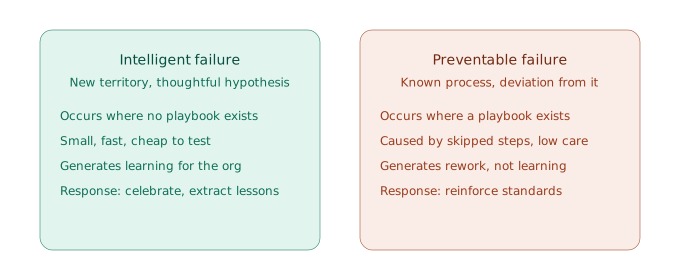
A healthy culture celebrates the first, learns from the second, and never confuses the two.
- Natalie: The onboarding experiment flopped. Activation actually dropped two points. I'm sorry, we spent a whole sprint on it.
- Ryan: Don't apologize. We bet on a question we couldn't answer any other way. What did the drop teach us?
- Natalie: That users want fewer steps, not more hand-holding. The opposite of what we assumed.
- Ryan: That's a real finding, and it cost us one sprint instead of a quarter. Write it up so the other squads don't run the same test.
- Natalie: I didn't expect "it failed" to become something worth sharing.
Notice that Ryan separated the outcome (a drop in activation) from the quality of the work (a sound bet), and then converted the loss into shared learning. That move, repeated consistently, is what makes safety real rather than a poster on the wall.
Aligning Structures and Governance with Your Values
Culture is not only mindset; it is also plumbing. If you preach team autonomy but fund work in annual project cycles, organize people by function, and route every decision upward, the structure wins and the values lose. Aligning structure with agile values means stable cross-functional teams instead of borrowed specialists, funding that follows products and outcomes rather than fixed project scopes, and decision rights pushed down to the people closest to the work.
Governance is where this gets tested, because agility is often misread as the absence of control. The goal is not to remove governance but to make it agile-compatible: lightweight, continuous, and built into the flow of work rather than bolted on as end-of-line gates. In a regulated product, that means baking compliance evidence and audit trails into your Definition of Done and automating the checks, so you satisfy oversight without freezing delivery. Designed-in governance protects agility; gate-based governance suffocates it.
People Systems and Sustainable Pace
The most overlooked lever is your people systems, the performance reviews, incentives, and career paths that quietly tell everyone what the organization actually rewards. If you ask for collaboration but rate individuals on personal heroics, the incentive wins every time. Align these systems with team outcomes and learning: reward the squad's results, value the engineer who shares knowledge, and create senior tracks for deep practitioners so people don't have to abandon the craft to advance.
Finally, sustainable pace is not a perk, it is a precondition for agility. Track well-being alongside delivery metrics, because a team running on chronic overtime stops experimenting, stops challenging, and eventually stops caring. Watch the signals, sustained crunch, falling engagement, rising attrition, and treat them as seriously as a slipping milestone.
The core takeaway: agile practices survive only inside a culture whose safety, structures, incentives, and pace all point the same direction; align those, and the behaviors hold without your constant pressure. Next you'll put this to work by designing concrete psychological safety practices and auditing the structures that quietly conflict with your values, then you'll test it live by standing in front of a frustrated executive and reframing a failed experiment around the learning it bought.
