Organizational Change Management
Steering Change Across the Organization
Coaching one team toward ownership is hard enough. Shifting an entire organization toward agility is a different order of difficulty, and the same instinct that traps new leaders traps new change agents: treating transformation as something you roll out and install rather than something you diagnose, shape, and grow. This unit widens the lens from the team in front of you to the system around it. The work ahead is less about choosing the right framework and more about reading your specific organization and bringing its people with you.
Assessing Readiness and Designing an Approach That Fits
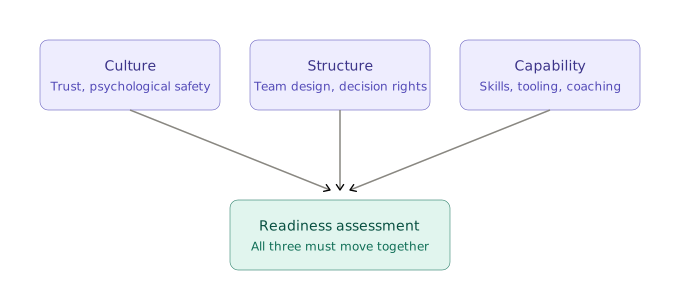
Before you change anything, you need an honest read on what you're working with. Organizational readiness is best assessed across three dimensions. The first is culture: how decisions actually get made, whether failure is punished or examined, and how much trust exists between layers. The second is structure: funding cycles, reporting lines, handoffs between functions, and whether teams are organized around products or around silos. The third is capability: the skills present, the coaching capacity available, and crucially whether leadership genuinely understands agile or just likes the word. A candid diagnosis here saves you from prescribing a cure for the wrong disease.
That diagnosis then drives design, and this is where most transformations go wrong. Two anti-patterns dominate. The first is copy-paste: importing another company's model wholesale because it worked for them, ignoring that their context bears no resemblance to yours. The second is fighting the culture head-on, demanding behaviors the existing system actively punishes. The better move is to fit the approach to the ground you're standing on. Meet the culture where it is, start where readiness and energy are highest, run a contained pilot, and let visible results pull the rest of the organization forward rather than pushing it.
Managing Resistance and Building Coalitions
When people push back, the reflex is to label them blockers and route around them. That instinct is expensive. Resistance is almost always information: underneath it sits a real fear, usually about losing status, competence, or control. Middle managers feel this most acutely, because "self-organizing teams" can sound a lot like "we no longer need you." Treat that fear as the thing to address, not the thing to overcome.
The practical skill is to surface the concern, name what the person stands to lose, and then offer them a role they can value inside the new way of working.
- Dan: Honestly, this agile push feels like a way to make my job disappear. What's left for a delivery manager once teams "self-organize"?
- Jessica: That's a fair worry. Which part of your work do you most want to protect?
- Dan: Making sure things actually ship on time. That's on me.
- Jessica: What if that's exactly where we lean on you, clearing the blockers that slow delivery, instead of chasing status updates?
- Dan: Put that way, I could get behind it. It's more useful than nagging people for reports.
Notice that Jessica named the underlying fear before offering a new role, which is what turns a skeptic into an ally. You cannot do this for everyone alone, which is why you build a coalition: a small set of sponsors with the authority to remove systemic obstacles, paired with credible early adopters whose results give the rest of the organization permission to follow.
Measuring and Communicating Transformation Progress
What you measure signals what you actually value, so resist the pull toward agile theater. Counting how many teams "do Scrum" or how many ceremonies ran tells you nothing about whether anything improved. Instead, pair leading indicators (team health, cycle time, depth of adoption) with business outcomes (delivery predictability, customer value realized). The leading indicators tell you change is taking root; the outcomes tell you it's worth the effort. Your job is to show how one connects to the other.
Then communicate it as a narrative, not a dashboard dump. A good update says where you started, what you changed, what you're learning, and what's next, and it stays honest about setbacks. Transparency about what isn't working buys you far more credibility than a wall of green metrics.
The single thread running through this unit: you don't install a transformation, you diagnose the ground, shape an approach that fits it, and carry people forward by addressing what they fear losing. This is where it gets concrete. Ahead you'll produce a readiness assessment of your own organization and a progress narrative leadership could actually read, then test your coalition-building live in a conversation with someone who sees agile as a threat to their role.
