Servant Leadership and Coaching
Welcome to the Course
Leading an agile transformation as a Product Manager rarely fails for lack of frameworks. It fails because the people involved, including you, default to old habits under pressure: deciding for the team, optimizing for control, and treating change as something you install rather than something you grow. This course is about the harder, more durable work of leading the humans and the systems around the product, not just shipping it.
By the end of this course, you'll be able to:
- Coach teams toward self-organization using servant leadership and powerful questions instead of directives.
- Assess organizational readiness and design a change approach that fits your culture rather than fighting it.
- Build psychological safety and a learning culture that treats intelligent failure as fuel.
- Choose and adapt scaling frameworks that coordinate many teams without crushing their autonomy.
- Recognize agile anti-patterns and build feedback loops that keep a transformation alive over time.
This first unit focuses on the most personal shift of all: how you show up as a leader, and how that changes whether a team grows dependent on you or grows beyond you.
From Command-and-Control to Servant Leadership
The instinct to take charge is strong, especially when you carry the title that stakeholders look to for answers. In a command-and-control posture, value flows down: you set direction, assign tasks, and resolve problems. It feels efficient, and in a crisis it sometimes is. But it quietly teaches the team that thinking is your job and execution is theirs.
Servant leadership inverts that flow. Your first question stops being "What should they do?" and becomes "What does this team need from me to do their best work?" Practically, that means clearing impediments, protecting focus, securing context and access, and then getting out of the way. You measure yourself not by the decisions you made but by the capability you built.
Here is the part most leaders underestimate: the team watches what you do far more closely than what you say. If you preach iteration but demand a locked annual plan, or champion safety but punish the messenger who flags a slip, the team believes your behavior, not your slogans. Modeling agile values consistently, especially when it costs you something, is what earns you the right to coach.
Coaching Stances and Self-Organization
Servant leadership is the mindset; coaching is the daily practice. The goal of coaching a team toward self-organization is to make yourself progressively less necessary. That does not mean abandoning the team. It means matching your intervention to what the moment actually requires.
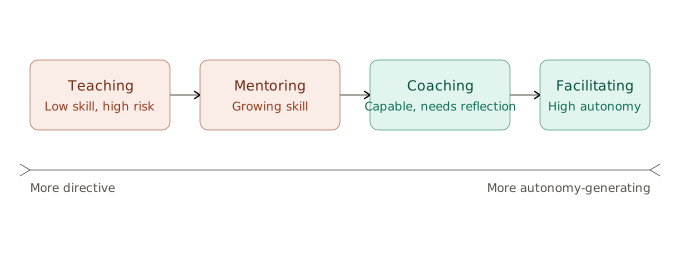
Think of four stances you can move between. When the team lacks knowledge they need, you teach. When they face a situation you've navigated before, you mentor by sharing your experience as one input, not a verdict. When they have the capability but not the clarity or confidence, you coach by drawing their own answer out of them. And when a group needs to think together productively, you facilitate, owning the process while they own the content. The mistake is getting stuck in one stance, usually teaching or mentoring, long after the team has outgrown it.
Facilitation is where lightweight structures earn their keep. Liberating Structures are small, repeatable methods that distribute participation so the loudest voice doesn't decide everything. A pattern like 1-2-4-All, where people think alone, then in pairs, then in fours, then as a group, surfaces far more ideas than a standard open discussion and signals that every voice counts. These micro-structures do quietly what a directive can't: they make self-organization the path of least resistance.
Developing Others Through Powerful Questions
If there is one habit that separates a coach from a controller, it is this: when someone brings you a problem, you resist the urge to answer it. A powerful question is open, short, and aimed at the other person's thinking, not at extracting the answer you already have. "What options have you considered?" develops people. "Just do the rebuild" does not.
- Natalie: The checkout flow is a mess. Should we rebuild it or patch it? You decide.
- Ryan: Before I weigh in, what options has the team already looked at?
- Natalie: Two. A full rebuild, or a quick patch that buys us a quarter.
- Ryan: What would each one cost you if it went wrong?
- Natalie: Honestly, the patch could trap us in tech debt again. The rebuild is safer long term.
- Ryan: Sounds like you already know which way you're leaning. What's stopping you from owning that call?
Notice that Ryan never gave an answer, yet Natalie left with a decision she owned and the reasoning to defend it. That is the whole trick: the question did the work the directive would have stolen.
The single most important takeaway of this unit is that your job is to grow the people who find the answers, not to be the person who has them. Three quick things sit ahead: a short self-check to help you spot the difference between a leading question and a genuinely open one, a coaching plan for shifting a command-driven team toward ownership, and a live conversation where someone hands you a decision the team should own. When the conversation comes, try catching your first instinct to solve it, and ask one real question instead.
