Implementing Face Culling
Introduction
Welcome to our Advanced Geometry and Model Loading course! In this first lesson, we'll explore one of the most fundamental performance optimization techniques in real-time graphics: face culling. As we begin working with increasingly complex 3D models and scenes, understanding how to eliminate unnecessary rendering work becomes crucial for maintaining smooth frame rates and efficient GPU utilization.
Face culling is an elegant solution to a simple problem: in most 3D objects, we only ever see the outer surfaces. The interior faces that point away from our viewpoint consume valuable processing power without contributing to the final image. By implementing face culling, we can automatically eliminate these hidden surfaces, often cutting our rendering workload in half for closed objects like cubes, spheres, and character models.
Understanding Face Culling Fundamentals
Face culling works on a beautifully simple principle: every triangle in 3D space has two sides, and we can determine which side faces toward the camera based on the order of its vertices. When we look at a triangle from the front, its vertices appear in a specific sequence. When viewed from behind, that same triangle's vertices appear in the reverse order.
This concept becomes powerful when we establish a consistent rule across our entire 3D model. If we define that all front-facing triangles have their vertices arranged in counterclockwise order when viewed from the camera, then any triangle appearing in clockwise order must be facing away from us. The graphics hardware can quickly test each triangle and discard the back-facing ones before expensive shading calculations begin.
The performance benefits are substantial: we eliminate roughly half of all triangles from processing, reduce memory bandwidth usage, and allow the GPU to focus its resources on pixels that will actually appear in the final image.
Winding Order and Triangle Orientation
Before implementing face culling, we need to understand winding order: the sequence in which we define vertices around a triangle's perimeter. This order determines which side of the triangle we consider the "front" face. Most graphics systems use counterclockwise (CCW) winding to indicate front faces, though this can be configured.
Consider a simple triangle with vertices A, B, and C. If we traverse from A to B to C and back to A in counterclockwise order when looking at the triangle's front side, then this triangle follows CCW winding. The same triangle viewed from behind would appear to have clockwise winding, signaling to the graphics system that it should be culled.
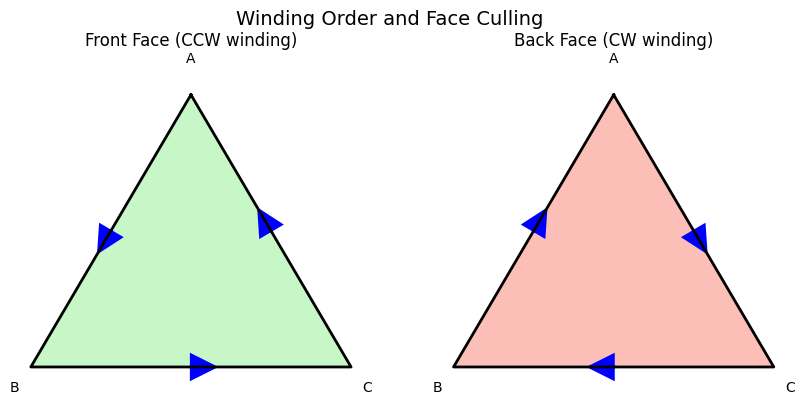
For complex 3D objects like cubes or character models, maintaining consistent winding order across all faces requires careful attention during modeling or procedural generation. Each face must have its vertices ordered so that the visible side follows our chosen winding convention.
