Matching Style to Personality
Matching Style to Personality (DISC Integration)
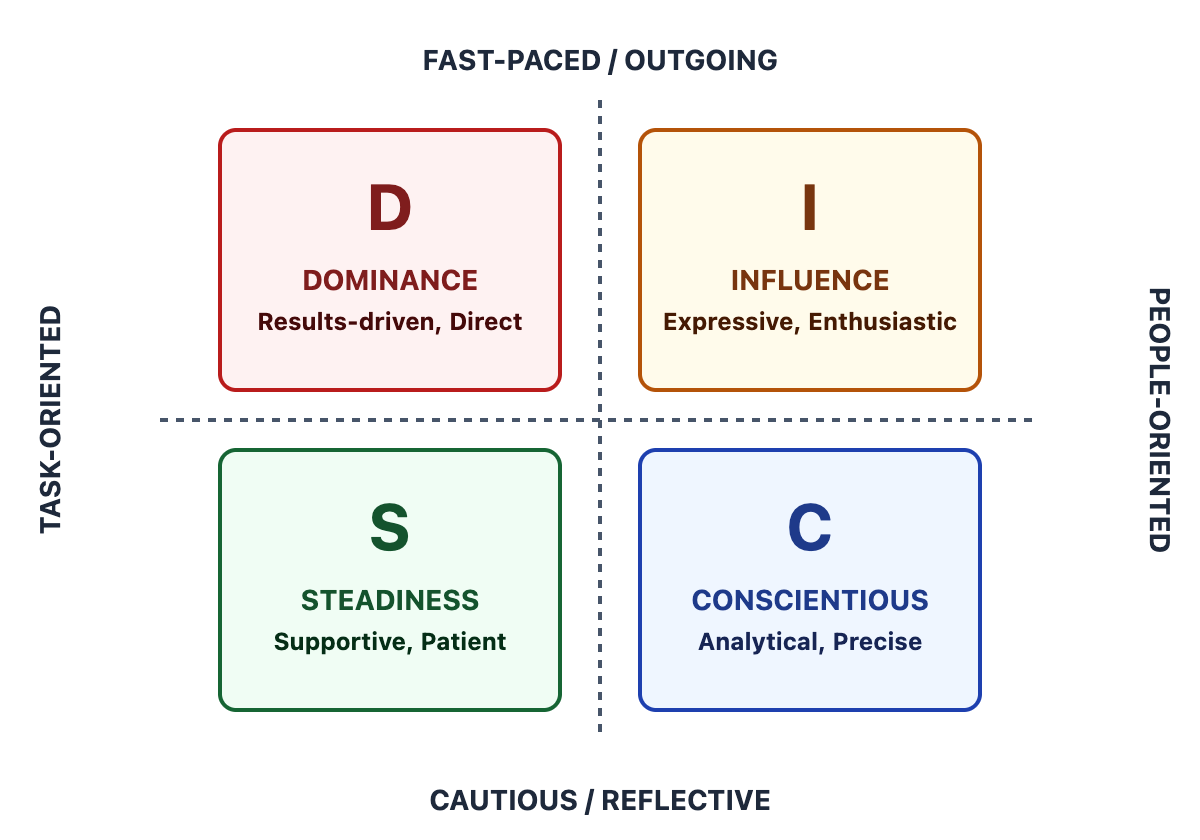 In the last lesson, you learned to switch between the four leadership styles fluidly within a single conversation. Now we're going to add another layer of nuance: personality. Two team members can both be at the same development stage on the same task—say, both S1 Enthusiastic Beginners learning a new system—and yet require very different flavors of Directing to actually land well. One might want you to get to the point in 60 seconds, while the other might need you to slow down, explain the reasoning, and reassure them they're not behind. Your leadership style tells you what the person needs; their DISC profile tells you how to deliver it. Throughout this unit, we'll marry those two dimensions so that your flex feels personal rather than formulaic.
Tailoring the Directing Style for High-D vs. High-S Personalities
Directing is the style with the highest instructional load—you're telling the person what to do, how to do it, and what "good" looks like. But how you direct needs to change dramatically based on the person receiving it, and the contrast between a High-D (Dominance) and a High-S (Steadiness) is one of the sharpest divides you'll encounter.
A High-D is results-driven, impatient, and allergic to over-explanation. When you direct a High-D, you need to lead with the outcome, keep instructions crisp, and explicitly name the decision rights they retain. Even though they're at an S1 development stage on this task, their personality craves a sense of ownership over the how. Language that works sounds like "Here's the target, here's the non-negotiable process for step one, and here's where you have latitude to figure out the rest." Long preambles, excessive context, or a warm check-in before the brief can feel like friction to them. The trap with a High-D is assuming their confidence means they already know what to do, so you still give clear direction, but you frame it as efficiency rather than remediation: "I'm going to save you time by giving you the template up front."
A High-S, by contrast, is steady, loyal, and deeply sensitive to change and interpersonal tone. When you direct a High-S, speed and brevity feel cold, not efficient. They need you to slow down, walk them through the reasoning, and reassure them that asking questions is welcome. A High-S learning something new often won't tell you they're lost—they'll quietly fall behind rather than interrupt you. So you build in pauses with prompts like "That was a lot. Tell me which part you'd like me to walk through again." You also want to emphasize continuity and support rather than autonomy, saying something like "I'll be available all week as you work through this. Just come find me." Where the High-D hears that and feels smothered, the High-S hears it and feels safe enough to actually start.
The mismatch cost is significant. Direct a High-D like a High-S and they tune you out by minute three. Direct a High-S like a High-D and they leave the meeting looking like they got it, then struggle alone for two days before asking for help.
How to Support an Influencer (High-I) vs. a Conscientious (High-C) Performer
The Supporting style is about low direction and high support—you're helping a capable but cautious person move past hesitation and trust their own judgment. But what "support" actually feels like to an Influencer versus a Conscientious performer is nearly opposite, and getting this wrong is one of the most common reasons leaders fail with capable people.
A High-I is people-oriented, expressive, and energized by recognition and social connection. When a High-I is hesitating, it's rarely about the technical work—it's usually about how the decision will land with others, whether they'll look bad, or whether they've lost momentum and need re-inspiring. Supporting a High-I looks like verbal affirmation, enthusiasm, and letting them think out loud with you. They don't want a quiet nod; they want you engaged. Phrases like "I love where your head is at—keep going, what else?" or "You've got strong instincts on this; trust them" are fuel for them. Sitting in silence while they process, which might comfort another type, feels like withdrawal to a High-I. The risk, however, is that your support can tip into cheerleading without substance, so anchor the warmth to something specific: "The way you handled the stakeholder pushback last week—that's exactly the judgment you should trust here."
A High-C, on the other hand, is analytical, precise, and motivated by accuracy and quality. When a High-C hesitates, it's usually because they're worried about getting something wrong—a missed detail, an unverified assumption, a decision they can't defend with data. Supporting a High-C with High-I energy will backfire badly; enthusiastic affirmations feel hollow or even suspicious to them. Instead, they need you to engage with the substance of their concern and validate that their caution is reasonable before helping them move forward. To see this in action, consider a manager supporting a High-C team member who is hesitating to finalize a vendor recommendation:
- Natalie: I've narrowed it down to two vendors, but I'm stuck. I keep going back and forth.
- Dan: Walk me through what's giving you pause.
- Natalie: Vendor A is the stronger fit on paper, but their references had one inconsistency around uptime that I haven't been able to verify.
- Dan: That's a reasonable thing to catch—I'd rather you flag it than miss it. What would actually have to be true for that inconsistency to become a real problem for us?
- Natalie: Honestly, only if we hit peak load in Q4 without their new infrastructure live. That's a narrow window.
- Dan: Then take until Thursday to stress-test that one scenario. If it holds up, go with your recommendation—you don't need me to sign off on it.
Notice what Dan didn't do. He didn't say "You've got this, trust yourself!"—which would have felt dismissive to a High-C. Instead, he validated the caution, engaged with the substance of the concern, helped her right-size the risk, and gave her time rather than pressure. That's what support looks like to a High-C. For contrast, that same conversation with a High-I would have involved more energy, more affirmation of their instincts, and explicit recognition of their judgment—a very different tone achieving the same purpose.
In short, you support a High-I with energy and affirmation, and you support a High-C with rigor and patience. Both are high-support moves—they just look nothing alike.
Avoiding Personality-Style Mismatches
The most dangerous mismatches aren't the ones where you pick the wrong style—those are usually caught quickly. The subtle, corrosive ones happen when you pick the right style but deliver it in a personality-incompatible way. The person eventually disengages, underperforms, or leaves, and you're left wondering what went wrong when on paper you did everything right.
A few common mismatches are worth naming. Coaching a High-C with High-D speed is a classic failure mode—you ask fast-paced probing questions and push for quick answers, and the High-C shuts down because they feel interrogated rather than coached. The fix is to send coaching questions in advance when possible and to use silence generously. Delegating to a High-I without recognition built in is another trap; you hand them the autonomy they've earned, but you forget they're partly motivated by visibility and acknowledgment, so the project quietly loses energy. Wrap the delegation with something like "I want you to own this because I want your fingerprints on it—and I'll make sure the exec team knows this was your work." Similarly, directing a High-D with too much context telegraphs that you don't trust them to execute, while directing a High-S with too little telegraphs that you don't care whether they succeed. And supporting a High-C with breezy encouragement feels dismissive of their concerns, whereas supporting a High-I with cool analytical detachment feels like a personal rejection.
The guiding principle is this: development stage determines the style; personality determines the delivery. Before any important leadership conversation, take 30 seconds to ask yourself two questions in order: What stage is this person on this task? and What DISC tendencies do I need to respect in how I communicate? The first tells you the right tool; the second tells you how to hold it. Over time, this becomes second nature, and your team stops experiencing your leadership as "one method applied to me"—they experience it as you paying attention to who they actually are.
A final caution is worth holding onto: DISC is a map, not a cage. People are complex, and any given person is a blend rather than a pure type. Treat your read of their DISC profile as a working hypothesis you update with every interaction, not a label you stamp on them and stop observing. The leaders who use this framework best hold it lightly, letting it sharpen their awareness without replacing it.
In the upcoming role-play, you'll practice tailored delegation to a High-I personality, handing over a creative task while making sure the recognition, energy, and social motivation this type needs are woven into the brief itself. You'll also complete a writing exercise building your own Personality-Style Matrix—a one-page guide mapping each DISC type on your team to their most frequent development stage, so you have a reference sheet ready before your next round of one-on-ones. Get ready to turn personality awareness into a repeatable leadership habit.
