Mastering Style Switching
Style Switching and Conversational Fluidity
So far, you've learned each of the four leadership styles in isolation—Directing, Coaching, Supporting, and Delegating—as if they were four separate tools you'd pull out of a drawer one at a time. In reality, leadership rarely works that cleanly. A single 30-minute meeting can require you to direct on a new process, coach through a tough skill gap, support a wavering decision, and delegate an adjacent project, sometimes with the same person in the same conversation. This unit is about building the fluency to move between styles without jarring your team, losing your thread, or confusing yourself. Think of it as moving from playing single notes to playing chords.
Recognizing the Need to Switch Styles Within a Single Meeting
Style switching begins with pattern recognition. Within any given conversation, the person in front of you is not a static S1, S2, S3, or S4—they are showing you, moment by moment, what they need. The topic shifts, their confidence shifts, and a different part of their development map lights up. Your job is to notice these shifts and respond to the task on the table right now, not to the label you assigned the person last quarter.
The most common trigger for a mid-meeting switch is a change in the task being discussed. A senior engineer might be a clear S4 on system architecture but drop to an S1 the moment the conversation turns to navigating a new compliance process. If you stay in Delegating mode out of habit, you'll abandon them at the exact moment they needed your direction.
A second trigger is a shift in emotional state—someone who walked in confident can visibly deflate when you raise a concern, signaling that they've moved from S3 to S2 in real time and now need more support alongside your direction.
A third trigger is an unexpected knowledge gap surfacing mid-conversation, when a person asks a question that reveals they don't know something you assumed they did, and suddenly Coaching is the right move instead of Supporting.
To catch these moments, watch for concrete cues such as a pause that lasts too long, the phrase "I'm not sure where to start", a sudden jump in energy and ideas, or a defensive tone when you offer input. Each of these is a signal asking you to reassess. A useful habit is the 30-second recalibration: every few minutes in a longer conversation, silently ask yourself, "What does this person need from me right now—direction, support, both, or neither?" That small internal check is what separates leaders who flex fluidly from those who drive the whole meeting in one gear.
Linguistic Markers for Style Transitions
Once you recognize the need to switch, the next challenge is making the transition visible and smooth. If you shift styles silently—going from telling someone exactly what to do into asking them open-ended questions with no warning—it can feel disorienting, even manipulative. Your team starts wondering, "Wait, does she actually want my opinion, or is she testing me?" Linguistic markers solve this by narrating the shift out loud, so the other person can shift with you.
When moving from Directing to Coaching, you're keeping the structure but inviting their thinking, with markers like "Now that you've seen how I'd approach it, let me ask—what would you do differently here?" or "Here's the framework. Walk me through how you'd apply it to your situation." When moving from Coaching to Supporting, you're handing the wheel back, which sounds like "You've clearly thought this through. What's your instinct telling you?" or "I don't think you need my input on the 'how' anymore—what's the part you still want to talk through?" When moving from Supporting to Delegating, you're formalizing autonomy, often with something like "It sounds like you've got this. Run with it, and just loop me in on the final call." And when you need to move back up the ladder, from Delegating to Directing because something went sideways, be direct without being punitive: "I'm going to lean in more closely on this one because the stakes just changed. This isn't about your capability; it's about the situation."
To see how these markers thread together inside a real conversation, consider a manager meeting with an experienced team member about a new client-reporting process:
- Ryan: Before we open it up, let me walk you through exactly how the new reporting template works—fields, deadlines, and sign-off chain. I want to make sure you have the full picture first.
- Jessica: Okay, that's clear. I think I can see where it fits.
- Ryan: Good. Now let me switch gears—you've run client reports longer than anyone on the team. How would you weave this into your existing workflow?
- Jessica: Honestly, I'd batch the new fields into my Friday review instead of doing them daily. I'm just not sure if that'll cause problems downstream.
- Ryan: You know this process better than I do. What's your gut telling you?
- Jessica: My gut says batching is fine. I'll flag it to finance so they know the cadence.
- Ryan: Sounds right to me. Run with it, and just loop me in if finance pushes back.
Notice how Ryan named every shift out loud. He opened in Directing with a clear, structured brief, then explicitly signaled the move to Coaching with "Now let me switch gears", then handed the wheel over to Supporting with "What's your gut telling you?", and finally landed on Delegating with "Run with it." The transitions weren't hidden—they were announced, which let Jessica recalibrate with him instead of guessing what mode they were in.
Notice the common thread across all of these: the markers name the shift rather than hide it. You're signaling, "We're changing modes, and here's why." That transparency preserves trust and prevents the person from feeling blindsided by your sudden change in tone. Just as importantly, it helps you stay intentional, because saying the transition out loud forces you to be clear about which style you're moving into.
Managing the Switching Cost in Communication
Every style switch carries a switching cost—a small tax on clarity, energy, and emotional momentum paid by both you and the person you're leading. Ignoring this cost is what causes meetings to feel chaotic even when each individual style is executed well. Managing it well, on the other hand, is what makes style-flexing feel effortless to the other person, even though it requires real discipline from you.
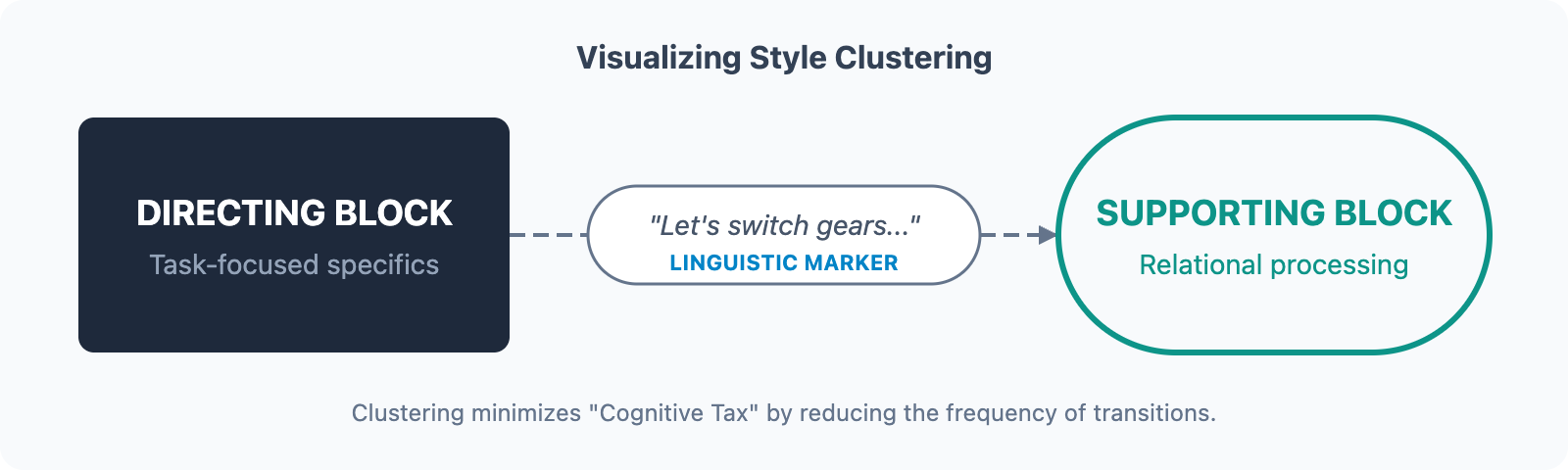
The first cost is cognitive: every time you switch, you're asking the other person's brain to recalibrate expectations, and if you switch too often or too abruptly, they stop knowing how to show up. The fix is to cluster your switches intentionally—handle all the Directing content in one block, then transition cleanly into Supporting, rather than ping-ponging back and forth.
The second cost is emotional, because shifting from high-support modes like Coaching and Supporting to lower-support modes like Directing and Delegating can feel like a sudden chill if you don't bridge it. Warm language in the transition, such as "I appreciate how openly you worked through that. Now let me switch gears and give you some firm direction on the next piece," absorbs the temperature change.
The third cost is pacing: if you switch styles faster than the person can process, they'll nod along while privately losing the plot. Slowing down at transition points, pausing for questions, and occasionally asking "Does this shift make sense? Do you want me to tell you what to do, or think through it with you?" lets you verify the other person is moving with you.
Finally, be aware of your own internal switching cost. Moving from Directing to Supporting requires you to shift from "expert with the answer" to "curious listener without one"—and that's a real mental change, not just a verbal one. Capable leaders who look effortless in these transitions typically take a brief internal breath before switching: a silent mental reset, a pause to close one mode before opening the next. Without that pause, you'll leak residue from the previous style, still sounding directive when you meant to be supportive, or still sounding like a coach when the moment called for a clean delegation. Over time, this internal fluidity becomes invisible, and your team simply experiences you as a leader who always seems to give them exactly what they need.
In the upcoming role-play, you'll practice dynamic style switching inside a single meeting—opening with a directive message about a new process, then fluidly shifting into a supporting stance as a capable team member works through how to integrate it into their existing workflow. You'll also complete a Style Switching Audit where you examine a recent meeting of your own, identify a moment where you stayed in one gear too long, and rewrite the dialogue to capture the switch you should have made. Get ready to turn four separate styles into one seamless conversation.
