Strategic Delegation and Accountability
Strategic Delegation and Accountability
Delegation is a system that determines whether your people grow into owners or drift into confusion. In this lesson, you will expand the Definition of Done into a micromanagement prevention tool, learn to use the Accountability Ladder to move people from blame to ownership, and build check-in structures that keep remote and hybrid teams aligned. By the end, you will have a complete delegation operating system that balances autonomy with informed leadership.
Setting the "Definition of Done" to Prevent Micromanagement
Micromanagement is often an anxiety response to uncertainty. The Definition of Done (DoD) neutralizes this by converting ambiguity into agreement across five components: the deliverable (what is produced), quality standard (what "good" looks like), timeline (due date), audience (who consumes it), and constraints (budget or tool boundaries). For example, instead of saying "Handle the onboarding," specify a "two-week schedule for June hires, including buddy assignments, due by May 20 for HR distribution."
Effective delegation defines the "what" while leaving the "how" to the team member. If you dictate the process, you are merely assigning tasks; if you define the outcome and constraints, you are truly delegating. To ensure alignment, always ask for a play back: have the person walk you through their understanding of the deliverable and timeline. This catches misalignment early and transfers ownership of the expectation to them.
The "Accountability Ladder": Moving from Victimhood to Ownership
Accountability is a person's relationship to the outcomes they produce. The Accountability Ladder maps the mindsets people adopt when facing challenges, ranging from the bottom rungs of Unaware, Blame, and Excuses to the higher rungs of Acknowledge and Own and Solve. Your goal is to help team members climb this ladder by modeling ownership yourself and using targeted coaching questions to move them from externalizing problems to proposing solutions.
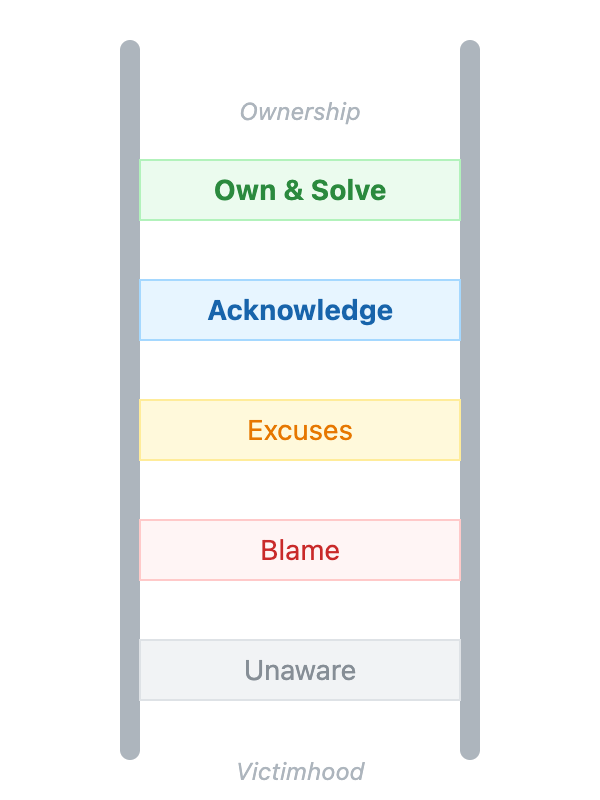
The power of this framework is not in labeling people — it is in shaping conversations. When a direct report comes to you stuck on the Blame rung, your instinct might be to either agree with their external attribution, which enables the behavior, or confront them harshly, which triggers defensiveness. Instead, you can use targeted questions to help them climb. Consider this exchange between a manager and a direct report who missed a client deliverable.
- Natalie: Let's talk about the client report that was due Friday. What happened?
- Ryan: Honestly, the analytics team didn't send me the data until Thursday afternoon. There was no way I could turn it around in time.
- Natalie: That sounds frustrating, and I understand the delay put you in a tough spot. Let me ask you this — what part of the situation was within your control?
- Ryan: I guess I could have followed up with them earlier in the week instead of waiting. And I probably should have flagged the risk to you on Wednesday when I still hadn't heard from them.
- Natalie: Those are strong insights. So what's your plan to make sure this doesn't happen next time?
- Ryan: I'm going to set a mid-week checkpoint with the analytics team on any deliverable that depends on their data, and I'll flag it to you immediately if I'm not getting what I need by that point.
Notice how Natalie never dismissed Ryan's frustration about the analytics team, but she also did not let the conversation stay on the Blame rung. By asking "What part of the situation was within your control?" she guided him up through Acknowledge and all the way to Own and Solve — where he left with a concrete prevention plan that he created. That is the Accountability Ladder in action.
Designing Effective Check-in Templates for Remote and Hybrid Teams
To maintain alignment without hovering, implement a "Done, Next, Blockers" check-in rhythm. This lightweight structure requires team members to briefly report what they accomplished, what is coming up, and where they are stuck. Moving status updates to a written template transforms your one-on-ones from administrative recaps into high-value coaching conversations focused on strategy and growth.
The frequency of these check-ins should align with the individual's development level. A D1 (low competence, high commitment) may need daily touchpoints, while a D4 (high competence, high commitment) might only require biweekly milestone reviews. Negotiate this cadence transparently: "Since this is a new project, let's connect every other day for the first week to ensure you have what you need."
For hybrid teams, consistency is a matter of equity. Prevent information gaps by requiring all updates to go through the same digital channel, regardless of whether a team member is in the office or remote. Adhere to a strict rule: if it was not written down, it did not happen. This ensures everyone has equal access to decisions and the same opportunity to flag obstacles.
With the Definition of Done preventing ambiguity, the Accountability Ladder building ownership, and a structured check-in rhythm keeping everyone aligned, you now have a delegation system that scales — whether your team is co-located, remote, or somewhere in between. In the upcoming role-play session, you will put this into practice by delegating a high-stakes project to a senior team member, where the challenge will be defining success clearly without prescribing the process. Start thinking about how you would communicate the "what" and "why" while leaving the "how" entirely in their hands.
