Situational Leadership and Coaching
Welcome to the Course
Welcome to Adaptive Leadership and Impact, where you move from understanding yourself to leading your team with tactical precision. You will put your self-awareness and communication skills into action by learning to flex your leadership style, coach for growth, delegate effectively, and build robust performance systems. By the end of this course, you will have a complete leadership operating system that is flexible, principled, and uniquely yours.
This course covers four major areas. You will begin with Situational Leadership and Coaching to learn how to adapt your style to the individual. Next, you will master Strategic Delegation and Accountability, followed by Performance Systems and Integration to manage talent with clarity. Finally, you will explore Systems Thinking and Culture Roadmapping to design a 90-day plan for your team and draft a personal leadership manifesto.
Adaptive leadership starts with the foundation: knowing which style to use and when. Let's dive into how to diagnose the needs of your team members on a task-by-task basis.
The Situational Leadership Matrix: Competence vs. Commitment
The Situational Leadership Model suggests that the right leadership style depends on a person’s competence (skills and knowledge) and commitment (motivation and confidence) for a specific task. By plotting these dimensions, we identify four styles: Directing (for high commitment/low competence learners), Coaching (for those with low competence and low commitment), Supporting (for competent but variable-commitment performers), and Delegating (for high competence/high commitment stars).
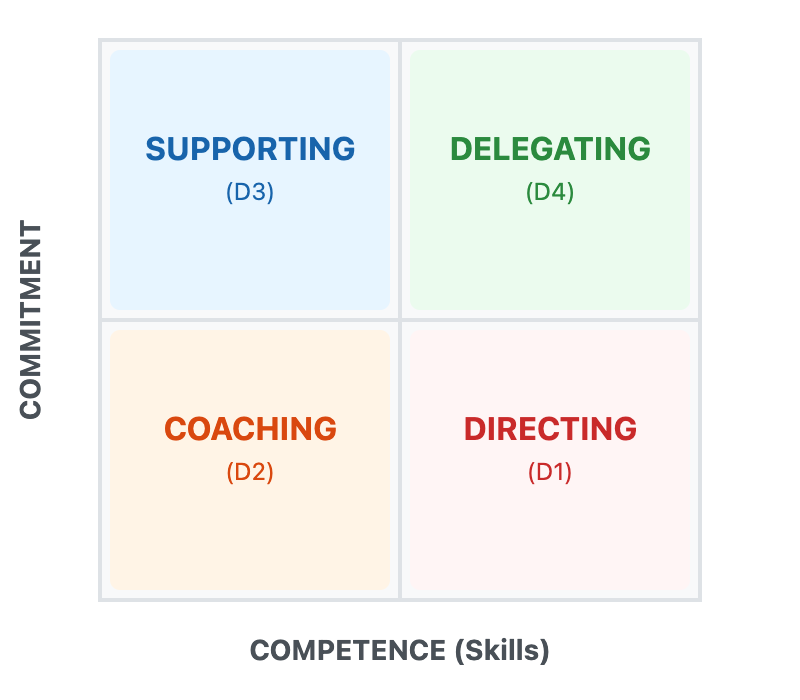
Effective leaders adjust their approach based on the quadrant. In Directing, you provide clear instructions and close monitoring. In Coaching, you offer both direction and heavy encouragement. Supporting requires you to pull back on direction to focus on listening and facilitation, while Delegating allows you to hand over responsibility and get out of the way. Overleading or underleading—such as micromanaging a star or abandoning a novice—is a primary cause of team friction.
The critical nuance is that these levels are task-specific, not person-specific. A senior engineer might be a "D4" at coding but a "D1" at stakeholder management. Your job as an adaptive leader is to diagnose the development level for each person on every key task and adjust your style accordingly.
Coaching for Growth Using the GROW Model
The GROW Model structures coaching conversations into four phases: Goal, Reality, Options, and Will. You begin by helping the person articulate their own Goal for the session. You then move to Reality, asking curious questions to assess their current obstacles without jumping to solutions. Finally, you explore Options to brainstorm paths forward and lock in the Will by securing a specific commitment to action and identifying potential hurdles.
To see all four phases in action, consider this coaching conversation between a manager and a direct report who has been struggling to lead a cross-functional initiative.
- Natalie: Thanks for sitting down with me, Jake. What would you like to focus on today?
- Jake: Honestly, I want to figure out how to get the design and engineering teams aligned. The project feels like it is stalling and I do not know how to move it forward.
- Natalie: That is a clear goal. So where do things stand right now — what have you tried so far to get alignment?
- Jake: I have been sending status emails and scheduling joint meetings, but the two teams just talk past each other. I think engineering feels like design keeps changing scope, and design feels unheard.
- Natalie: It sounds like the current approach is not bridging that gap. If you could try anything — no constraints — what are a couple of different ways you might tackle this?
- Jake: I guess I could set up a shared working session where both teams co-create the requirements together instead of passing documents back and forth. Or I could meet with each lead one-on-one first to understand their concerns before bringing them together. Actually, the one-on-one route feels like the right first step — I would know what I am walking into before the joint session.
- Natalie: That sounds like a strong plan. When will you have those one-on-ones done, and what might get in the way?
- Jake: I can have both done by Thursday. The only risk is getting bumped off their calendars, so I will block time with them today and flag it as a priority.
Notice how Natalie never once told Jake what to do. She moved through Goal by asking what he wanted to focus on, explored Reality by asking what he had already tried, opened Options by inviting him to brainstorm freely, and locked in Will by asking for a specific timeline and surfacing potential obstacles. Jake left the conversation with a plan he owns — not one that was handed to him.
Strategic Delegation: Setting the "Definition of Done"
Delegation fails when there is a gap between a manager's expectations and a direct report's understanding. To bridge this, you must establish a Definition of Done: a clear agreement on what the final output looks like, the quality standards it must meet, and the deadline. By making the implicit explicit, you ensure that "putting together a report" means exactly the same thing to both parties, eliminating ambiguity and wasted effort.
A clear Definition of Done is the best antidote to micromanagement. When the destination is crystal clear, you can afford to let the person choose their own route. This grants them the autonomy needed for high motivation while giving you the confidence to step back. It transforms delegation from a risky hand-off into a structured growth opportunity that builds trust over time. To ensure alignment, always ask the person to "play back" the Definition of Done in their own words before they begin. This simple check catches misunderstandings early and reinforces accountability.
Using the Situational Leadership Matrix, GROW coaching, and the Definition of Done together creates a powerful toolkit for building a high-performing, autonomous team. In the upcoming role-play session, you will put the GROW Model into practice by coaching a team member through a real confidence challenge, so start thinking about how you would guide someone to find their own answers rather than handing them yours.
