Welcome to Lesson 5, the final lesson of Weather and Nature Measurements! Over the past four lessons, you have learned to read and convert temperatures, interpret rainfall and snowfall, and make sense of wind speed forecasts. With those skills, you can already handle most of the numbers in a weather report. In this lesson, we will round out your toolkit by covering two important health and safety indexes that appear alongside daily forecasts: the UV Index and the Air Quality Index (AQI). By the end, you will be able to read each index, classify a value into its standard band, identify who needs to be most careful, and decide when outdoor plans should change.
What Is an Index Scale?
Before we look at UV and air quality specifically, let's take a moment to understand what an index scale is. An index takes something complex and distills it into a single number on a fixed range, so you can make a quick decision without needing specialized knowledge.
You have already used a similar idea in this course. In the previous lesson, we matched wind speed ranges to real-world effects like swaying trees and difficult umbrellas. An index works the same way: you look up the number, find the band it falls in, and read the recommended action. Both the UV Index and the AQI convert detailed scientific measurements into a simple number paired with plain-language guidance. Once you learn the bands, these numbers become just as easy to use as the temperature or wind values you already know.
The UV Index: Scale and Bands
Classifying a UV Value: A Quick Example
The Air Quality Index: Scale and Categories
Who Is Most Affected?
Planning a Safe Outdoor Day
Conclusion and Next Steps
In this lesson, you explored the UV Index and the Air Quality Index, the two main health-and-safety indexes that sit alongside temperature, precipitation, and wind in a weather forecast. You learned to classify UV values into five bands from Low to Extreme, AQI values into six categories from Good to Hazardous, and you practiced identifying who is most at risk and combining both indexes into a real-world outdoor plan.
With this lesson, you have completed all five topics in Weather and Nature Measurements. Up next is a set of practice exercises where you will classify index values, match them to recommended actions and affected groups, and write your own outdoor safety plan for a family scenario. Let's see how confidently you can read the forecast and call the shots!
Be a part of our community of 1M+ users who develop and demonstrate their skills on CodeSignal
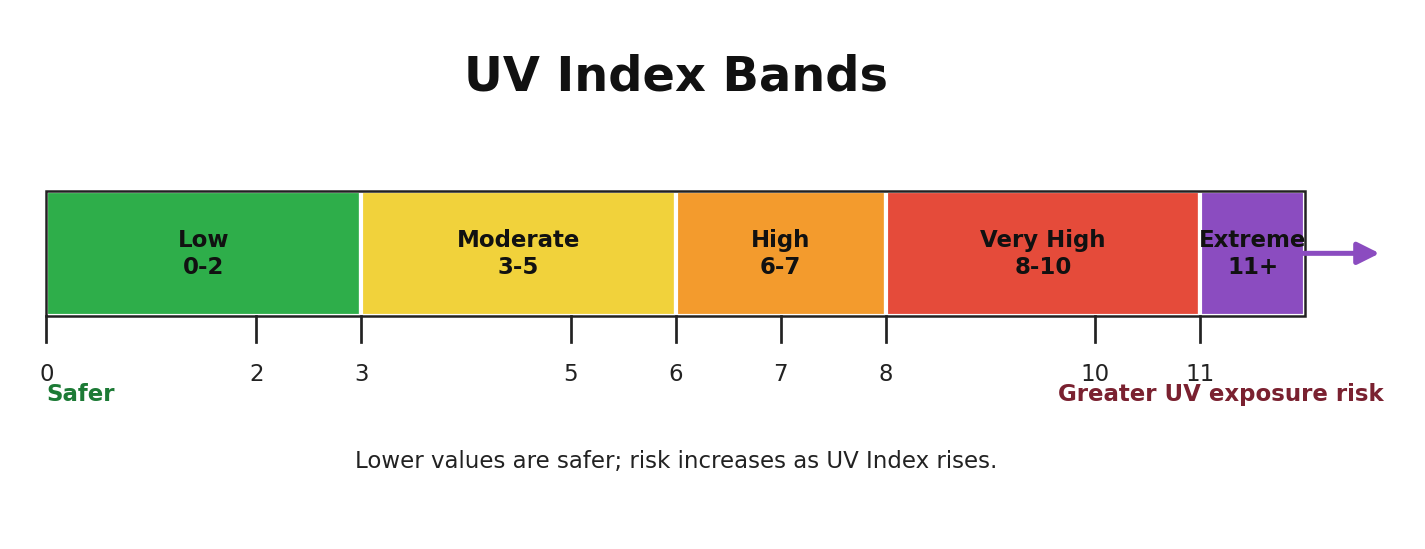
The UV Index is an international standard measurement of the strength of sunburn-producing ultraviolet (UV) radiation at a particular place and time. It rates UV radiation levels on a scale from 0 to 11+. The scale is linear, which means that a UV Index of 8 represents twice the UV intensity of a UV Index of 4. This makes comparison straightforward: double the index means double the UV strength.
The UV Index is grouped into five bands, each with a color code. The table below summarizes these bands along with the level of protection you should consider at each one.
UV Index
Band
Color
Protection Level
0–2
Low
Green
Minimal protection needed; sunglasses on bright days
3–5
Moderate
Yellow
Wear sunscreen and seek shade during midday
6–7
High
Orange
Apply SPF 30+ sunscreen, hat, and sunglasses; reduce midday sun
8–10
Very High
Red
Minimize sun exposure 10 a.m. to 4 p.m.; reapply sunscreen every 2 hours
11+
Extreme
Violet
Avoid outdoor sun if possible; take all precautions
UV Index values are most meaningful around solar noon, which is when the sun is at its highest point of the day. Keep in mind that UV levels over reflective surfaces such as sand, snow, and water can be noticeably higher than the reported number, so take extra care in those settings.
Suppose your weather app shows a UV Index of 9 for Saturday afternoon. To classify it, find where 9 falls in the table: it lands in the 8–10 range, so the band is Very High. The recommended action is to minimize midday sun, apply SPF 30+ sunscreen generously, and wear protective clothing.
Now imagine Monday's forecast shows a UV Index of 4. That falls in 3–5, the Moderate band. Sun protection is still a good idea, especially if you will be outside for more than 30 minutes, but you do not need the same level of caution as on Saturday.
The classification step is always the same:
Read the UV number from the forecast.
Find the band it belongs to in the table.
Follow the matching protection advice.
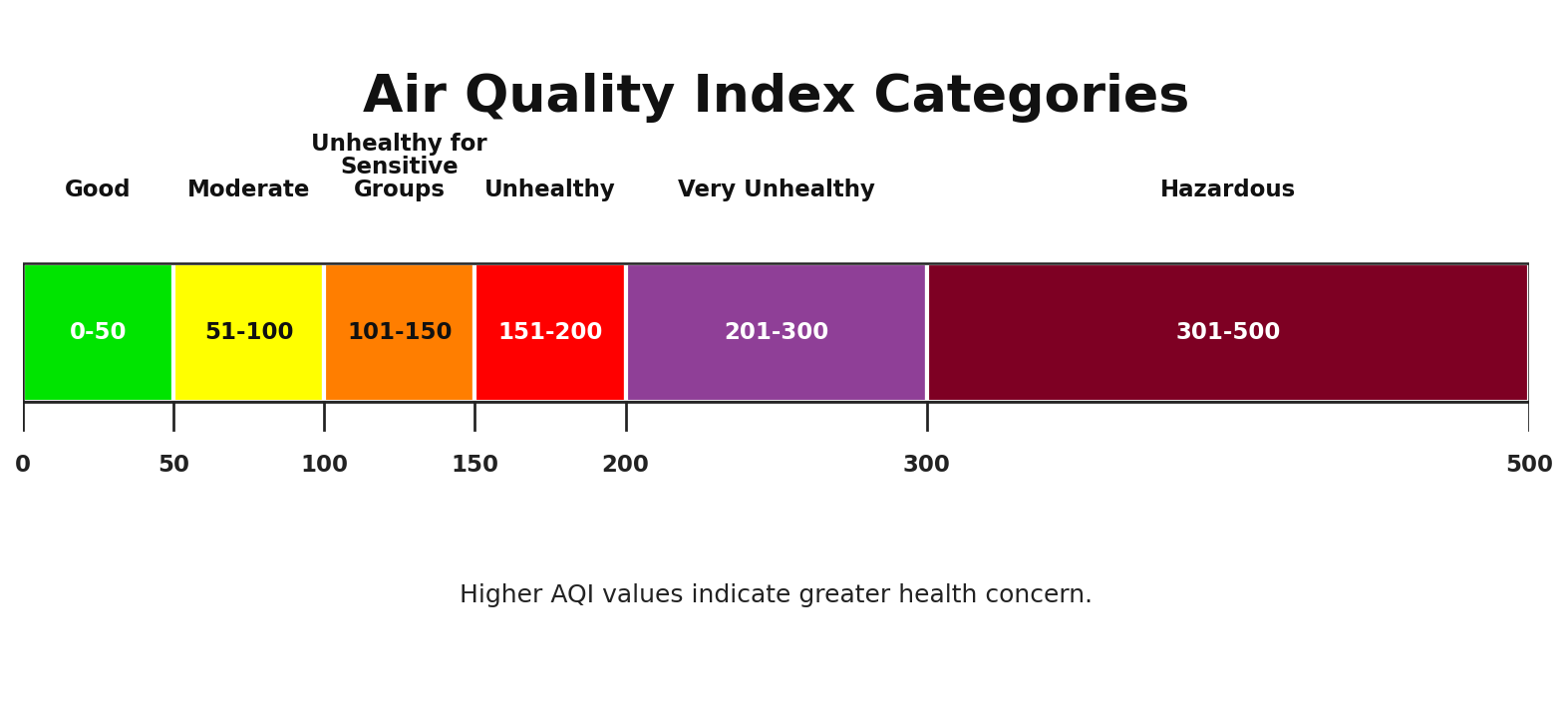
Now let's turn to the second index. The U.S. Air Quality Index, or AQI, is the EPA's tool for communicating daily air quality. Think of the AQI as a yardstick that runs from 0 to 500. The higher the AQI value, the greater the level of air pollution and the greater the health concern.
The AQI is divided into six categories, each corresponding to a different level of health concern and each with its own color. The table below lays them out.
AQI Range
Category
Color
What It Means
0–50
Good
Green
Air quality is satisfactory; little or no risk
51–100
Moderate
Yellow
Acceptable; slight concern for unusually sensitive people
101–150
Unhealthy for Sensitive Groups
Orange
Sensitive groups should reduce prolonged outdoor effort
151–200
Unhealthy
Red
Everyone may feel effects; sensitive groups feel more
201–300
Very Unhealthy
Purple
Health alert: everyone should limit outdoor activity
301–500
Hazardous
Maroon
Emergency conditions; everyone should avoid outdoor activity
An AQI value of 100 generally corresponds to the national air quality standard, and values below that are considered satisfactory. A simple rule of thumb: if the AQI is above 100, start paying attention, because that is the threshold where health effects begin for sensitive groups.
Not everyone reacts to UV radiation or poor air quality at the same level, so knowing who is most at risk is just as important as knowing the numbers.
For air quality, children, the elderly, and individuals with respiratory or cardiovascular conditions — especially asthma — are typically the first to feel the effects. The list below shows how the level of concern widens as the AQI climbs:
AQI 51–100 (Moderate): A very small number of unusually sensitive people may be affected.
AQI 101–150 (Unhealthy for Sensitive Groups): People with heart or lung disease, older adults, children, and people with diabetes should reduce prolonged outdoor effort.
AQI 151–200 (Unhealthy): Everyone may begin to experience adverse effects; sensitive groups may experience more serious ones.
AQI 201+: All individuals, including healthy adults, should cut back on or avoid outdoor activity.
For the UV Index, fair-skinned individuals, young children, and older adults face higher risk of sunburn at any given level. People with darker skin can generally tolerate more sun exposure before burning, but UV damage is still cumulative for everyone. When a household includes children, seniors, or fair-skinned members, it is wise to follow the protection advice one band higher than you might for yourself alone.
In real life, both indexes often appear on the same forecast, and the smartest decisions come from reading them together. Let's walk through a practical example to see how.
Scenario: You are planning a Saturday at the park with your family. The household includes two adults, a teenager, and an eight-year-old with asthma. The forecast reads: UV Index 7 and AQI 120.
Step 1 — Classify each value. UV 7 falls in the 6–7 range, placing it in the High band, which means sun protection is essential: SPF 30+ sunscreen, hats, sunglasses, and shade during midday. AQI 120 falls in the 101–150 range, the Unhealthy for Sensitive Groups category, so sensitive individuals should reduce prolonged outdoor effort.
Step 2 — Identify who is most affected. The child with asthma belongs to a sensitive group for air quality. At AQI 120, that child should avoid long stretches of heavy outdoor activity like running or biking. The UV level also calls for extra vigilance with sun protection for the child and anyone who is fair-skinned.
Step 3 — Adjust the plan. Combining both indexes, here is how you might reshape the day:
Schedule outdoor time for the morning before 10 a.m., when UV is lower and air quality tends to be better.
Apply sunscreen to everyone before heading out and set a reminder to reapply every two hours.
Keep the child's outdoor play to shorter sessions with rest breaks indoors or in shade.
Swap the planned afternoon soccer game for an indoor activity or a short, easy walk in a shaded area.
By reading both indexes and combining them, you can protect everyone in the household without canceling the day entirely.