Evidence Order and Independence
Introduction
Welcome to the final lesson of Updating Beliefs and Surprising Results! Over the previous four lessons, you built a powerful toolkit: you saw how priors shape posteriors, decoded the false positive paradox, learned to spot base-rate neglect, and mastered the carry-forward rule of sequential updating. That last lesson ended with an important caveat we had not yet explored — the pieces of evidence need to be conditionally independent for our step-by-step updates to work cleanly.
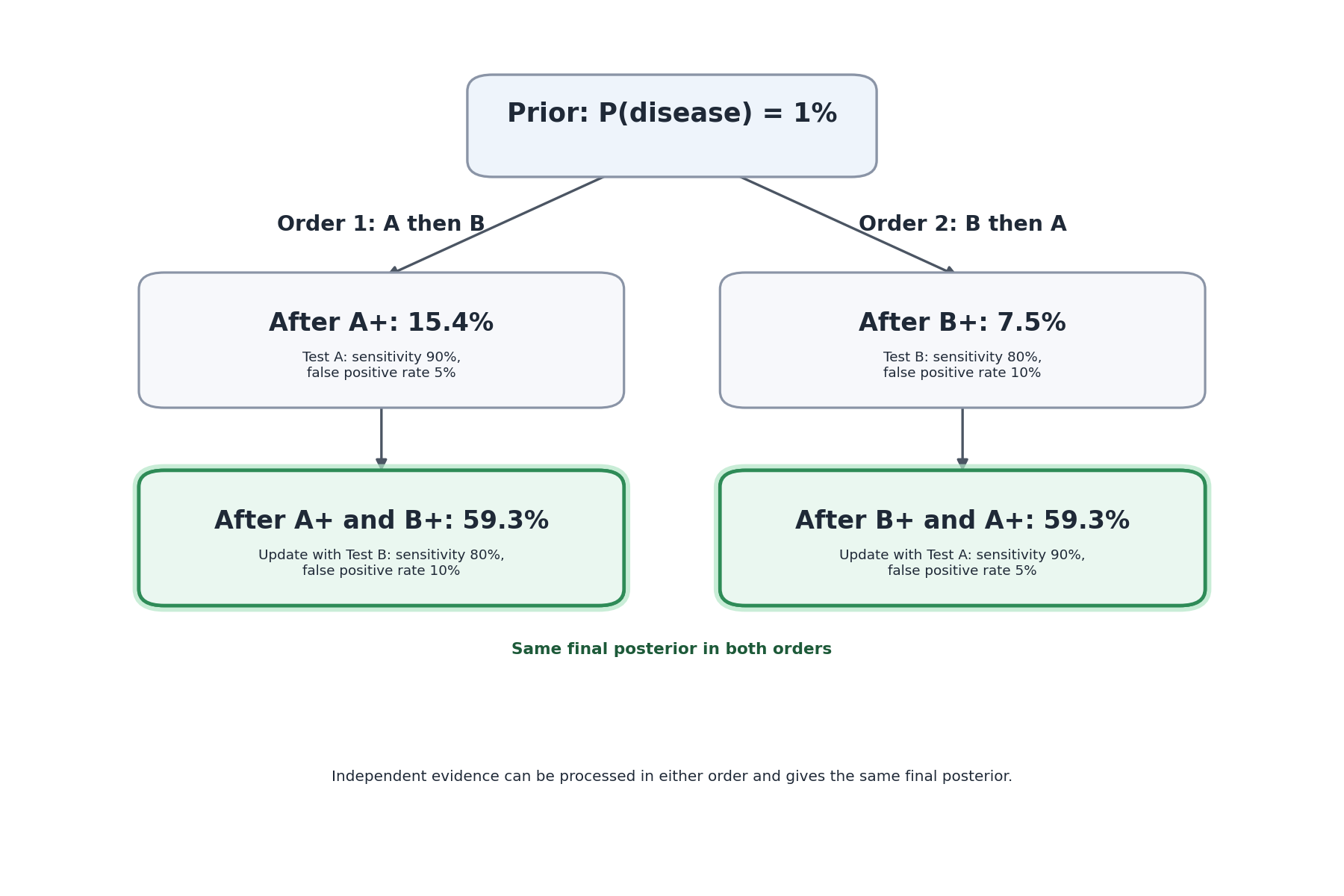
This lesson puts that assumption under the microscope. We will clarify what conditional independence means, show that independent evidence produces the same final posterior regardless of the order we process it in, and examine what goes wrong when evidence overlaps. By the end, you will know how to check whether two pieces of evidence deserve separate updates or whether combining them naively would inflate your conclusions.
A Quick Analogy for Independence
Before we touch any formulas, let us build some intuition. Imagine rolling two separate dice. Knowing that the first die landed on 4 tells you absolutely nothing about the second die. The two rolls are independent. Now imagine drawing two cards from a tiny deck without putting the first card back. Knowing the first card was an ace changes the odds for the second draw. Those two draws are not independent.
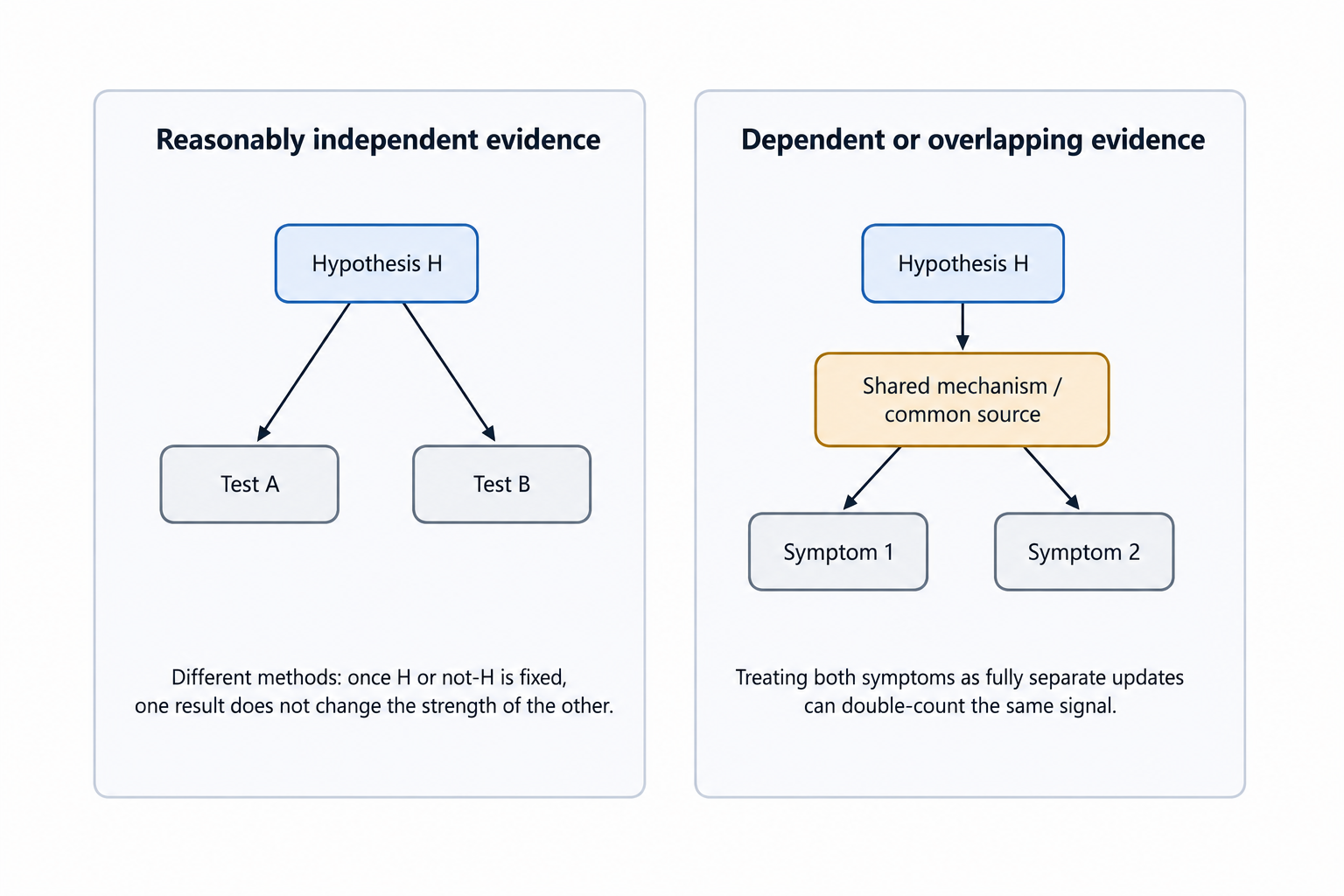
For Bayesian updating, the same idea applies to evidence, but the key assumption is conditional. Marginally, a positive result on one medical test can raise the probability of disease, which can also raise the expected chance of a positive result on another test. What we need is that, once disease status or non-disease status is fixed, the result of one test does not change the reliability or expected result of the other. Two symptoms driven by the same inflammatory response are more like draws from a small deck — they are tied together by a shared mechanism. The distinction between these two situations is what this lesson is all about.
Conditional Independence Defined
The formal name for the kind of independence we need is conditional independence. Two pieces of evidence, and , are conditionally independent given a hypothesis when:
The same factoring must also hold under the alternative, . In plain language, once we know whether is true, learning gives us no extra information about , and vice versa. The hypothesis itself can make both pieces of evidence more likely, but beyond that shared connection, the two pieces do not influence each other.
This is precisely the assumption we relied on in the previous lesson when we updated on two positive test results in sequence. Each test's accuracy numbers stayed the same regardless of the other test's outcome, because the tests measured different things. Without this property, the neat carry-forward chain would not produce reliable results.