Welcome to Understanding Inequalities, the first course in your journey toward mastering one of the most practical ideas in mathematics! This is the very first lesson, so we are starting from the ground up. By the end of this course, you will be comfortable reading, writing, and interpreting inequality statements in a variety of forms. Today, we begin with the two most fundamental comparison symbols in math: greater than (>) and less than (<). These small symbols carry a big idea, and once they click, everything that follows in this course will build naturally on top of them.
Comparisons Are Everywhere
Before we touch any symbols, let's notice something: we compare things all the time in everyday life. You might say "today is hotter than yesterday" or "gas is cheaper at the station down the road." Each of these statements puts two quantities side by side and tells us which one is larger or smaller.
Mathematics simply gives us a short, precise way to write those same comparisons down. Instead of a full sentence, we can capture the entire relationship between two values with a single symbol. That shorthand is exactly what we will learn in this lesson.
The Two Core Symbols
In math, we use two symbols to express a comparison between two quantities:
The less than symbol: <
The greater than symbol: >
A quick way to remember which is which: the symbol always points toward the smaller number. Think of the narrow, pointed end as an arrow aimed at the lesser value. For example:
3<7
This reads "3 is less than 7." The pointed end faces 3 because 3 is the smaller number. Now look at the reverse idea:
7>3
This reads "7 is greater than 3." The wide, open side of the symbol faces 7 because 7 is the larger number. Both statements say exactly the same thing about the relationship between 3 and 7 — they simply approach the comparison from different directions.
Reading a Comparison Left to Right
An inequality is always read from left to right, just like a sentence. The number on the left is the subject, the symbol is the verb, and the number on the right completes the statement.
Expression
How to Read It
2<9
"2 is less than 9"
10>6
"10 is greater than 6"
1<5
"1 is less than 5"
Every time you read the symbol, start with the left-hand number. Getting comfortable with this left-to-right habit will make more complex inequalities easier to handle later on.
Join the 1M+ learners on CodeSignal
Be a part of our community of 1M+ users who develop and demonstrate their skills on CodeSignal
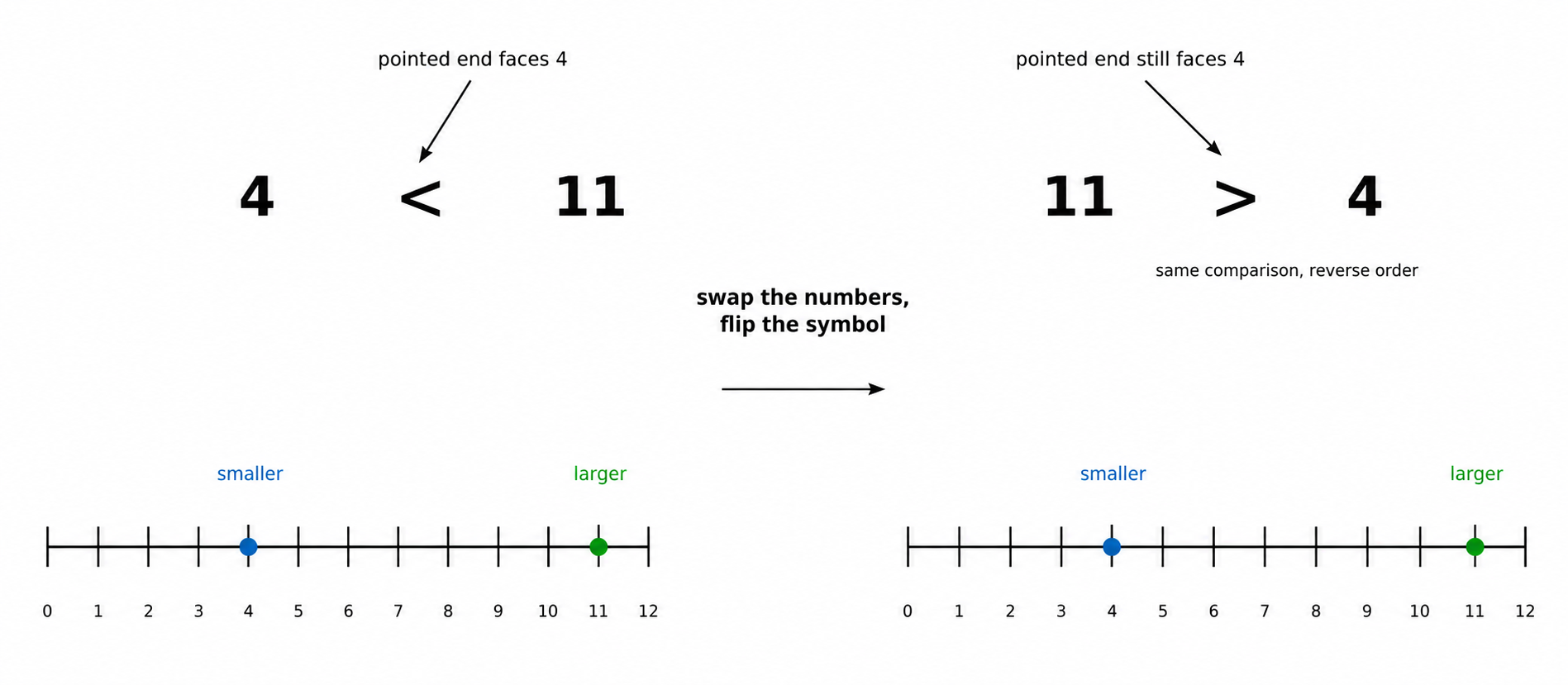
Now that we can read a comparison in one direction, let's look at what happens when the two numbers trade places. If we switch which number appears on the left and which appears on the right, the symbol must flip to keep the statement true.
Consider the true statement 4<11. If we move 11 to the left and 4 to the right, we need to reverse the symbol:
11>4
A visual can help make that flip easier to remember:
Both 4<11 and 11>4 describe the same fact: 11 is the bigger number. Writing 11<4, on the other hand, would be false — it would claim that 11 is less than 4, which is clearly not the case.
Here is a simple rule to keep in mind:
If a<b, then b>a.
If a>b, then b<a.
Whenever the two quantities trade places, the symbol flips direction.
So far we have used plain numbers like 3, 7, and 11. These symbols work just as well with any two quantities we can measure or count in real life. Imagine you are at the grocery store and a loaf of bread costs $3 while a gallon of milk costs $5. We can write:
3<5
This tells us the bread costs less than the milk. Equally, 5>3 tells us the milk costs more than the bread.
Or picture two cities reporting their daily high temperatures: City A hit 82°F and City B hit 76°F. We write 82>76 to show City A was warmer. Whether we are comparing temperatures, distances, prices, or ages, the symbols behave in exactly the same way: the pointed end always faces the smaller quantity.
As you start practicing, two errors come up more often than any others:
Ignoring direction. Some learners assume the symbol can face either way without changing meaning. Remember, 5<8 and 5>8 are not the same statement — only one of them is true.
Forgetting to flip when swapping. If you rewrite a comparison with the numbers in the opposite order, always reverse the symbol. Writing 8>5 and then swapping to 5>8 turns a true statement into a false one.
Keeping the "pointed end aims at the smaller number" rule in mind will help you avoid both of these pitfalls every time.
In this lesson we explored how the symbols < and > capture the simple but essential idea of "which quantity is bigger?" We learned that the pointed end always aims at the smaller number, that we read comparisons from left to right, and that swapping the two quantities means flipping the symbol. These ideas form the foundation for every inequality you will encounter in this course.
Up next, you will put this knowledge into action with a set of hands-on practice tasks. You will choose the correct symbol for number pairs, type symbols on your own, spot true and false statements when the order is reversed, and apply comparisons to real-world quantities like prices and temperatures. Let's jump in and make these skills second nature!