Sustainable Prioritization Habits
Build Sustainable Prioritization Rituals
You've learned to separate signal from noise, sequence your work strategically, and adapt when new information arrives. But here's the truth: prioritization isn't a one-time event. It's a habit. Without a consistent rhythm of review and adjustment, even the best-laid plans drift. Tasks pile up, goals get fuzzy, and you find yourself reacting rather than directing. This unit focuses on building sustainable prioritization rituals—lightweight, repeatable practices that keep your work aligned with what matters most.
The key word here is sustainable. You're not aiming for elaborate systems that collapse under their own weight. Instead, you want rituals that are simple enough to maintain when things get busy and valuable enough that you miss them when you skip.
Use RICE for Prioritization
RICE stands for Reach, Impact, Confidence, and Effort and is a . For each potential task or project, you estimate how many people or outcomes it affects (Reach), how significant the effect will be (Impact), how certain you are about your estimates (Confidence), and how much time or resources it requires (Effort). You then calculate a score using the formula (Reach × Impact × Confidence) / Effort. Higher scores indicate better candidates for your attention. RICE works particularly well when you have multiple competing initiatives and need a rational way to compare them.
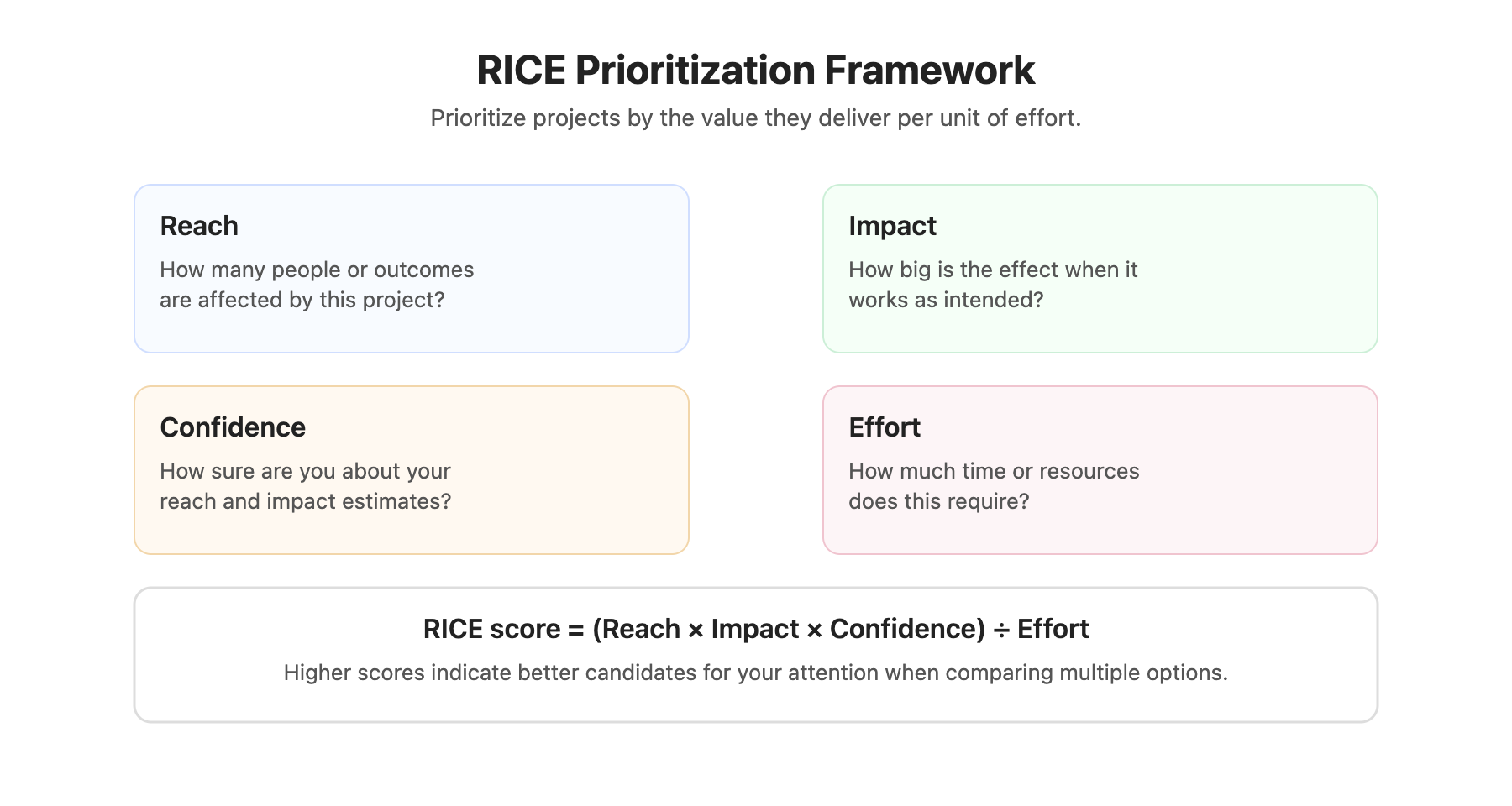
Consider an example where you're deciding between two personal projects. Project A affects a small group but has high impact and low effort, while Project B affects a larger group but has moderate impact and high effort. Running both through RICE might reveal that Project A scores higher—it delivers more value per unit of effort—even though Project B sounds more impressive on the surface.
Review and Adjust Priorities Regularly
The most common prioritization mistake isn't choosing the wrong priorities—it's setting priorities once and never revisiting them. Life evolves, deadlines shift, and new requests arrive. If you don't pause regularly to reassess, you end up executing a plan that no longer fits reality.
A prioritization review is a scheduled moment to step back and ask: "Is what I'm working on still the most important thing?" This doesn't need to be long or formal. Even ten to fifteen minutes at the start of each week can make a dramatic difference. The goal is to create a checkpoint that forces you to look up from the daily grind and recalibrate.
During your review, consider starting with "What's changed since my last review?" Perhaps a deadline moved, your focus shifted, or you completed something that unlocks new work. From there, ask yourself "Are my current priorities still aligned with my core goal?" If you're working hard but not moving toward the outcome that matters, something needs to shift. Finally, determine "What should I stop, start, or continue?" This simple framework helps you make concrete adjustments rather than vaguely resolving to do better.
The rhythm you choose matters less than the consistency. Some people prefer a quick daily check-in while others find a weekly review sufficient. What's essential is that the review happens reliably. Treat it like any other important meeting—block the time, protect it, and show up. Over time, this ritual becomes automatic, and you'll notice problems earlier and course-correct faster.
Track Progress Toward Desired Outcomes, Not Just Tasks Completed
Here's a trap that catches even disciplined prioritizers: measuring success by how many tasks you finish rather than whether you're achieving the outcomes you care about. Completing ten tasks feels productive, but if none of them moved you closer to your goal, you've been busy without being effective.
Outcome tracking means defining what success looks like before you start and then checking regularly whether you're getting there. Instead of asking "What did I get done?" ask "What progress did I make toward the result I wanted?" This shift in focus changes how you prioritize. Tasks that contribute directly to outcomes rise in importance, while tasks that feel productive but don't move the needle become candidates for elimination.
Consider this conversation between two friends who are realizing the difference between activity and progress:
- Jessica: I finished eight tasks this week, but I still feel like I'm not making real progress on what matters.
- Dan: What outcome were those tasks supposed to achieve?
- Jessica: I'm not sure—they were all on my list, so I just worked through them.
- Dan: That might be the issue. Let's step back. What's the actual result you're trying to hit?
- Jessica: I want to finish my portfolio website.
- Dan: Okay, so next week, before you start any task, ask yourself: "Does this move me toward finishing the website?" If it doesn't, it probably shouldn't be your priority.
Notice how Dan helps Jessica reframe her approach. Rather than celebrating the volume of completed tasks, he redirects her attention to the outcome that matters. This simple question—"Does this move me toward my goal?"—becomes a filter that keeps work purposeful.
To implement outcome tracking, start by articulating your desired outcomes clearly. Vague goals like "get better at writing" don't give you anything to measure against. Specific outcomes like "write three blog posts this month" or "complete a 5k run in under 30 minutes" create a target you can track. Subsequently, during each prioritization review, assess your progress toward that outcome. Are you closer than last week? If not, why not? What needs to change?
A simple practice is to pair each task with the outcome it supports. When you add something to your list, note which goal it serves. If you can't connect a task to an outcome, question whether it belongs on your list at all. This habit keeps your work tethered to purpose and makes it easier to spot when you're drifting into busywork.
Furthermore, be willing to celebrate outcomes, not just activity. When you hit a milestone—when you finish the website or complete the run—acknowledge it. This reinforces the connection between thoughtful prioritization and real results, making your rituals feel worthwhile rather than like bureaucratic overhead.
In the upcoming role-play, you'll practice proposing a prioritization ritual to a friend who worries that regular reviews will add unnecessary overhead. You'll need to demonstrate how a lightweight, outcome-focused ritual creates value rather than drag—bringing together everything you've learned about reviewing, using tools, and tracking what truly matters.
