Separate Signal from Noise
Welcome to the Course
You've made a decision—now what? The gap between deciding and doing is where good intentions often stall. This course, Turn Decisions into Action, is designed to help you bridge that gap with confidence and clarity. Throughout these lessons, you'll learn how to cut through the chaos of competing priorities, sequence your work strategically, adapt when circumstances shift, and build habits that make effective prioritization second nature.
Here's what you can expect to cover. First, you'll practice separating what truly matters from what just feels urgent. Then, you'll learn to order your action steps in a way that builds momentum and reduces risk. You'll also explore how to stay flexible when new information changes the game—without losing sight of your core goals. Finally, you'll design simple rituals that help you maintain focus over time, not just in the heat of the moment.
By the end of this course, you won't just be someone who makes good decisions—you'll be someone who executes them. That's where real impact happens, and that's what makes this work so exciting. Let's dive in.
Distinguish Urgent Tasks from Important Ones
One of the most common traps in execution is treating everything as equally pressing. When your to-do list feels like a five-alarm fire, it's tempting to tackle whatever is loudest or closest. However, urgency and importance are not the same thing, and confusing them leads to burnout and mediocre results.
A simple and powerful tool for cutting through this confusion is the Eisenhower Matrix, which divides tasks into four categories based on two questions: Is this urgent? and Is this important? Tasks that are both urgent and important get your immediate attention. Meanwhile, tasks that are important but not urgent require scheduled, protected time. On the other hand, tasks that are urgent but not important should be delegated or batched. As for tasks that are neither urgent nor important, those are candidates for elimination altogether:
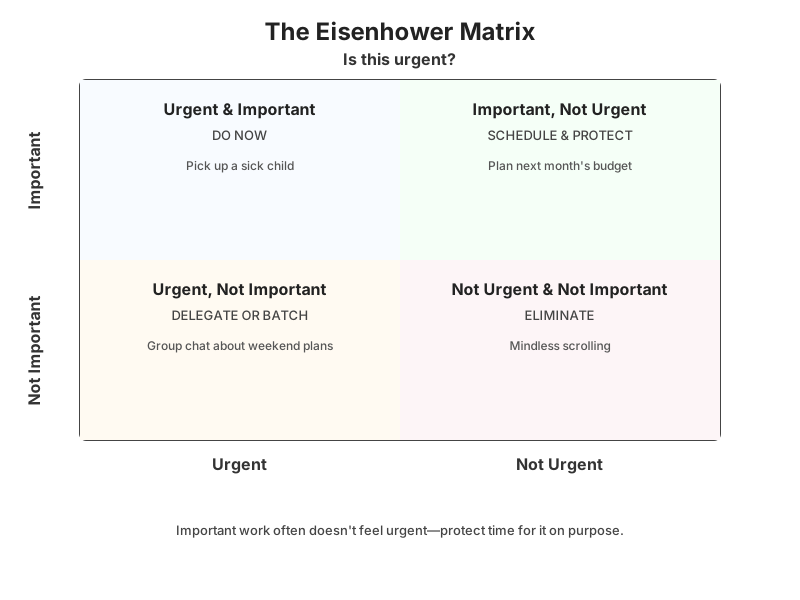
The key insight here is that important work often doesn't feel urgent, which means it gets pushed aside unless you intentionally protect it.
Let's look at how this might play out in a real conversation between two friends:
- Natalie: I'm overwhelmed. I need to reply to all these messages, finish my application, and update my calendar.
- Ryan: Hold on—which of those actually helps you reach your main goal?
- Natalie: Well, the application is due Friday, and it's really important to me.
- Ryan: That sounds important. What about the messages and the calendar?
- Natalie: I guess the messages feel urgent because they're piling up, but most of them aren't time-sensitive. And the calendar... honestly, I just always update it out of habit.
- Ryan: So maybe batch the messages for later and skip the calendar update for now. Focus your energy on what actually matters right now.
Notice how Ryan helps Natalie step back and evaluate her tasks against what truly matters. By asking a simple clarifying question, he helps her realize that the feeling of urgency doesn't always align with genuine importance—and that some tasks persist out of habit rather than necessity.
Identify the Root Cause
Even with a clear sense of what's important, you can waste effort by solving the wrong problem. Jumping straight into action feels productive, but it often addresses symptoms rather than causes—leaving the real issue to resurface later.
One practical approach to identifying the root cause of an issue is the "5 Whys" technique, where you keep asking why until you reach a deeper explanation. If a project is behind schedule, you might discover that it's not because you're slow, but because your plans kept changing, which happened because you didn't gather all the information early enough. Once you see the root, your action becomes far more effective. Consequently, you stop patching and start solving, freeing up time and energy for the work that truly matters.
Eliminate Tasks That Don't Support the Goal
Even after you've identified what's important and traced problems to their roots, your list may still be too long. The final step in separating signal from noise is ruthless elimination. Not every task deserves your time, and saying no—or not now—is a skill that protects your ability to deliver on what matters most.
Start by asking: "Does this task directly support my goal, or is it just something I've always done?" Some tasks persist out of habit or politeness rather than necessity, while others feel productive but don't actually move outcomes forward. If a task doesn't clearly connect to your priorities, challenge whether it belongs on your list at all.
This doesn't mean ignoring everything that isn't a top priority—it means being honest about trade-offs. You might say, "I'm deferring this until next week so I can focus on the project that's due Thursday." Alternatively, you could decide, "This task is low-impact right now—I'm going to remove it unless something changes." The goal isn't to do less for its own sake; it's to create space for the work that truly counts.
Now that you've built a foundation for identifying what matters, you'll have the chance to apply these skills in an upcoming role-play. You'll work through a realistic scenario where too many tasks compete for limited time—and practice making tough prioritization calls in the moment.
