Stress Testing With Premortems
Welcome to the Course 🎉
Welcome to Tools for Deliberate Reasoning! As a general manager, your hardest calls (launches, vendors, forecasts, big hires) rarely fail because you lacked information. They fail because you slow down when a quick call would do, or move fast when the moment demanded real deliberation. This course hands you a small toolkit of deliberate-reasoning moves so you slow down productively instead of just slowly, and reach for the right tool for the problem in front of you rather than agonizing over every choice. Across this course you'll build a small toolkit of deliberate-reasoning moves you can match to the decision in front of you.
In this lesson, you will learn to:
- Tell structured doubt (consider-the-opposite and the pre-mortem) apart from vague pessimism
- Facilitate a pre-mortem that surfaces named, rankable failure causes
- Turn each serious failure mode into prevention, detection, and response safeguards
Structured Doubt, Not Vague Gloom 🤔
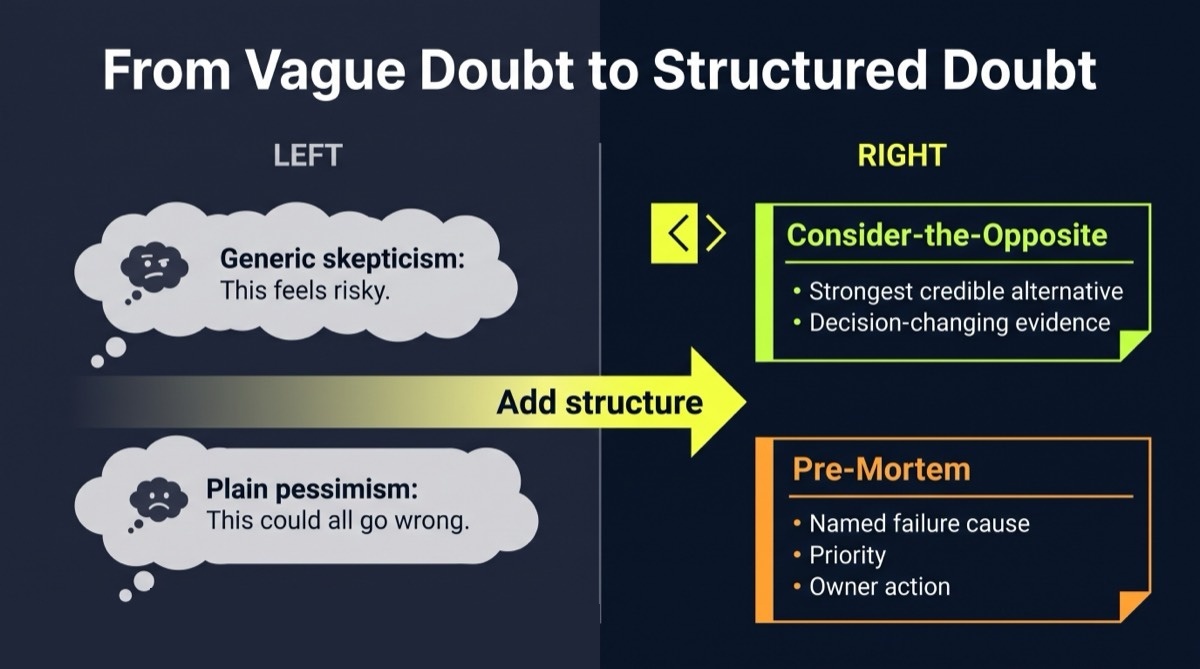
Two tools live here, and both are disciplined versions of something you already do informally. Consider-the-Opposite starts by assuming your preferred conclusion might be wrong. From there you build the strongest credible case for the alternative and name the specific evidence that would actually favor it. If that evidence turns up, you revise. That is different from generic skepticism, which is just poking holes ("I don't know, feels risky") without constructing a real rival case or defining what would change your mind.
The Pre-Mortem applies the same discipline to a plan. You imagine it is months from now and the plan has failed badly, then work backward to the plausible causes. This is not unstructured pessimism. Doom-saying is someone in the meeting sighing that "this could all go wrong" with no specific cause, no priority, and no owner. A pre-mortem forces named, plausible failure causes, ranked by severity, each attached to an action. The tell is simple: vague worry names a mood, a pre-mortem names a mechanism.
Both tools do the same job. They give your natural doubt a structure so it produces decisions instead of just anxiety.
Running the Pre-Mortem 🔮
Let's look at how to run through a pre-mortem:
- Assume it failed. Open by framing the failure as already real — "It's six months out, this launch flopped. What went wrong?" That prospective-hindsight framing gives people permission to voice concerns they would otherwise soften.
- List the causes. Have everyone write their causes down independently before anyone speaks, so the most senior or loudest voice does not set the anchor.
- Prioritize. Pool the list and rank by severity and plausibility, so your time goes only to the serious, credible few.
- Build safeguards. For each surviving cause, attach a concrete action (covered next), turning the list into something the team can execute.
Here's what that looks like in practice. Chris, a regional manager, is about to lock a promo rollout across 40 stores; Jessica, his GM, wants one structured pass before sign-off.
- Chris: I think the rollout plan's solid. Anything you'd flag before we lock it?
- Jessica: Let's pre-mortem it. It's three months post-launch and it bombed. What killed it?
- Chris: Honestly? Store staff weren't trained in time, so the promo confused customers at the register.
- Jessica: Good, that's specific and likely. Not "people might not like it," but a mechanism we can act on. What else, and which of these would hurt most?
- Chris: Training gap is the worst. If that slips, the whole first week reads as a failure.
Notice Jessica keeps steering from mood ("people might not like it") toward a named, rankable cause. That is the difference between a working pre-mortem and a gripe session.
Turning Failure Modes Into Safeguards 🛡️
A pre-mortem that stops at a list of fears has done half the job. For each serious failure mode, attach three layers, and walk one example through all three. Take the failure mode "store staff aren't trained in time, so the launch-week promo confuses customers at the register."
Prevention is what you do now to make it less likely. Here, lock the training schedule two weeks out and confirm every store has completed it before launch.
Detection is the early signal that tells you it's happening while you can still act. Here, a mid-week training-completion-rate check, not a post-launch customer-satisfaction survey that arrives too late to help.
Response is the pre-agreed move if it happens anyway. Here, a scripted register fallback and a named store-ops owner authorized to trigger it the moment completion rates fall behind. Ranked most-serious-first, this becomes a short risk-action memo your team can actually execute: not a scarier plan, a safer one.
This lesson's one move is to replace vague worry with named failure modes, ranked by severity, each carrying a prevention, detection, and response action. That is what turns a pre-mortem into a safer plan rather than a scarier one. Up next, you'll sort structured doubt from vague pessimism, run a live pre-mortem with Dan, and turn what surfaces into a risk-action memo.
