Setting Decision Criteria
Setting Decision Criteria 📋
The pre-mortem helped you find how a plan could fail. This lesson shifts to a different problem: choosing fairly between options that are all competing for your yes. Vendors, candidates, and proposals rarely arrive as neutral data. One shows up with a slick deck, another with a confident closer, a third simply goes last and lingers in memory. Left unguarded, whichever pitch impresses most sets your sense of what "good" looks like, and you end up reverse-engineering criteria to justify the option you already liked. The fix is a discipline of sequence: decide what matters before you see who's offering it.
In this lesson, you will learn to:
- Lock a Precommitment Decision Checklist (objective, must-haves, disqualifiers, weighted criteria) before any option is on the table
- Score every option against the same criteria and evidence standard rather than the most polished pitch
- Build a Weighted Decision Matrix, run a sensitivity check, and document any exception you make
Fix the Rules Before You See the Players 📏
One move protects you more than any other, the Precommitment Decision Checklist. It locks the decision architecture in place before a single option is on the table. Written down in advance, it names:
- Objective — what this decision is actually for
- Must-haves — non-negotiables an option has to clear
- Disqualifiers — conditions that knock an option out regardless of other strengths
- Weighted criteria — the handful of factors that matter, and how much each counts
- Evidence standards — what proof a score requires
- Trade-offs — what you're willing to give up, and a review point
Why before? Because once you've seen a compelling option, your criteria will quietly bend toward it. Set weights in advance so you can't inflate "presentation quality" to 30% just because one vendor dazzled. This is the counter to the anchoring and halo effects you met earlier: the criteria, not the most polished pitch, decide what wins.
Here's how that discipline sounds in practice. Milo wants to reopen the criteria after a strong pitch, and Nova holds the line:
- Milo: That last vendor was so polished — should we bump "presentation quality" up in the weighting?
- Nova: We locked the checklist before anyone pitched. Changing a weight now just because they impressed us is exactly what the precommitment is meant to stop.
- Milo: Fair. So we score them on the criteria we already agreed to.
- Nova: Right. If they still win on those, great. If they only win because we moved the goalposts, that's the halo effect, not the evidence.
Notice what Nova did not do. She didn't argue that the vendor was unimpressive — she simply refused to let the impression rewrite the weights. That's the whole function of the checklist: once it's locked, a compelling pitch can't quietly change what good means. The vendor is still free to win, but they have to win on the criteria everyone agreed to before the pitching started. And Nova's last line is the test worth remembering: if an option only wins because you moved the goalposts, you're scoring the halo effect, not the evidence.
Scoring Options Against the Same Yardstick ⚖️
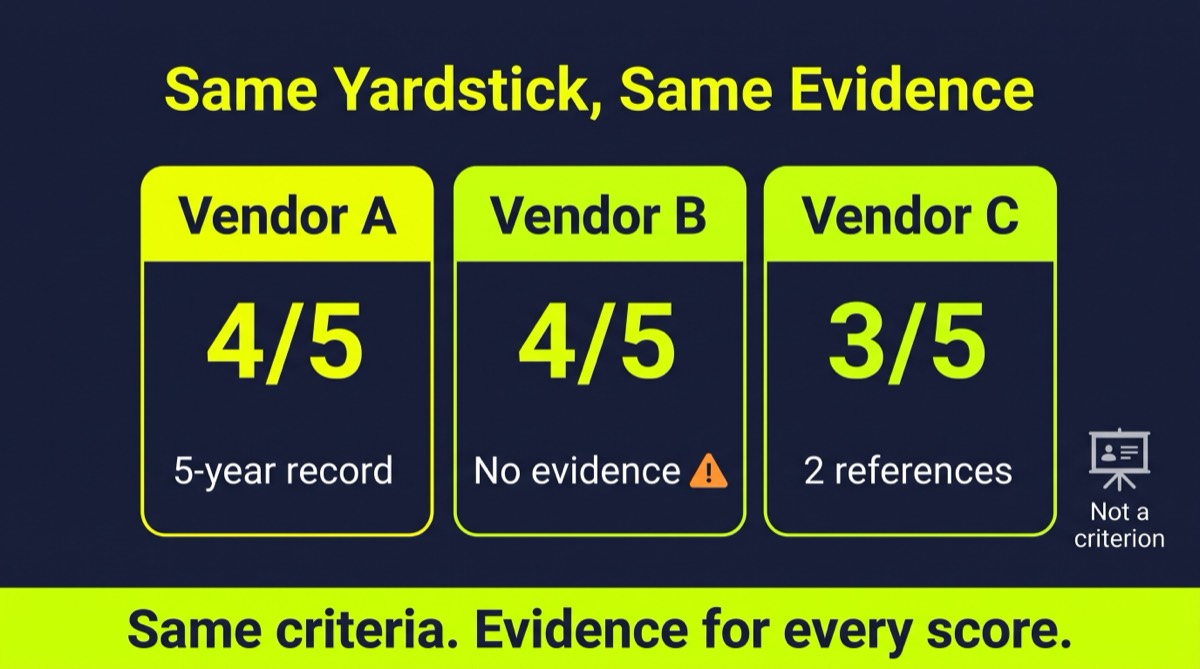
With criteria fixed, comparison becomes an evidence exercise rather than a beauty contest. Score every option against the same factors, holding each to the same evidence standard. When a score feels generous, ask out loud, "What's the evidence for that rating?" If the answer is a strong impression rather than a fact, the score isn't earned yet.
The same evidence standard has to hold for every option. If one vendor's "reliability: 4/5" rests on a five-year performance record and another's identical 4/5 rests on nothing but a confident pitch, the two scores aren't comparable — one is earned and one is borrowed. Flag any score without a fact behind it and either find the evidence or lower it. And keep presentation quality out of the rubric entirely. A glossy deck or a charismatic presenter is not one of your criteria, so it earns no points, no matter how much it moved the room.
Building the Matrix and Owning the Exceptions 🧮
The Weighted Decision Matrix turns that discipline into a number you can defend. Building it is mechanical:
- Set your criteria and weights in advance.
- Score each option on consistent evidence.
- Multiply each score by its weight, then sum the totals.
| Criterion | Weight | Vendor A (score → weighted) | Vendor B (score → weighted) |
|---|---|---|---|
| Service quality | 30% | 4 → 1.20 | 3 → 0.90 |
| Reliability | 30% | 5 → 1.50 | 2 → 0.60 |
| Cost | 25% | 5 → 1.25 | 3 → 0.75 |
| Transition risk | 15% | 4 → 0.60 | 2 → 0.30 |
| Weighted total | 100% | 4.55 | 2.55 |
The number is only the start. Take your least-certain scores and flex them up or down a point — if the ranking flips, that uncertainty, not the apparent winner, is where your attention belongs. Then hold the result up against your gut. When the matrix and your instinct disagree, don't blindly obey either one; sit with the gap and ask what it's telling you. Sometimes your instinct has caught a factor you forgot to weight, and sometimes it's just the halo you built the matrix to resist. Either way, if you end up departing from the ranking, write down why in a single sentence — a recorded exception is defensible, while a silent override just dresses up the same bias in spreadsheet clothing.
The takeaway is one of sequence: define objectives, must-haves, disqualifiers, and weighted criteria before you look, and the polished pitch loses its power to quietly set the bar. Next you'll do a quick fill-in-the-blank check to lock the Precommitment Decision Checklist in your head, then carry it into a live comparison, and finally build a matrix you could hand to a skeptical VP. Before your next vendor or hiring shortlist, try writing the weights down and getting sign-off on them before a single option is opened.
