Bounding Irrational Numbers
Introduction
Welcome to the final lesson of The Real Number System and Irrationality! Across the first four lessons, you built a powerful set of skills: defining irrational numbers, exploring π and e, using the perfect-square test on square roots, and classifying any number as rational or irrational with a clear justification. That toolkit tells you what kind of number you are looking at — but it does not yet tell you how big that number is.
In this lesson, we tackle exactly that gap. Given an irrational number, our goal is to find the two consecutive integers it sits between. This is a concrete, practical skill: it turns an abstract irrational value into something you can visualize on the number line and estimate in everyday situations.
Why Bounding Matters
When we label a number like as irrational, we know its decimal never terminates or repeats. But that classification alone does not tell us whether is closer to or to . Pinning an irrational number between two consecutive integers gives us an immediate sense of its size without needing a calculator.
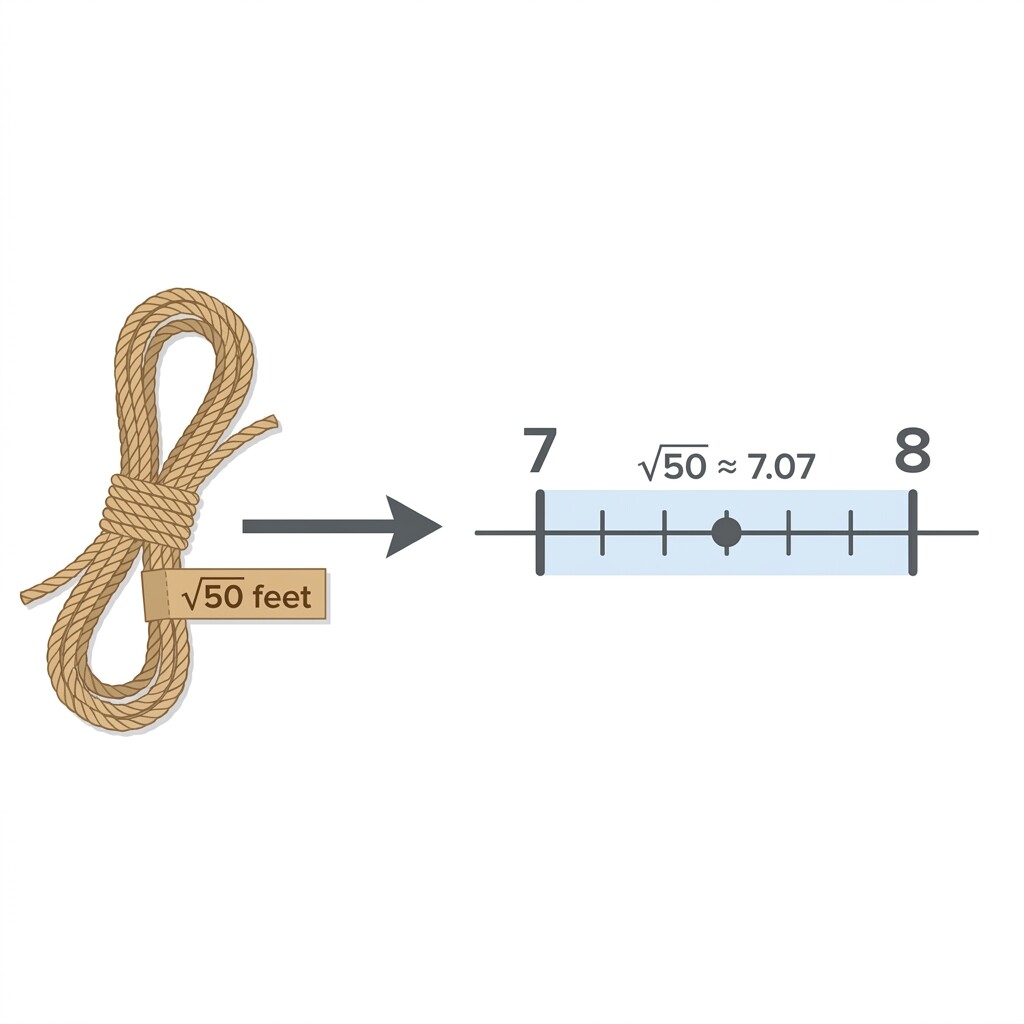
Think of it this way: if someone tells you a rope measures feet, you cannot cut it to the right length unless you have some idea of the value. Knowing that falls between and is a useful first step — and that is exactly what this lesson teaches.
The Perfect-Square Sandwich
The perfect squares — — serve as our guideposts for bounding square roots. The key idea relies on a simple property: the square root function preserves order. In other words, if , then . So when we find two consecutive perfect squares that surround a number , the square roots of those perfect squares surround .
Here is the step-by-step strategy:
- Find the neighboring perfect squares. Identify two consecutive perfect squares, and , such that .
- Take square roots of all three parts: , which simplifies to .
- State the result. The irrational number lies between the consecutive integers and .
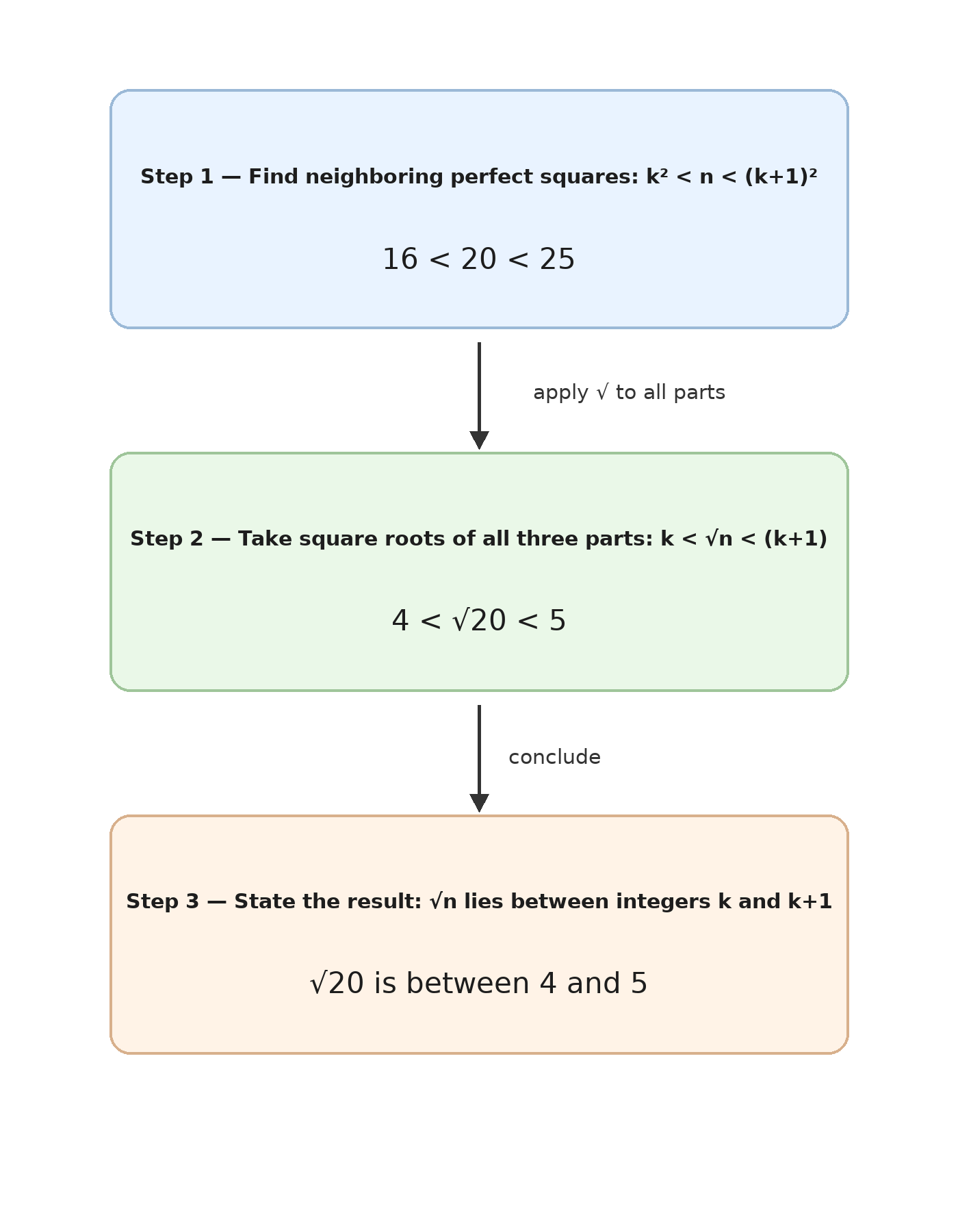
Because each step follows directly from the one before it, you will find that the process becomes almost automatic once you are comfortable with your perfect squares.
Worked Examples With Square Roots
Example 1 —
We need two consecutive perfect squares around . Since and , we have:
Taking square roots across the inequality:
So lies between 4 and 5.
Example 2 —
The nearest perfect squares are and :
So lies between 7 and 8. This confirms the rope estimate from our earlier scenario — a -foot rope is a little over feet long.
Example 3 —
Here, and :
So lies between 1 and 2.
Notice that in every example the process is identical: find the perfect squares on either side, then take roots. The only thing that changes is which squares you need.
A Handy Reference: Perfect Squares
Having the first several perfect squares at your fingertips makes bounding feel almost instant. Here is a compact table worth memorizing:
| 1 | 2 | 3 | 4 | 5 | 6 | 7 | 8 | 9 | 10 | 11 | 12 | |
|---|---|---|---|---|---|---|---|---|---|---|---|---|
| 1 | 4 | 9 | 16 | 25 | 36 | 49 | 64 | 81 | 100 | 121 | 144 |
For instance, if someone asks about , a quick scan of the table shows , so . No pencil work needed once you know the squares. Building fluency with this table — ideally up through — is one of the most useful things you can do for fast estimation.
Bounding Famous Constants
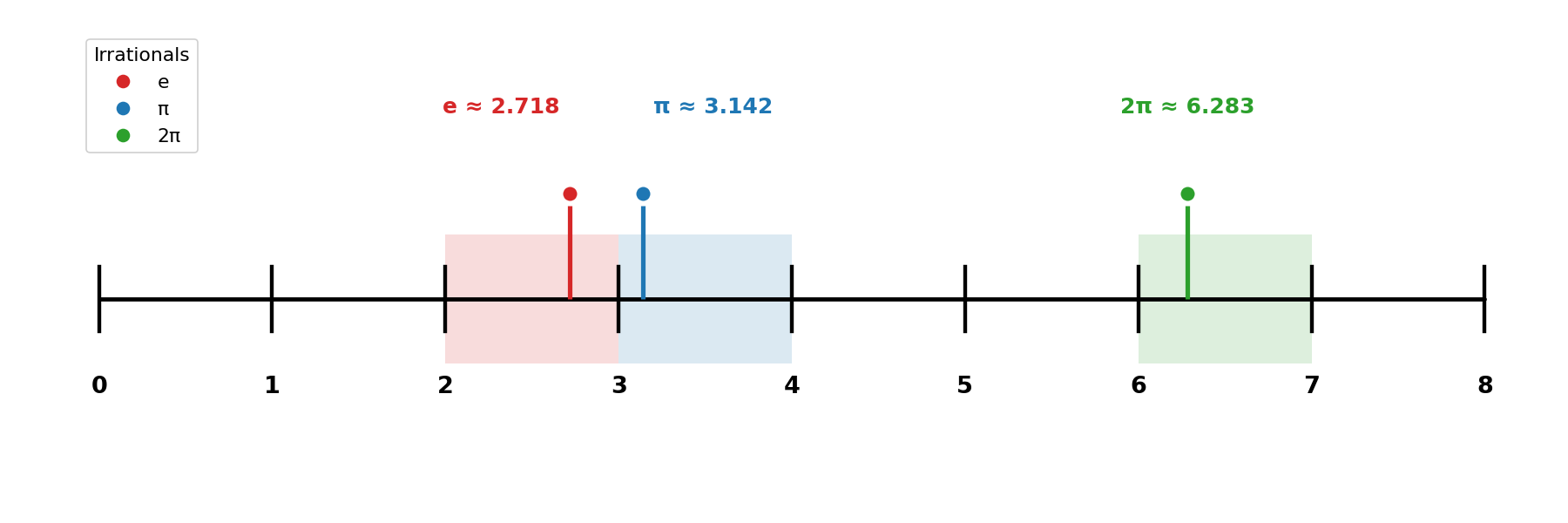
Square roots are not the only irrational numbers we need to bound. The constants π and e have well-known approximate values that let us place them between consecutive integers just as easily:
- π ≈ 3.14159…, so .
- e ≈ 2.71828…, so .
We can also bound expressions built from these constants. A common one is :
Since , we conclude . The strategy mirrors the perfect-square sandwich: use what you know about the number's approximate value to identify which two integers it falls between.
Extending Bounds to Expressions
Once you have pinned an irrational number between two consecutive integers, you can apply basic arithmetic to bound more complex expressions. The idea is simple: perform the same operation on every part of the inequality.
Consider . From the perfect-squares table, and . Since , we get .
Now consider . From our earlier work, . Adding to every part of the inequality gives:
The same logic works with subtraction, multiplication by a positive number, or any operation that preserves the direction of the inequality. This flexibility means that whether you face a bare square root, a named constant like , or an arithmetic expression involving irrationals, the core approach stays the same: start with a known bound and adjust.
Conclusion and Next Steps
In this lesson, you learned how to locate irrational numbers on the number line by squeezing them between two consecutive integers. For square roots, the technique relies on finding neighboring perfect squares and taking roots — the perfect-square sandwich. For constants like π and e, you lean on their standard decimal approximations. In every case, the underlying logic is the same: use what you already know to pin down what you do not.
Now it is time to put this bounding skill into practice! The upcoming exercises will ask you to fill in perfect-square sandwiches step by step, identify bounding integers for various square roots on your own, and locate famous constants between consecutive integers. Let's see how quickly you can pin down these numbers!
