Recognizing the Bell Shape
Introduction
Welcome to The Normal Distribution, the third course in our learning path! By now, we have built a solid foundation: we know how to read distribution graphs, describe their center and spread, and we have explored the flat, equal-likelihood world of the uniform distribution. With all of that under our belt, we are ready to meet the most famous distribution in all of statistics.
In this first lesson, we will learn to recognize the normal distribution by its distinctive shape, often called the bell curve. By the end, we will be able to pick it out at a glance and explain exactly what makes it different from the flat and lopsided shapes we have already seen.
Not Everything Is Flat
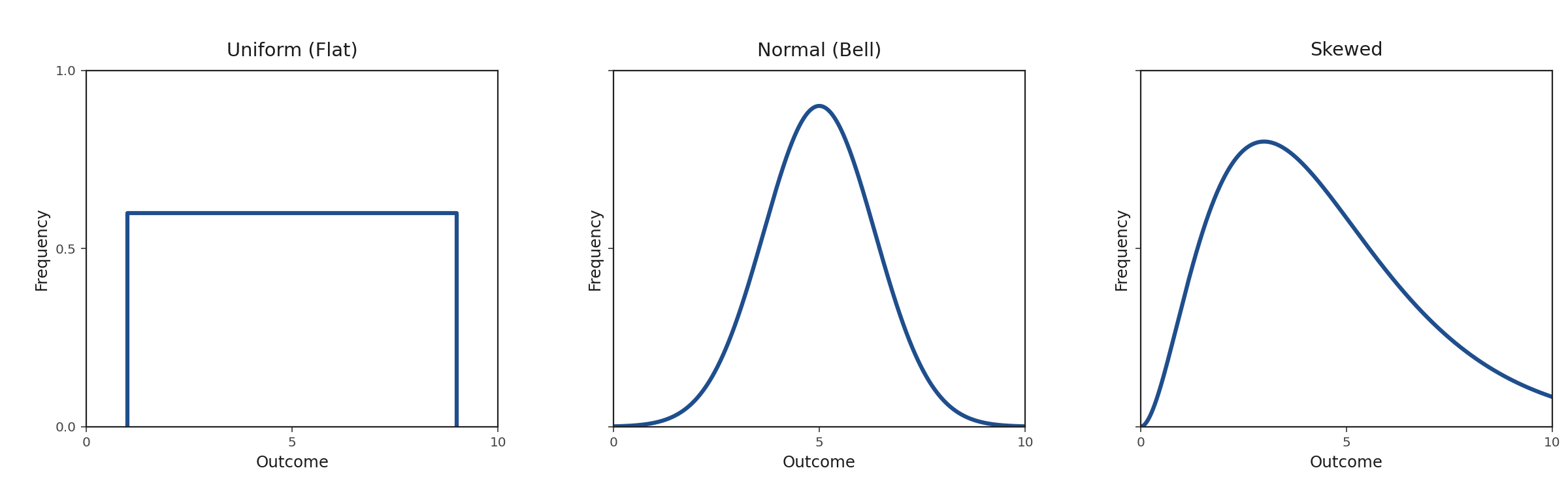
As you may recall from the previous course, a uniform distribution looks flat because every outcome is equally likely. That model fits some situations well, like rolling a fair die, but most real-world measurements do not behave that way.
Think about the heights of adult women in a large city. A few people are very short, a few are very tall, and a large number cluster somewhere in the middle. If we plotted this as a distribution, it would not look flat at all. Instead, the graph would rise up in the center and fall away on both sides. This "rise and fall" pattern is exactly the shape we are about to explore.
The Bell Curve Up Close
The normal distribution gets its nickname from its outline: it looks like a bell. The curve rises smoothly to a single rounded peak in the center, then slopes downward on each side, tapering gradually toward the horizontal axis without ever quite touching it.
In the sketch below, notice the single center peak, the mirror symmetry, and the tapering tails.
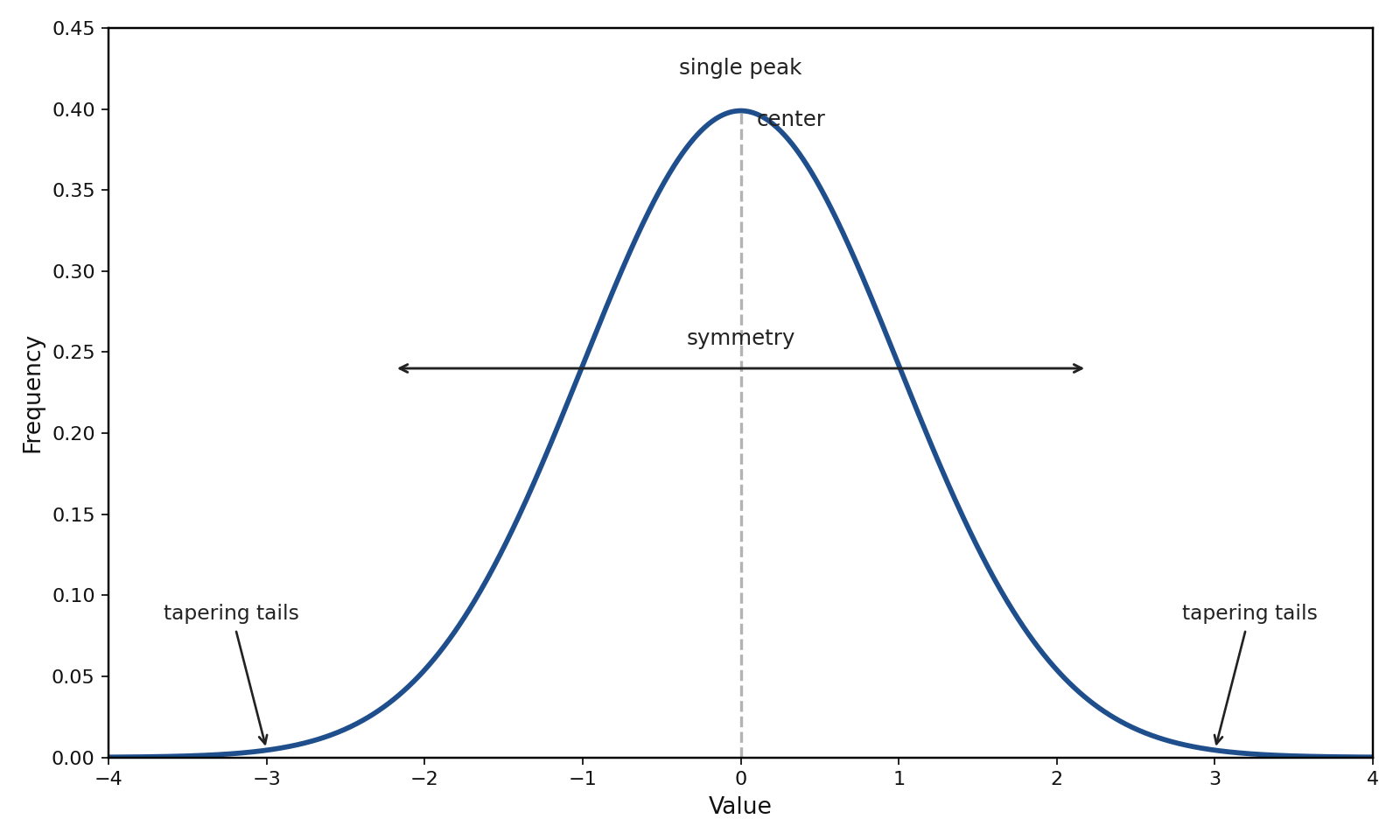
Here are the three defining features to look for:
- One peak — the curve has a single highest point, right at the center.
- Symmetry — the left half is a mirror image of the right half.
- Tapering tails — frequencies decrease steadily as we move away from the center, and they do so at the same rate on both sides.
If all three features are present, we are looking at a bell shape. If any one is missing, the distribution is something else.