Welcome to The Meaning and Limits of Division, the fifth course in this learning path! Over the previous four courses, you built a solid foundation in multiplying and dividing signed integers and rational numbers. Now we shift our focus from how to compute quotients to what those quotients actually mean and where division reaches its limits.
This first lesson explores how to interpret positive quotients in everyday situations. By the end, you will be able to look at a division expression and describe, in plain language with the right units, what the result represents in context.
More Than Just a Number
Division as Equal Sharing
Division as a Per-Unit Amount
Join the 1M+ learners on CodeSignal
Be a part of our community of 1M+ users who develop and demonstrate their skills on CodeSignal
As you may recall from earlier courses, we defined division as the inverse of multiplication: a÷b asks "what number multiplied by b gives a?" That definition helped us find values and check our work. But in daily life, a quotient is rarely just a number sitting on a page — it carries meaning.
Think about the difference between hearing "the answer is 5" and hearing "each person gets 5 cookies." The math is the same, but the second version tells a story. Our goal in this lesson is to connect every quotient to the story it tells.
One of the most natural ways to think about division is equal sharing. When a total amount is split into equal groups, division tells us how much each group receives.
Consider this situation: three friends split a $27 restaurant bill evenly. We write
27÷3=9
The quotient 9 means each friend pays $9. Notice that the total ($27) is being divided by the number of people (3), and the result describes the amount per person.
Here are a few more examples of equal sharing:
Situation
Expression
Quotient meaning
20 stickers shared among 5 children
20÷5=4
4 stickers per child
36 bottles packed into 6 boxes
36÷6=6
6 bottles per box
50 pages read over 10 days
50÷10=5
5 pages per day
In every case, the quotient answers the question: how much for each one?
Equal sharing is one lens, but division also appears whenever we calculate a rate — a quantity measured per one unit of something else.
Imagine a car travels 120 miles in 4 hours. We compute
120÷4=30
The quotient 30 is not about splitting miles into groups. Instead, it tells us the car covers 30 miles per hour. This is a rate: it compares two different units (miles and hours) and expresses how much of one unit corresponds to exactly one of the other.
Rates pop up everywhere: price per item, calories per serving, words per minute. Whenever you divide a total quantity by a count of a different kind of unit, the quotient is a per-unit amount.
Units Tell the Story
Choosing the Right Interpretation
Conclusion and Next Steps
In this lesson, you explored two powerful ways to read a positive quotient: as an equal share (how much each group gets) and as a per-unit amount (a rate). You also saw that attaching the right units to a quotient is what transforms a bare number into a meaningful answer. These ideas will serve as the foundation for the rest of this course, where we will extend interpretation to negative quotients and investigate what happens when zero enters the picture.
Up next, you will put these ideas into action with a set of hands-on practice tasks. You will match division expressions to real-world situations, evaluate what a quotient measures, and write your own unit-aware interpretations — jump in and see how naturally these concepts click!
The single most important habit when interpreting a quotient is stating the units. Without units, the number is ambiguous. Look at this example:
A baker uses 24 ounces of flour to make 8 muffins. What does 24÷8=3 tell us?
If we only say "the answer is 3," a reader might wonder: 3 muffins? 3 batches? The units make it clear: 3 ounces per muffin. The dividend's unit (ounces) becomes the numerator of the rate, and the divisor's unit (muffins) becomes the denominator.
A helpful pattern to remember: Dividend units ÷ Divisor units → Dividend units per Divisor unit. So dollars÷tickets=dollars per ticket, and miles÷gallons=miles per gallon. Paying attention to this pattern will keep your interpretations accurate every time.
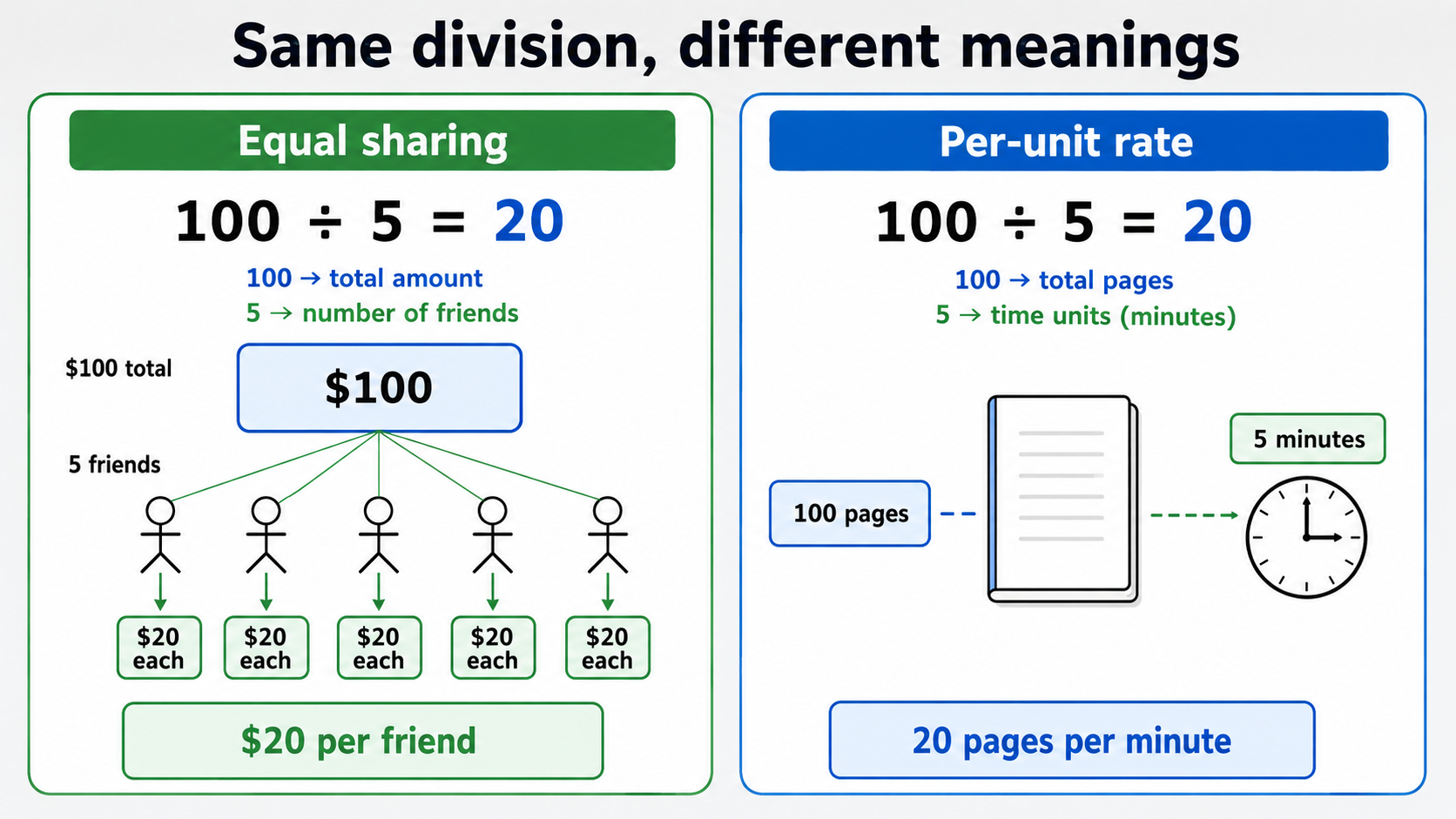
Sometimes the same numbers can appear in more than one story, so you need to read the context carefully. Consider the expression 100÷5=20. It could mean:
Equal sharing: $100 is divided among 5 friends → each friend gets $20. Here the total is money and the divisor is a count of people, so the quotient is dollars per person.
Per-unit rate: A printer produces 100 pages in 5 minutes → the printer runs at 20 pages per minute. Here the total is pages and the divisor is a time measurement, so the quotient is a speed.
Both use the same arithmetic, but the meaning of 20 is completely different. To choose the right interpretation, ask yourself: What does the total (dividend) measure, and what is the number of groups or units (divisor)? The quotient then describes how much of the total belongs to each single group or unit. Matching the context to the correct reading is a skill you will practice right after this lesson.