Dividing Zero By Zero
Introduction
Welcome to the fifth and final lesson of The Meaning and Limits of Division! You have worked through the entire course, and this is the last concept standing between you and the finish line. In the previous lesson, we proved that dividing a nonzero number by zero is undefined because no number passes the missing-factor test. Now we turn to the last and perhaps most surprising case: what happens when both the dividend and the divisor are zero?
By the end of this lesson, you will be able to explain why is also undefined — but for a completely different reason than the one we saw last time. Instead of having no solution at all, this problem has far too many.
A Question with Too Many Answers
In everyday life, "undefined" usually signals that something is broken or impossible. That was exactly the story for : no number could fill the role of the missing factor, so the expression had no answer at all. It might seem logical, then, that would break in the same way. But it does not.
Think about it with a real-world picture. Suppose a company reports that its total profit over a period was $0, and there were employees to split it among. Did each employee earn $50? Well, employees each earning $50 accounts for $0 in total — that checks out. Did each employee earn $1,000? That checks out too. Every proposed answer is perfectly consistent with the starting information, and that is precisely the problem.
When every number is a valid candidate, we cannot point to a single definitive result. Let us confirm this more rigorously with the tool we have used throughout this course.
Applying the Missing-Factor Test
As you know from previous lessons, we interpret division through multiplication. Writing
is the same as asking: what number satisfies
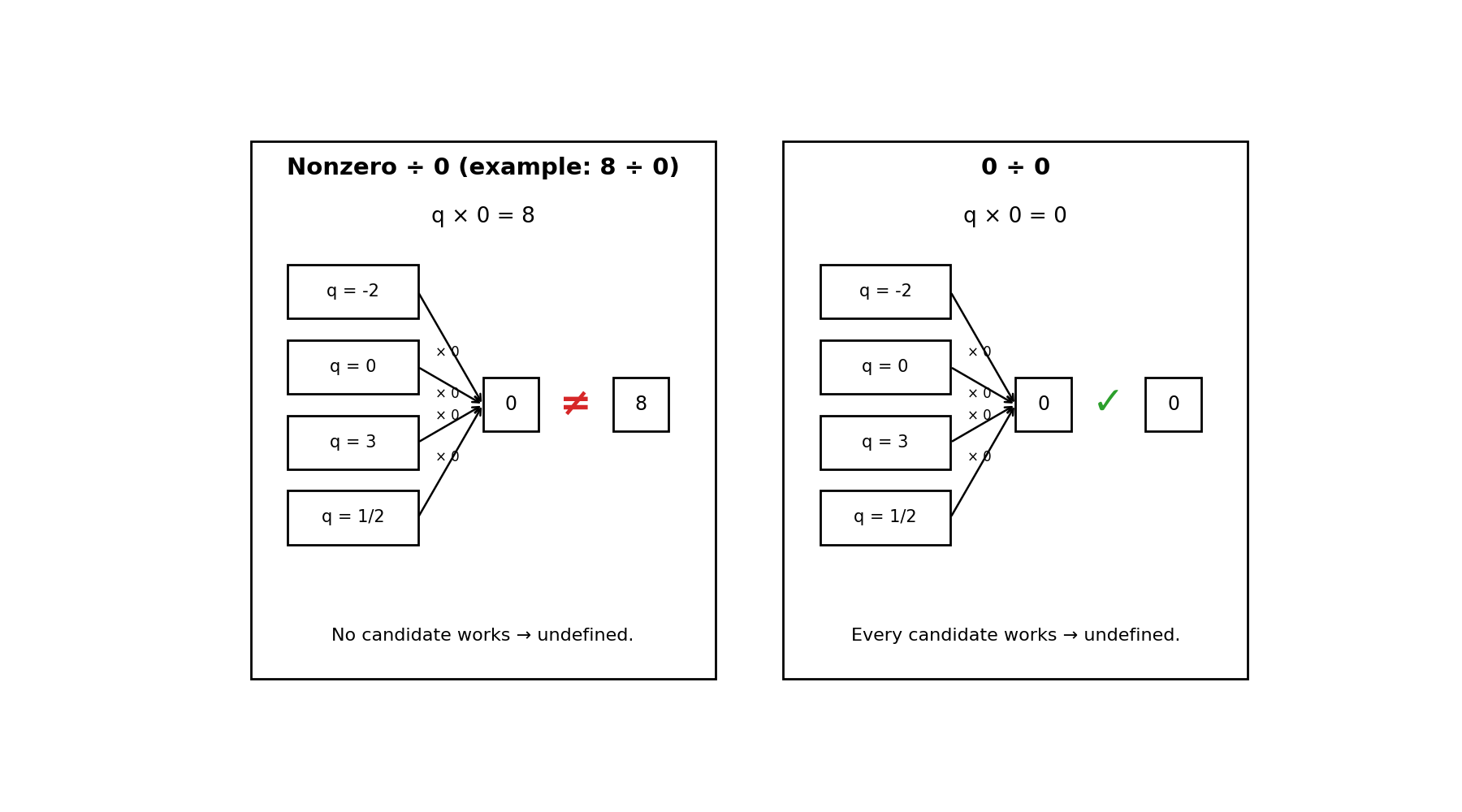
Let us try a few candidates:
| Candidate | Equals ? | |
|---|---|---|
| Yes | ||
| Yes | ||
| Yes | ||
| Yes |
Every single number we plug in produces on the left side, which matches the on the right side. The number works just as well as or or any other value you can think of.
Because every number satisfies the equation , we have no basis for choosing one answer over another. Division is supposed to produce a single, unique quotient. When it cannot, the expression is undefined.