Dividing by Zero Undefined
Introduction
Welcome back to The Meaning and Limits of Division! You have reached lesson four out of five in this course, so we are very close to the finish line. In the previous lesson, we proved that divided by any nonzero number is always , using the missing-factor relationship between division and multiplication. Now we turn the question around: what happens when we try to divide a nonzero number by zero?
By the end of this lesson, you will be able to explain why dividing a nonzero number by zero is undefined. This is not a rule to memorize. It is a logical conclusion you can reach on your own, using the same missing-factor reasoning we have relied on throughout the course.
What Does It Mean to Divide by Zero?
Before we open the algebra toolbox, let us think about this question using a simple real-world picture. Suppose you have 8 cookies and you want to package them into bags that each hold 0 cookies. How many bags would you need?
You could fill one bag (0 cookies used), two bags (still 0 cookies used), a hundred bags (still 0 cookies used). No matter how many bags you fill, you never use up a single cookie. The task simply cannot be completed, because groups of size zero will never account for 8 cookies.
This everyday reasoning already hints at the answer: dividing 8 by 0 does not produce a meaningful number. Let us now confirm this with the precise tool we have been using all along.
The Missing-Factor Test
As you may recall from previous lessons, every division problem translates into a missing-factor question. When we write
we are asking: what number times gives ? In other words, we need a value such that
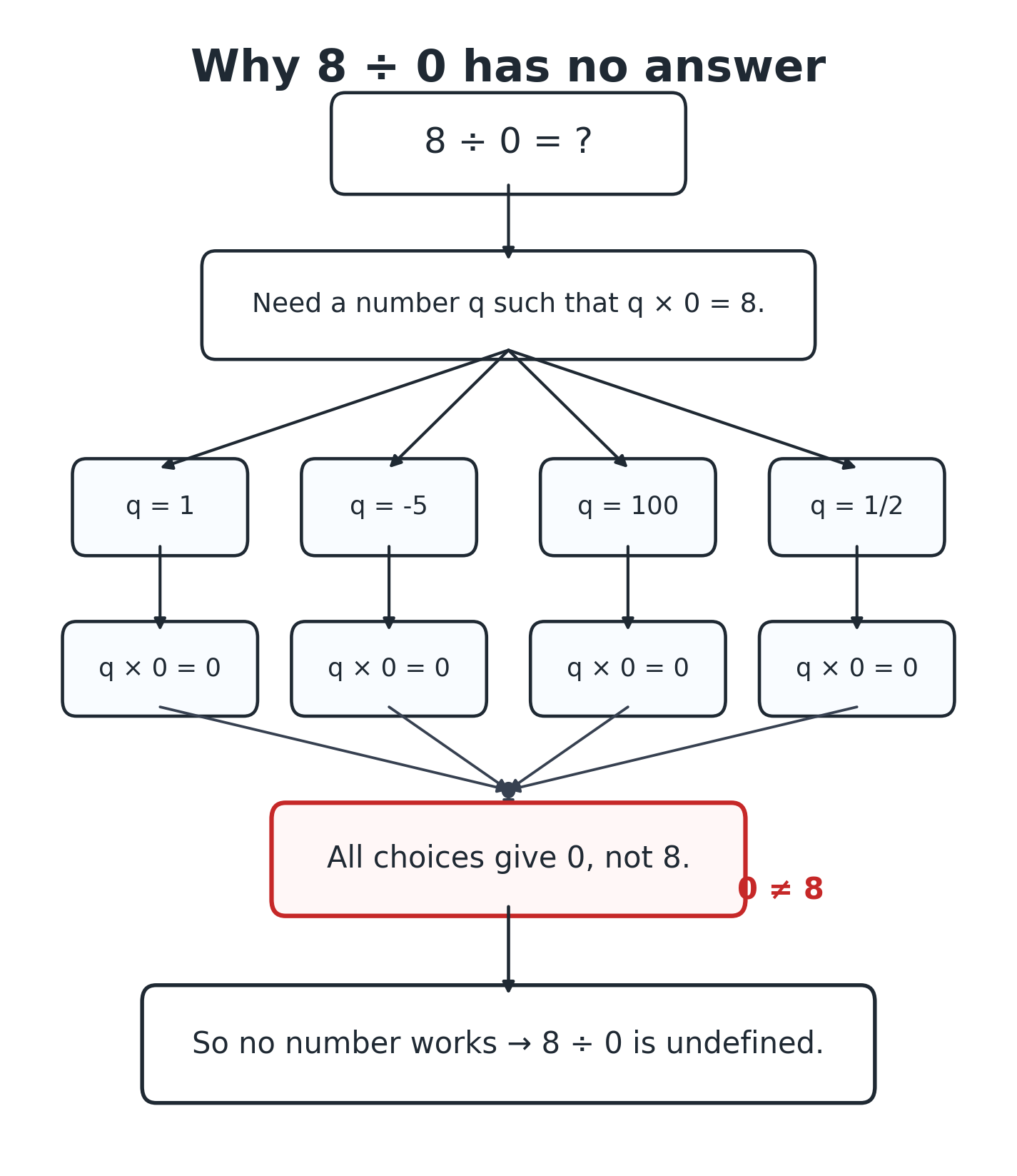
Now, what is for any number ? It is always . Whether is , , a million, or any other value, multiplying by zero always produces zero. So there is no number that makes true.
Because no missing factor exists, the division has no answer. We say it is undefined.
