Rebooting After Setbacks Without Shame
Rebooting After Setbacks Without Shame
You've built the systems. You've run the maintenance cycles. You've facilitated team resets with grace and vulnerability. For six weeks, maybe even three months, everything hummed along beautifully. Then life happened. A family crisis consumed your attention. A reorganization upended your priorities. Or perhaps nothing dramatic occurred at all—you simply stopped doing the things that worked, sliding back into old patterns so gradually you barely noticed until you found yourself drowning in 500 unread emails, working until midnight, and feeling that familiar knot of anxiety that your productivity system was supposed to eliminate.
Here's what most productivity advice gets wrong: it treats setback as failure rather than data. When your carefully constructed systems collapse, the temptation is to either abandon them entirely ("This stuff doesn't work for me") or to restart with punishing intensity ("This time I'll do it perfectly"). Both responses miss the opportunity hidden in every setback—the chance to understand what actually broke, why it broke, and how to build something more resilient. Through diagnostic curiosity rather than self-flagellation, behavioral replacement rather than elimination, and transparent communication rather than hiding, you'll transform setbacks into stronger systems. The goal isn't to never fall off the wagon; it's to make getting back on so frictionless that a two-week setback doesn't become a two-year abandonment.
Diagnosing the Root of Avoidance
When productivity systems fail, we tend to blame our discipline, willpower, or character. I'm just lazy, I can't stick to anything, I'm not cut out for this level of organization—these explanations feel satisfying in their simplicity, but they obscure the real patterns that drive avoidance. Understanding whether you're dealing with task aversion or capability gaps fundamentally changes your recovery approach.
The key to diagnosis lies in examining your avoidance through what we call the dislike versus don't-know-how framework. Tasks you dislike trigger emotional resistance—you know exactly how to update that status report, you just hate doing it. The very thought of opening that spreadsheet makes your chest tighten. You've done it successfully dozens of times before, which paradoxically makes the avoidance feel worse. In contrast, tasks you don't know how to do trigger cognitive resistance. You're avoiding that data analysis not because you hate it, but because you're genuinely unsure where to start. The new reporting tool remains unopened because you don't understand its interface. The strategic planning document sits blank because you've never written one before.
When dealing with tasks you dislike, the solution isn't motivation—it's strategic pairing and minimum viable completion. The approach involves linking the aversive task to something you enjoy or at least tolerate. Consider strategies like "I'll update the budget spreadsheet while listening to my favorite podcast" or "I'll knock out these performance reviews at my favorite coffee shop". Additionally, you need to radically lower the bar for what counts as progress. Instead of setting an overwhelming goal like "Complete quarterly report", try "Open report template and write one sentence".
For tasks you don't know how to do, the solution requires learning scaffolds and expertise borrowing. Break the mysterious task into its smallest possible learning unit. Instead of tackling "Figure out new CRM system", start with "Watch one 5-minute tutorial on adding a contact". Rather than facing "Create strategic plan", begin with "Find three examples of plans from similar teams".
Replacing Unhelpful Behaviors with Constructive Solutions
Eliminating bad habits through willpower alone is like holding your breath—eventually, you'll gasp for air. When you try to stop checking email compulsively, scrolling social media during deep work, or saying yes to every request, you create a behavioral vacuum that your brain desperately wants to fill. The solution isn't elimination but substitution, or giving your brain an alternative path that satisfies the same underlying need while moving you toward your goals.
The foundation of behavioral replacement is the "If X then Y" substitution protocol, where X represents the trigger moment and Y becomes your new response. However, most people make a critical error: they make Y too hard or too different from X. If checking email gives you a dopamine hit from feeling productive, replacing it with "meditate for 10 minutes" won't stick. Instead, try "If I feel the urge to check email, then I'll check my task list and mark one item complete". You still get the satisfaction of productivity, but channeled toward real work. A sales manager who constantly refreshed his inbox replaced it with "If I want to check email, then I'll send one follow-up message to a prospect". He maintained the same satisfying action of sending messages, but directed it toward revenue-generating activities. Within three weeks, his email compulsion had transformed into a prospecting habit that boosted his pipeline by 30%.
Your replacement behaviors must match the energy and context of what they're replacing. High-energy procrastination like bouncing between browser tabs needs high-energy substitution like standing up and writing on a whiteboard. Low-energy avoidance like endless meeting attendance needs low-energy alternatives like reviewing your calendar and declining one unnecessary meeting. One engineering lead noticed she procrastinated on code reviews by attending optional meetings. Her replacement became "If I'm avoiding code reviews, then I'll set a 15-minute timer and review just the test files". This gave her the same escape from the difficult task but kept her adjacent to the work. She often found that once she started with tests, reviewing the actual code felt less daunting.
The real power emerges when you build implementation chains that create unstoppable momentum. Rather than replacing just one behavior, create a sequence where each action triggers the next. Consider this chain: "If I open my laptop, then I immediately open my task manager. If I open my task manager, then I click on today's priority. If I click on today's priority, then I start a 25-minute timer. If I start the timer, then I begin working." Each step is so small that resistance becomes almost impossible.
Crafting Transparent Stakeholder Updates
When your productivity system collapses and deliverables slip, the instinct is to hide—to work furiously in secret hoping to catch up before anyone notices. This approach multiplies stress, erodes trust, and usually makes the situation worse. Transparent communication about your reboot plan, paradoxically, strengthens stakeholder confidence because it demonstrates ownership, learning, and concrete forward movement.
The most effective reboot communications follow what is called the "3R Framework":
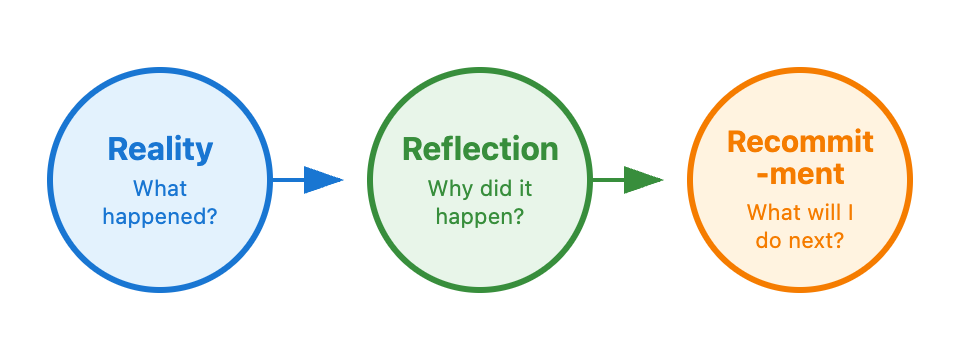
Reality means stating what actually happened without excuse or elaborate explanation. A statement like "The customer analysis promised for March 15th is two weeks behind" beats "Various competing priorities and unexpected complexities in the data infrastructure have created some challenges in delivering the analysis on the originally anticipated timeline". The directness shows you're not hiding from the truth.
Reflection demonstrates that you understand why it happened and what you've learned. A simple acknowledgment like "I underestimated the data cleaning required and didn't build in buffer time" shows insight without self-flagellation. Finally, Recommitment provides specific, dated next actions that rebuild confidence. Clear commitments such as "New delivery date: March 29th. First draft to you March 26th for feedback" give stakeholders something concrete to track.
Here's how this conversation might unfold between a team member and their manager:
- Jessica: Ryan, I need to talk to you about the vendor evaluation project. It's not where it should be.
- Ryan: Okay, what's going on? The last update showed everything was on track.
- Jessica: That's part of the problem. I wasn't being transparent. The reality is the final recommendations are two weeks behind the April 1st deadline.
- Ryan: I see. What happened?
- Jessica: I underestimated how long the vendor demos would take—I scheduled them back-to-back without processing time between them. Also, my email system completely fell apart during the product launch, and I missed two follow-ups that delayed decisions.
- Ryan: I appreciate you being direct about this. What's your plan?
- Jessica: I've already rescheduled the remaining demos with buffer time. I can deliver a preliminary comparison by April 8th—just the data, no narrative yet. Full recommendations with risk analysis by April 12th. And I'm implementing email batching again with calendar blocks to prevent this from happening.
- Ryan: Those dates work. How will I know you're back on track without having to check in constantly?
- Jessica: I'll send you a quick update every Tuesday and Friday—just three bullets: what's done, what's next, any risks. Takes me five minutes, keeps you informed.
- Ryan: Perfect. And Jessica? Thanks for coming to me early instead of trying to fix it alone.
Notice how Jessica uses all three R's—she states the reality bluntly, reflects on what went wrong without excessive self-blame, and provides specific recommitments with conservative dates. Ryan's response shows how transparency actually builds trust rather than eroding it.
Your stakeholder updates must include "to-go" commitments that are both specific and conservative. Rather than promising to "get back on track" or "improve going forward", commit to exact deliverables with dates that you're 90% confident you can hit. The key is to underpromise by 20% on timing—if you think you need five days, say six. If you believe you can deliver three sections, commit to two.
The most successful reboot communications conclude with progress indicators and check-in points that maintain transparency without creating additional overhead. Share how stakeholders will know you're back on track without them having to ask. Consider commitments like "I'll send a brief Friday update each week with: tasks completed, next week's focus, and any emerging risks" or "I've set up a shared tracker showing daily progress on the three delayed deliverables".
In your upcoming roleplay, you'll practice having this vulnerable but confident conversation with your manager, presenting your diagnosis of what went wrong, your concrete replacement behaviors, and your transparent recommitment plan. Through your writing exercises, you'll craft your own behavioral substitution protocols and stakeholder updates that transform setback from career risk into a demonstration of professional maturity.
