Managing Energy for Momentum
Welcome to the Course
Welcome to Sustaining Productive Momentum, where you'll master the art of maintaining peak performance over the long haul. Too often, productivity systems start strong but fade as energy depletes, tools become burdensome, and old habits creep back in. This course equips you with the practical strategies to keep your momentum alive, month after month.
Throughout this course, you will learn to manage your energy as deliberately as you manage your time, discovering how sleep, nutrition, and strategic breaks fuel sustained performance. You'll design and run controlled email experiments that actually stick, measuring what works and codifying wins into simple standard operating procedures. Furthermore, you'll build maintenance cycles that prevent system drift before it happens, and when setbacks inevitably occur, you'll learn to reboot without shame using proven replacement strategies that get you back on track quickly.
As a people manager, these skills are doubly important. Not only will you model sustainable productivity for your team, but you'll also create team norms that respect everyone's energy patterns and working styles. By the end of this course, you'll have a complete toolkit for maintaining productive momentum—for yourself and for those you lead.
Measuring Energy Drivers
Your energy is the foundation of sustained productivity, yet most professionals track their tasks obsessively while ignoring the factors that actually determine whether those tasks get done well. To sustain momentum, you need to become a scientist of your own energy patterns.
Begin by tracking five core energy drivers for at least a week.:
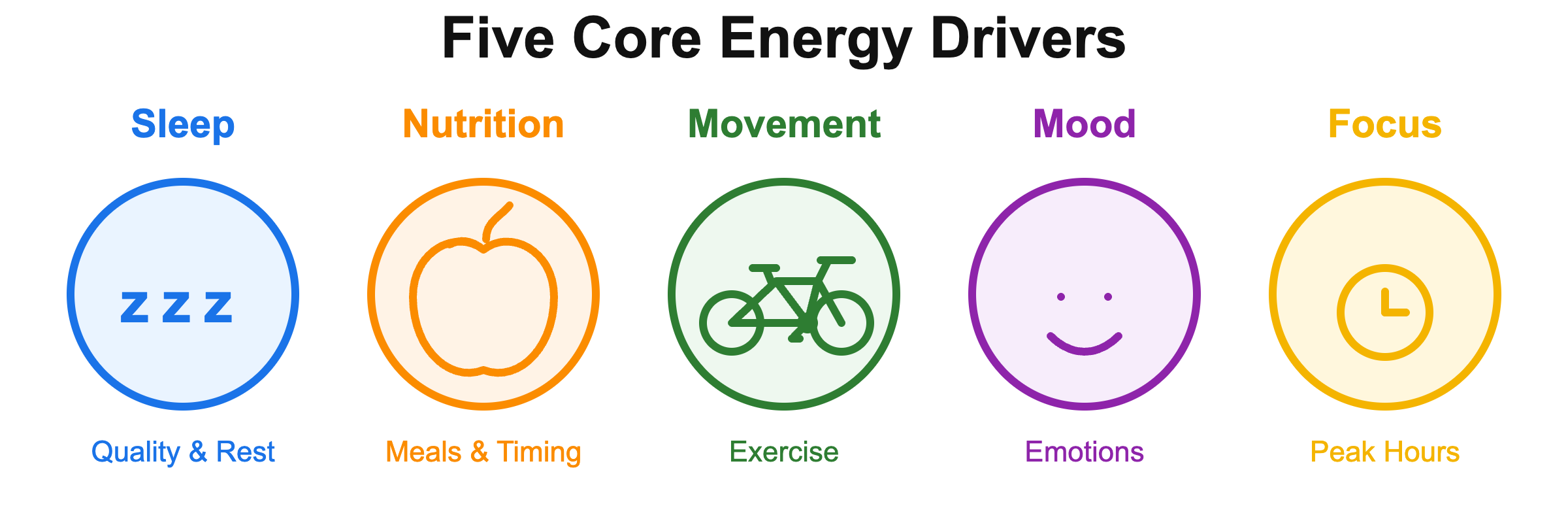
Use a simple scale from 1-10 to rate your energy hourly, noting what happened in the previous hour. You might discover patterns like "After the 10am–2pm meeting marathon, my energy crashes to a 3," or "When I eat protein at lunch instead of pasta, my afternoon focus stays at 8+." In addition, pay attention to your chronotype, or your body's natural rhythm for peak energy. Some folks are sharp at 6am, drafting strategy documents before the day begins, while others hit their stride at 10pm when the office quiets and deep thinking becomes possible. Track when you naturally feel most alert, when complex problem-solving feels easiest, and when you're best at creative work versus routine tasks. This isn't laziness, it's biology. Working with it rather than against it transforms your effectiveness.
The goal isn't perfection but pattern recognition. After a week of tracking, you'll see clear correlations between your inputs and your energy outputs, and these patterns become the foundation for sustainable changes that actually stick.
Defining Sustainable Changes and Recovery Buffers
Once you understand your energy patterns, the temptation is to overhaul everything at once. Resist this urge. Sustainable momentum comes from small, consistent changes that compound over time, not dramatic interventions that flame out after a week.
Choose three energy improvements based on your data, but make them incremental. Instead of committing to exercise for an hour daily, start with walk for 10 minutes after lunch. Rather than pursuing perfect sleep hygiene, begin leaving your phone to charge outside of the bedroom. These micro-changes might seem insignificant, but they build the foundation for lasting transformation.
Recovery buffers are equally crucial for sustainability. These planned periods of lower intensity prevent burnout before it begins, acting as strategic investments in your long-term performance. After completing a major product launch, schedule two days of lighter work—not vacation, but tasks that restore rather than drain. Following international travel, block your first morning back for email and planning rather than critical decisions.
Moreover, build these buffers into your team's rhythm as well. After intensive sprints, plan a documentation week where the pace deliberately slows and the team can consolidate learning. Before major planning cycles, create a clearing week to close out old work and prepare mentally for what's ahead. These buffers aren't luxuries or signs of weakness—they're strategic investments in sustained high performance that prevent the feast-or-famine cycles that plague most teams.
Establishing Group Norms for Scheduling by Chronotype
Your personal energy management means little if your group’s scheduling practices work against natural rhythms. Whether you’re a team member or a manager, you have the opportunity to help create norms that respect diverse energy patterns while maintaining group cohesion.
Start by making energy patterns visible and legitimate within your group culture. Encourage colleagues to share their chronotypes and peak performance windows without judgment or comparison. Create a simple group charter that acknowledges these differences constructively, such as: "Sarah codes best before noon, Mike writes clearly after 3pm, Jennifer problem-solves optimally between 10am-2pm." This isn't about accommodation or special treatment—it's about optimization. When you schedule creative brainstorming during Jennifer's peak window and detailed review during Mike's afternoon clarity, the quality of work measurably improves.
Here's how a conversation about establishing these norms might unfold:
- Jessica: Ryan, I've been tracking my energy patterns and realized our 8am design reviews might not be optimal timing. How's your energy typically in the mornings?
- Ryan: Honestly? I'm not at my sharpest until about 10am. I've been drinking extra coffee to compensate, but I still feel like I miss details.
- Jessica: That's really valuable to know. I'm actually most alert early, but I fade after 3pm. What if we moved the design reviews to 10:30am?
- Ryan: That would be perfect! I could use my early morning for prep work when I don't need peak creativity.
- Jessica: Great. And maybe we can avoid scheduling anything complex for me after 3pm—that's when you could handle the detailed implementation work you mentioned you enjoy.
- Ryan: I love that. It feels like we're working with our natural rhythms instead of fighting them.
Notice how this conversation normalizes discussing energy patterns without judgment, focuses on optimization rather than accommodation, and results in a win-win scheduling arrangement that respects both people's chronotypes.
Next, establish protected time blocks based on these collective patterns. If half your group consists of morning people, consider making afternoons meeting-free for deep work. Conversely, if you have night owls, avoid scheduling critical decisions for 8am when their cognitive resources are at their lowest. One engineering group implemented Maker Morning Mondays where no meetings could be scheduled before noon, allowing their morning-optimal developers uninterrupted coding time. The result was striking—their bug rate dropped by 40%, and satisfaction scores increased significantly.
Finally, create explicit norms around energy transparency that make it psychologically safe to optimize for performance. Make it acceptable and even encouraged for group members to say something like: "I need to shift this to tomorrow morning when I'll be sharper", or "Can we move this review to after 2pm? That's when I'm best at detailed analysis."
A sales team successfully introduced energy check-ins at the start of meetings where each person rates their current energy from 1-10. When multiple people report being below 5, the group either energizes with a quick activity or reschedules complex decisions for a better time. The result has been better decision quality and a culture where people feel genuinely respected and heard.
You're now ready to put these energy management principles into practice. In your upcoming roleplay exercise, you'll negotiate meeting schedules that honor peak performance windows while maintaining business needs. Additionally, in your writing assignments, you'll create concrete energy audit reports and group norms that transform these concepts into daily reality, setting the foundation for sustained productive momentum.
