Narrative Arcs and Storytelling
Narrative Arcs and the Story Spine
In the previous lesson, you learned two powerful frameworks—Why-What-How and PREP—that give your messages a clear logical structure. Those frameworks are your foundation, and they will serve you well in countless professional moments. But here is something every experienced people manager eventually discovers: logic alone does not make people care. You can lay out a flawless argument with perfect structure, and your audience might nod along politely while their minds drift to their next meeting. What locks a message into memory—what makes people feel it—is story.
Throughout this unit, you will learn how to layer narrative into your structured messages so that your ideas do not just make sense; they stick. You will master a simple storytelling spine that transforms dry data into something human, practice building micro-stories that bring abstract ideas to life, and assemble a toolkit of hooks that capture attention from your very first sentence. By the end, you will have the narrative skills to make any message memorable.
Using the "Once-Then-Because" Spine to Humanize Data
Great stories—from fairy tales to boardroom case studies—follow a remarkably consistent pattern. Something is true, then something changes, and because of that change, a new reality emerges. This is the "Once-Then-Because" spine, and it is the simplest way to turn flat information into a narrative your listeners can follow and feel.
The structure works like this. Once describes the starting situation—the way things were. Then introduces a change, a challenge, or a turning point. Because connects that change to a meaningful outcome or insight. When you string these three beats together, you create a tiny arc of tension and resolution that mirrors how humans naturally process experience.
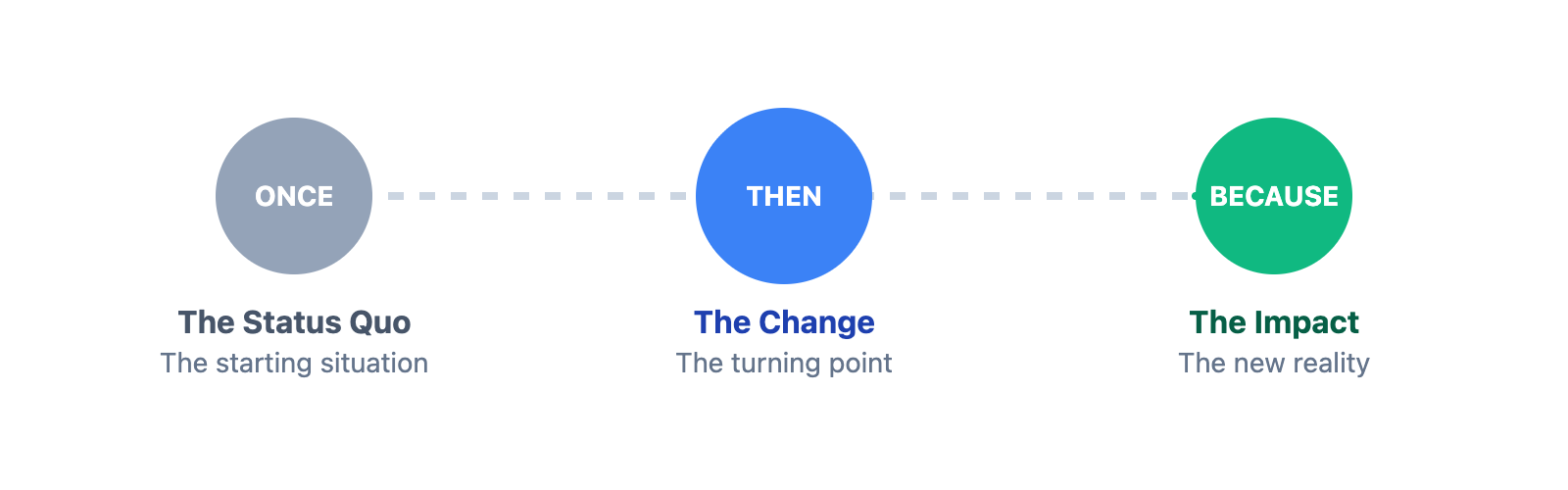
Consider how differently the same data lands when it is delivered as a fact versus a story. You could say, "Our onboarding completion rate improved by 22% this quarter." That is clear, but it is also forgettable. Now apply the spine: "Once, nearly a third of our new hires were dropping off before finishing onboarding—they felt overwhelmed and unsupported. Then we redesigned the first week to include daily check-ins with a buddy. Because of that change, our completion rate jumped by 22%, and new hires started reporting they felt welcomed instead of lost." The data is identical. The impact is not even close.
To see this transformation in action, imagine the following exchange between two people managers preparing for a quarterly review:
- Natalie: I need to present our team's engagement results tomorrow, but every time I share survey data it feels like people just tune out. I was going to open with, "Employee engagement scores rose from 68 to 81 this quarter."
- Dan: That's a solid number, but try running it through the Once-Then-Because spine. Start with what the situation used to look like—make them feel the problem first.
- Natalie: Okay, let me try. "Once, our team's engagement scores were stuck at 68—people told us in one-on-ones that they felt disconnected from the bigger picture and didn't see how their work mattered. Then we introduced monthly strategy sessions where every person could see how their projects tied to company goals. Because of that shift, engagement climbed to 81, and three people specifically cited those sessions as a turning point in how they felt about their roles."
- Dan: That's night and day. You just turned a number on a slide into something the room can actually feel. They'll remember the story long after they forget the score.
Notice how Natalie's revised version hits all three beats of the spine. The Once paints a picture of disconnection that the audience can empathize with. The Then introduces a specific, tangible change. The Because ties it all together with both the data and the human impact. Her original statement was accurate; her revised version is unforgettable.
As a people manager, you are constantly communicating results, justifying decisions, and explaining change. The Once-Then-Because spine gives you a way to do all of that while making your audience feel like they are inside the experience rather than observing it from a distance. You are not abandoning logic; you are wrapping logic in a human container. The next time you need to share a metric in a team meeting or a stakeholder update, challenge yourself to build a thirty-second narrative around it using this spine. You will notice people leaning in instead of checking their phones.
Crafting Micro-Stories to Make Abstract Concepts Relatable
Not every story needs to be a sweeping narrative. In fact, for day-to-day management communication, shorter is almost always better. A micro-story is a brief, specific anecdote—typically three to five sentences—that illustrates an abstract concept by grounding it in a real moment with real people and real stakes.
The key to a strong micro-story is specificity. Vague stories feel generic and forgettable, while detailed ones create mental pictures that linger. Compare "A team member once struggled with a project and then figured it out" to "Last March, Priya was two days from a deadline and realized the client's requirements had shifted entirely. She called an emergency sync, rebuilt the scope in one afternoon, and delivered on time." The second version works because it has a who, a when, a tension, and a resolution. Those concrete details are what allow your listener's brain to construct a vivid mental image—and images are far stickier than abstractions.
As a people manager, you encounter micro-story material every single week. Someone on your team overcomes a blocker. A process change produces an unexpected result. A piece of feedback transforms someone's approach. These moments are not just anecdotes—they are communication assets. When you need to explain why psychological safety matters, do not define it; tell the thirty-second story about the time a junior team member spoke up in a retrospective and saved the team from repeating a costly mistake. Similarly, when you need to advocate for investing in professional development, do not recite statistics; share the moment one of your direct reports applied a new skill and closed a deal that had been stalling for weeks.
A practical habit that will serve you well is keeping a running list—even just a note on your phone—of moments that made you think, "That's a good example." Over time, you build a personal library of micro-stories you can pull from whenever a conversation calls for one. The best communicators are not people who invent stories on the spot; they are people who notice stories as they happen and file them away for the right moment.
The "Hook Toolkit": Stats, Questions, and Images
Every message has a critical first few seconds. If you do not capture attention early, even a beautifully structured narrative will go unheard. This is where the Hook Toolkit comes in—three reliable types of opening moves that interrupt your listener's autopilot and pull them into your message.
The first type is the startling stat. Numbers that surprise or challenge assumptions create an immediate itch of curiosity. For example, opening a team discussion about meeting culture with "We spent a combined 340 hours in meetings last quarter—that's the equivalent of two full-time employees doing nothing but sitting in conference rooms" forces your audience to reckon with a reality they may have been ignoring. The stat does not need to be shocking for its own sake; it needs to reframe something familiar in a way that makes people think, "I didn't realize that."
The second type is the provocative question. A well-placed question shifts your audience from passive listeners to active thinkers. Instead of opening a feedback conversation with a statement, you might begin with "When was the last time someone gave you feedback that actually changed the way you work?" The moment a question is asked, your listener's brain cannot help but start searching for an answer—and that search keeps them engaged as you deliver the rest of your message. The most effective questions are ones your audience cannot answer instantly, because the brief moment of uncertainty is what holds their attention.
The third type is the vivid image. This is a brief, sensory description that paints a picture in your listener's mind. You might open a presentation on burnout by saying, "Imagine opening your laptop on a Monday morning and feeling a knot in your stomach before a single email has loaded." You have not cited a study or asked a question—you have placed your audience inside a feeling. Vivid images work because they bypass analytical processing and land directly in emotional memory, which is exactly where lasting impressions are formed.
You do not need to use all three hooks at once. The real skill is in matching the hook to the moment. A data-driven audience may respond best to a startling stat. A team that is emotionally fatigued may need to feel seen through a vivid image. A room full of senior leaders who think they already know the answer may be best served by a question that cracks open their certainty. As you grow more comfortable with these tools, you will start instinctively sensing which hook fits—and your opening lines will become the part of your message people remember most.
With a storytelling spine, a library of micro-stories, and a toolkit of hooks at your disposal, you are now equipped to make any message feel human, memorable, and compelling. In the upcoming role-play session, you will put these skills to work by sharing a brief micro-story with a peer—practicing how to build a clear beginning, middle, and end that brings a real work experience to life. Get ready to tell your story.
