Message Sprints and Signposting
Message Sprints and Signposting
In the previous lesson, you learned how to bring your words to life through vocal color—pitch, pace, volume, pauses, and clean delivery. You now have both the structural frameworks from earlier lessons and the vocal tools to deliver them with impact. But there is one challenge every people manager faces that we have not yet addressed: what do you do when you have almost no time to prepare? Whether you are pulled into an impromptu leadership sync, asked to summarize a complex initiative on the spot, or given three minutes before a town hall to organize your thoughts, you need a system for rapid, clear message assembly. That is exactly what this unit delivers. You will learn the 3-Minute Message Sprint for lightning-fast preparation, verbal signposts that keep your audience oriented no matter how complex the topic, and the art of distilling big ideas into sticky phrases people actually remember.
Rapid Preparation: The 3-Minute Message Sprint
The 3-Minute Message Sprint is a disciplined, timed routine that transforms scattered thoughts into a structured message before you even open your mouth. It works by dividing your prep into three one-minute blocks. In Minute 1, you answer one question: What is the single thing I need my audience to walk away knowing? Write that down in one sentence—this is your core message. In Minute 2, you identify two or three supporting points that back up that core message, whether they are reasons, examples, or data points. Then in Minute 3, you decide on your opening hook and your closing line, giving your message a clear beginning and end that frame everything in between.
The beauty of this method is that it forces you to prioritize ruthlessly. As a people manager, you often have more information than your audience needs, and the temptation is to share all of it. The sprint prevents that by making you commit to a single core message first. For example, if your VP asks you to brief the leadership team on your department's hiring progress, your Minute 1 sentence might be: "We are on track to fill all five roles by end of quarter, with two offers already accepted." Everything else you say exists to support that one line. The sprint is not about perfection—it is about arriving at the microphone with a clear direction instead of a foggy collection of thoughts.
Here is what the sprint looks like when a people manager uses it in real time:
- Natalie: I just got pulled into the ops review in five minutes. They want an update on the onboarding redesign and I have nothing prepared.
- Dan: Okay, let's sprint it. Minute 1—what is the one thing they need to walk away knowing?
- Natalie: That the new onboarding flow launches August 1st and will cut ramp-up time by two weeks.
- Dan: Perfect, that is your core message. Minute 2—give me two supporting points.
- Natalie: We have already piloted it with one cohort and the feedback scores jumped 30 percent. Plus, the training team signed off on the final materials last Friday.
- Dan: Great. Minute 3—open with the pilot result as your hook, and close by restating the August 1st date. You are ready.
Notice how Dan guided Natalie through the entire sprint in well under three minutes. She walked into that meeting with a single clear message, two pieces of evidence, and a strong opening and close—all built from scratch in a handful of sentences. That is the power of the sprint: it replaces panic with structure.
Using Verbal "Road-Signs" to Keep the Audience Oriented
Even a well-structured message can lose an audience if listeners cannot tell where they are inside it. Verbal signposts are short transitional phrases that act like road signs on a highway—they tell your audience what just happened, what is coming next, and how the pieces connect. Without them, your listener has to work hard to follow your logic. With them, you do that work for the listener, which is one of the most generous things a people manager can do in any meeting:
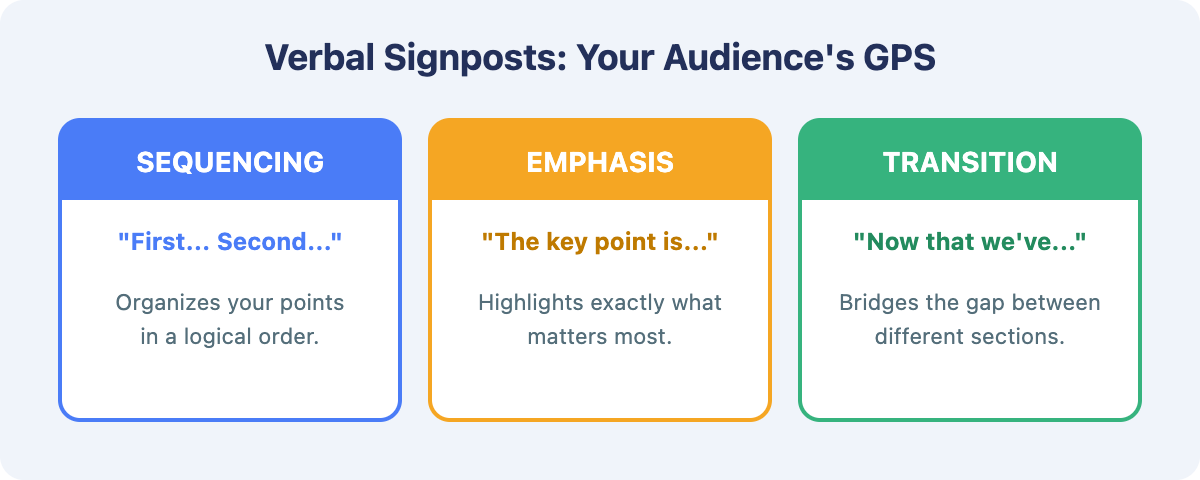
The most useful signposts fall into three natural categories that you can start using immediately. Sequencing signposts organize your points in order, using phrases like "First," "Second," and "Finally." Emphasis signposts tell the audience to pay extra attention, such as "The most important thing here is..." or "If you remember nothing else, remember this." Transition signposts bridge between sections, with phrases like "Now that we've covered the timeline, let's talk about resources" or "That was the problem—here is our solution." A particularly effective practice is to announce your structure up front. Opening with something like "I want to cover three things: where we are, where we're going, and what I need from you" gives your team a mental map before you even begin. Each time you hit a new section, a quick signpost like "That brings me to point two" reorients everyone instantly.
Think of signposting as a kindness to your listeners' working memory. In a busy team standup or a cross-functional review, people are juggling their own thoughts while trying to track yours. A simple "The bottom line is..." before your closing recommendation snaps attention back to what matters most and ensures your core message lands clearly, even if someone drifted for a moment in the middle.
Synthesizing Complex Ideas into Sticky Phrases
As a people manager, you regularly translate complex strategies, process changes, and performance data into language your team can act on. The final skill in this course is synthesis—the ability to compress a big idea into a short, memorable phrase that people carry with them long after the meeting ends. A sticky phrase is not a slogan invented for fun; it is a thinking tool that helps your team make decisions when you are not in the room.
The best sticky phrases share a few important traits. They are short, ideally under ten words. They use concrete language instead of jargon. And they often employ rhythm, contrast, or repetition to lodge in memory. For instance, instead of saying "We need to ensure that speed does not come at the expense of quality," you might synthesize that into "Fast is good; broken is not." Similarly, instead of a paragraph about your team's quarterly focus, you could distill it to "Three roles, three months, zero compromises." These phrases become verbal shorthand your team can repeat in their own conversations, extending your message far beyond the original meeting.
To create your own sticky phrases, try the "Say It in Seven" exercise: take your core message and challenge yourself to express it in seven words or fewer. It will feel reductive at first, but that compression forces clarity. If you cannot say it simply, you may not fully understand what you are trying to communicate—and that is valuable feedback in itself. Combined with the sprint, signposts, and every framework you have built throughout this course, sticky phrases give your communication a lasting footprint. In the upcoming role-play session, you will put all of this together by explaining a multi-step process using clear signposts and a concise closing phrase that ties it all together. Get ready to make every word count.
