Aligning Measurement and Execution
The Alignment of Measurement and Execution
You've done the strategic work: channels prioritized, content architected, touchpoints orchestrated into one experience. None of it survives contact with the quarter unless two things happen. You have to prove the program worked, including the parts that don't show up in a last-click report, and you have to hand the strategy to sales, customer success, and leadership in a form they'll actually run. This unit is about closing that gap.
Measure both the direct and the indirect
Here's the trap to avoid: reporting only what's cleanly trackable. A demo request tied to a paid ad is direct influence, easy to count and easy to defend. But the analyst mention, the community thread, and the three nurture emails that made that click possible are indirect influence, and if your measurement ignores them, you'll defund the very touchpoints that fed the pipeline. A Measurement Strategy that captures both is your protection.
The move is to pair metrics rather than pick one. For each funnel stage, report a direct conversion metric alongside an indirect signal that shows contribution without overclaiming. Problem recognition pairs a content conversion with engagement reach; consideration pairs demo requests with influenced pipeline; decision pairs close rate with sales-cycle velocity. Label each honestly so no one thinks you're inventing credit.
- Ryan: Leadership wants one number: demo requests from paid. Everything else is noise.
- Jessica: That number is real, but it credits the last click and erases the analyst mention and the community thread that got them there.
- Ryan: So how do we show those without sounding like we're inventing credit?
- Jessica: Pair them. Report the direct conversion next to an indirect signal for the same stage, like influenced pipeline, and label each honestly.
- Ryan: So finance keeps its clean number, and we still make the invisible touches visible.
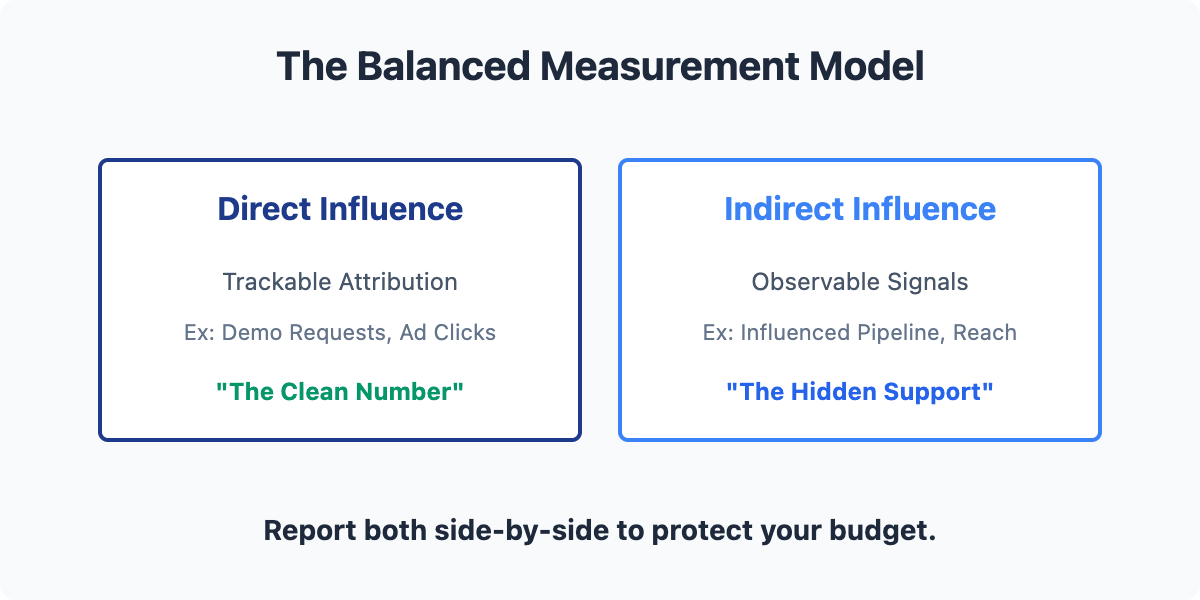
Notice Jessica doesn't fight the clean number. She adds a second column beside it. That's how you defend indirect influence without looking like you're spinning.
Integrate with sales, customer success, and growth planning
Demand generation doesn't hand off to a void. Every stage you built connects to another team, and Organizational Alignment means naming those interfaces before the quarter starts instead of arguing about them mid-quarter.
Work each seam concretely. With sales, define the lead follow-up commitment (who acts on what signal, how fast) and a shared pipeline-health review so a stalled cohort surfaces to both teams at once. With customer success, define the expansion motion: which post-purchase signals demand generation nurtures versus which CS owns, so retention and expansion don't fall between you. With growth planning, tie your demand targets to the quarterly goals leadership already committed to, so your program reads as a contribution to revenue rather than a parallel marketing agenda.
The deliverable isn't a philosophy of collaboration. It's a short answer to "who owns what, and when do we sync." Name an owner for each shared responsibility and set the operating rhythm, weekly or biweekly, where the interface actually gets worked.
Translate the strategy into an execution and optimization plan
The last step is converting frameworks into something a team can run on Monday. Strategic Implementation Readiness means four things are explicit: priorities (what gets done first when time is short), named owners (a person, not a team), feedback loops (how signal flows back so you learn in-flight), and adjustment triggers (the specific number that prompts a course correction before the quarter ends).
The adjustment trigger is the piece most plans skip. Decide in advance what would make you change course: if consideration-to-demo conversion drops below a set threshold by week four, you reallocate budget rather than waiting for the post-mortem. A plan without triggers isn't a plan, it's a hope.
The single takeaway: strategy becomes results only when measurement makes both direct and indirect impact visible, every cross-functional seam has a named owner and a rhythm, and the execution plan carries explicit triggers for changing course. Ahead, you'll first spot-check whether you can classify measurement and alignment scenarios correctly, then draft an executive-ready alignment plan you could actually put in front of leadership, and finally defend how that plan becomes real execution in a live review. Before that, try writing down the one number that would make you change course this quarter, and who would make the call.
