Substituting Fractional Expressions
Introduction
Welcome back to Solving Systems by Substitution — we are on lesson four of five, so the finish line is within reach! In the previous lesson, we practiced isolating variables whose coefficients are not or , producing fractional expressions such as . We carefully divided every term by the coefficient to keep the equation equivalent. But building the expression was only half the job. In this lesson, we will substitute that fractional expression into the second equation and carry fractions accurately through the entire solving process: distributing, clearing denominators, back-substituting, and verifying.
From Isolation to Substitution
The substitution workflow has a clear rhythm you have practiced since lesson one: isolate a variable, replace it in the other equation, solve, back-substitute, and verify. When the isolated expression was something clean like , the arithmetic after substitution stayed straightforward. Now that we can isolate variables with any coefficient, the expression we plug in may contain fractions.
The algebra does not change, but the arithmetic requires two additional moves. First, we need to distribute the second equation's coefficient through the fractional expression. Second, we can multiply every term by the denominator to clear fractions before solving. These two skills are the focus of this lesson.
Substituting a Fractional Expression
In the previous lesson, we isolated from and arrived at:
Now let's pair it with a second equation to form a system:
To substitute, we replace in the second equation with the entire fractional expression, wrapping it in parentheses:
Next, distribute the to every term inside the parentheses:
Notice that . The fraction does not vanish; it simply picks up a new numerator. Parentheses and careful distribution ensure that no term is left behind.
Clearing Fractions and Solving
The equation still contains a fraction, which can make combining like terms awkward. A powerful technique is to multiply every term on both sides by the denominator to eliminate the fraction entirely. Here the denominator is :
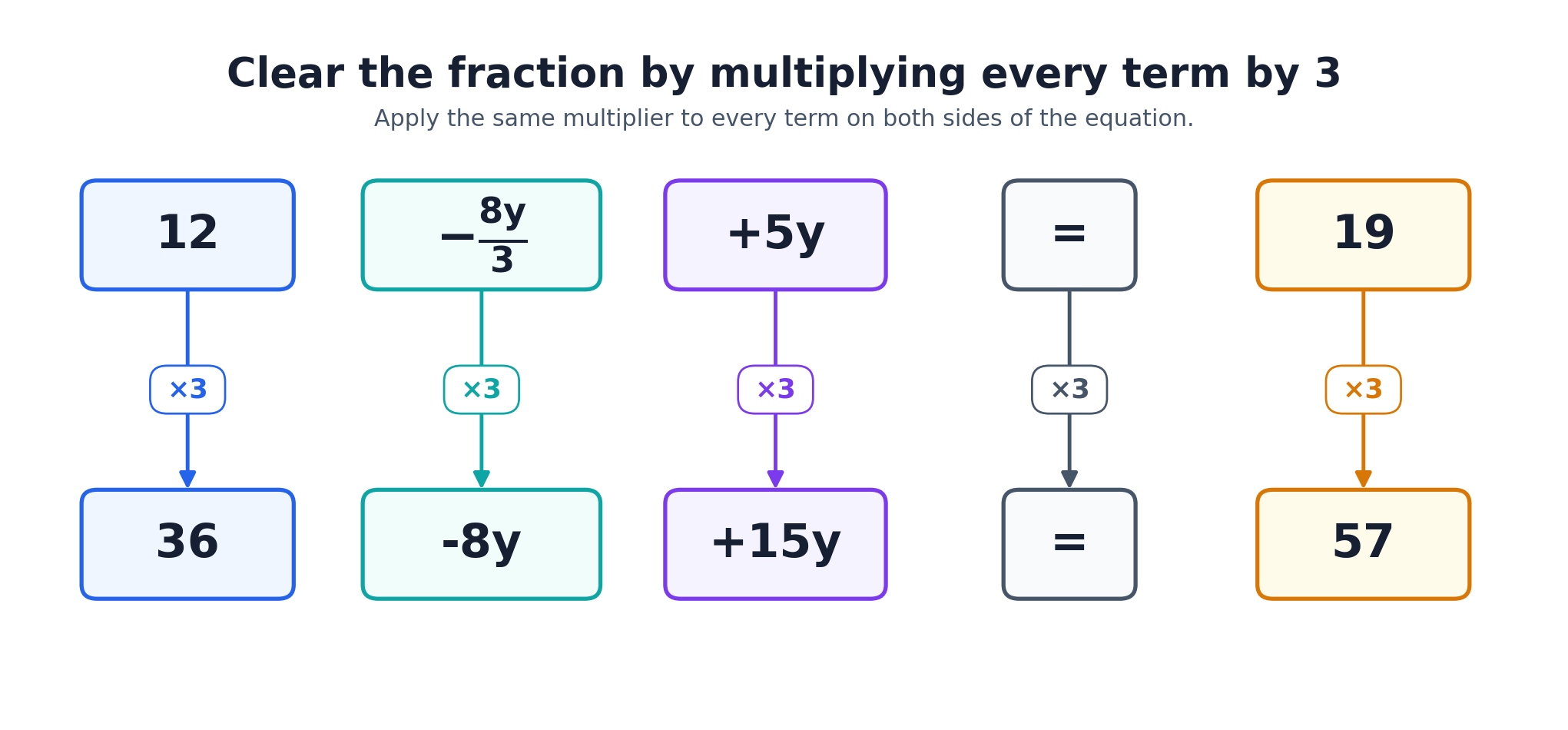
Now the equation is fraction-free. Combine like terms and solve:
The key rule when clearing fractions is the same one we stressed in the previous lesson: every term must be multiplied by the same number. Skipping even one term breaks the equality.
