You have reached the midpoint of Solving Systems by Substitution — this is lesson three of five! In the first two lessons, we built the complete substitution workflow and practiced isolating variables whose coefficients were 1 or −1, which kept everything neat because no division was required. But not every system is so accommodating. What happens when every coefficient in sight is something like 2, −3, or 5? In this lesson, we will learn how to isolate a variable whose coefficient forces a fraction into the expression. Mastering this step now will prepare us to handle tougher substitutions in the next lesson.
When Fractions Become Unavoidable
In the previous lesson, we scanned both equations for a coefficient of 1 or −1 because isolating those variables involved only addition or subtraction — no division needed. Not every system offers that shortcut. Consider:
2x+5y=163x−4y=7
The coefficients are 2, 5, 3, and −4. None of them is 1 or −1, so no matter which variable we choose to isolate, we will need to divide by a coefficient other than one. That division introduces fractions into our expression. The good news? Fractions do not change the correctness of the algebra — they just demand a bit more care, and that care is exactly what this lesson teaches.
The Core Rule: Divide Every Term
When we isolate a variable whose coefficient is not 1 or −1, we first move the other variable's term to the opposite side and then divide both sides by the coefficient. The rule to remember is simple: every term on both sides must be divided by that coefficient. Let's see this in action.
Suppose we want to isolate x in:
3x+4y=18
First, subtract 4y from both sides:
3x=18−4y
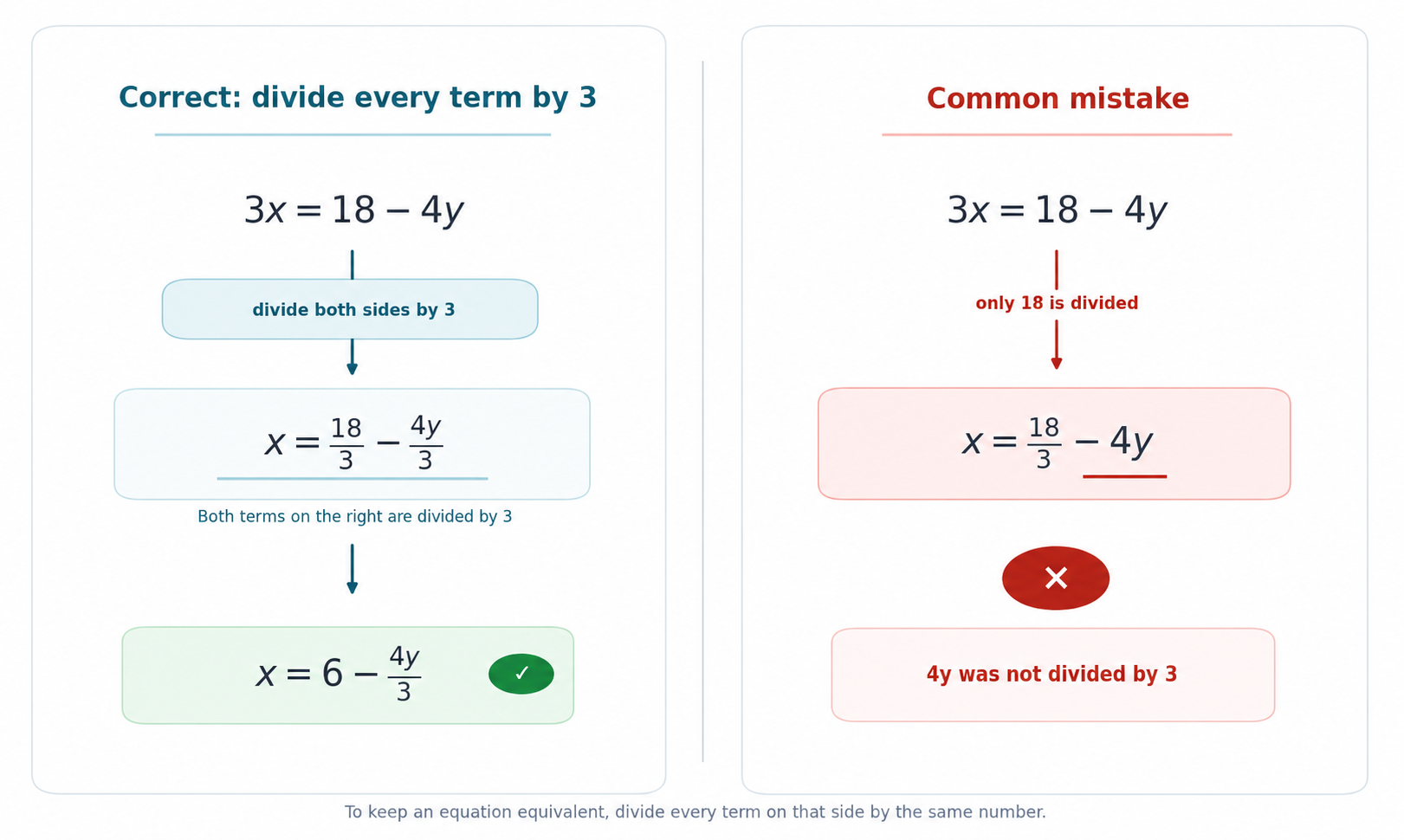
Now divide every term on both sides by 3:
x=318−34y
Simplify wherever possible:
x=6−34y
The fraction 34y stays as is because 4 is not evenly divisible by 3, and that is perfectly fine. This expression is equivalent to the original equation and ready to be used in substitution.
A very common mistake is dividing only the constant while leaving the other term untouched. Writing x=6−4y would be incorrect because the 4y term was never divided by 3. Every term must go through the same division.
Join the 1M+ learners on CodeSignal
Be a part of our community of 1M+ users who develop and demonstrate their skills on CodeSignal
Let's slow down and isolate y from 5x+2y=14 using a repeatable three-step process.
Step 1 — Move the other variable's term. Subtract 5x from both sides:
2y=14−5x
Step 2 — Divide every term by the coefficient of y. The coefficient is 2:
y=214−25x
Step 3 — Simplify where possible.
y=7−25x
The constant 214 simplified neatly to 7, but 25x cannot be reduced further because 5 and 2 share no common factor. That is our final, correct fractional expression.
To double-check, multiply every term by 2 to see if we recover the equation we started with: 2y=14−5x, which rearranges to 5x+2y=14. It matches, so the isolation is correct.
The same three-step process applies when the coefficient is negative, but we need to track signs with extra attention. Let's isolate y from:
4x−3y=15
Step 1 — Move the other variable's term. Subtract 4x from both sides:
−3y=15−4x
Step 2 — Divide every term by −3.
y=−315−−34x
Step 3 — Simplify and clean up signs.
−315=−5
−−34x=+34x (a negative divided by a negative is positive)
Putting it together:
y=−5+34x
We can reorder if we prefer the variable term first:
y=34x−5
Both forms are correct. The important thing is that each sign ended up where it belongs. With negative coefficients, it helps to evaluate each division separately and confirm the resulting sign before combining terms.
You might wonder why dividing every term still gives a true equation. The answer comes from the division property of equality: if two quantities are equal, dividing both by the same nonzero number keeps them equal.
When we wrote −3y=15−4x, the left side and the right side were equal. Dividing both entire sides by −3 maintains that balance. Because the right side contains two terms, each term must be included in the division. Skipping a term would mean dividing only part of one side, which breaks the equality.
Think of it with a practical analogy: if you have $15 in bills and coins and you want to split everything equally among 3 people, you cannot hand each person $5 from the bills and leave the coins undivided. Every piece of the total must go through the same split. Equations work the same way.
To see this isolation skill in a practical setting, imagine you are planning a school fundraiser where adult tickets cost a dollars each and child tickets cost c dollars each. Your team sells 5 adult tickets and 3 child tickets for a total of $40:
5a+3c=40
Suppose you want to express the adult ticket price in terms of the child ticket price. Isolate a using our three steps.
Step 1 — Move the other term. Subtract 3c from both sides:
5a=40−3c
Step 2 — Divide every term by 5:
a=540−53c
Step 3 — Simplify.
a=8−53c
The expression a=8−53c tells us exactly how the adult ticket price relates to the child ticket price for this particular sale. Even though 53c looks less tidy than a whole number, the equation is perfectly valid. In the next lesson, we will learn how to plug expressions like this into a second equation to find the actual prices.
Here are the most frequent errors learners encounter when isolating a non-unit-coefficient variable:
Dividing only one term. Given 3x=12−5y, writing x=4−5y forgets to divide 5y by 3. The correct result is x=4−35y.
Losing a sign during division by a negative. Given −2y=8−6x, writing y=4−3x ignores the negative divisor. Dividing each term by −2 gives y=−4+3x.
Flipping only one sign instead of all. When dividing by a negative number, every term's sign changes. If only one term flips, the expression is wrong.
A reliable self-check is to multiply your final expression back by the original coefficient. If you recover the equation you started with, your isolation is correct.
In this lesson, we extended our rearranging skills to variables with coefficients other than 1 or −1. The process follows three clear steps: move the other variable's term to the opposite side, divide every remaining term by the coefficient, and simplify. When that coefficient is negative, each resulting term picks up a sign change. As long as every term goes through the division, the new fractional expression is fully equivalent to the original equation.
Up next, the practice exercises will take you from matching equations to their correct fractional forms, through guided fill-in tasks, all the way to writing your own isolations from scratch — including those tricky negative coefficients. Once you feel confident producing these fractional expressions, you will be ready for the next lesson, where we put them to work inside a full substitution solve.