Discounts and Sale Prices
Introduction
Welcome to Shopping and Spending with Percentages, your second course in this learning path! In the first course, you built a strong foundation with percent conversions, benchmark mental math, and the three core percent problem types. Now we put those skills to work in real shopping and spending situations.
This first lesson focuses on one of the most common uses of percentages you will encounter: calculating discounts and sale prices. By the end, you will be comfortable finding how much you save and what you actually pay when a store offers a percent off.
What Does "Percent Off" Mean in a Store?
Before we jump into calculations, let's make sure the idea behind a discount is crystal clear. When a store tag reads "25% off," it means the store is removing 25 out of every 100 units of currency from the original price. As you may recall from previous lessons, a percent is simply a number out of 100, so "25% off" tells us exactly what fraction of the price is being taken away.
This leads to two natural questions every shopper wants answered:
- How much money do I save? (the discount amount)
- How much do I actually pay? (the sale price)
We will learn two methods that answer both questions, and you can pick whichever feels more natural for a given situation.
Method 1: Subtract the Discount
The most straightforward approach has two short steps. First, find the discount amount by multiplying the original price by the discount percent written as a decimal. Then, subtract that discount from the original price to get the sale price.
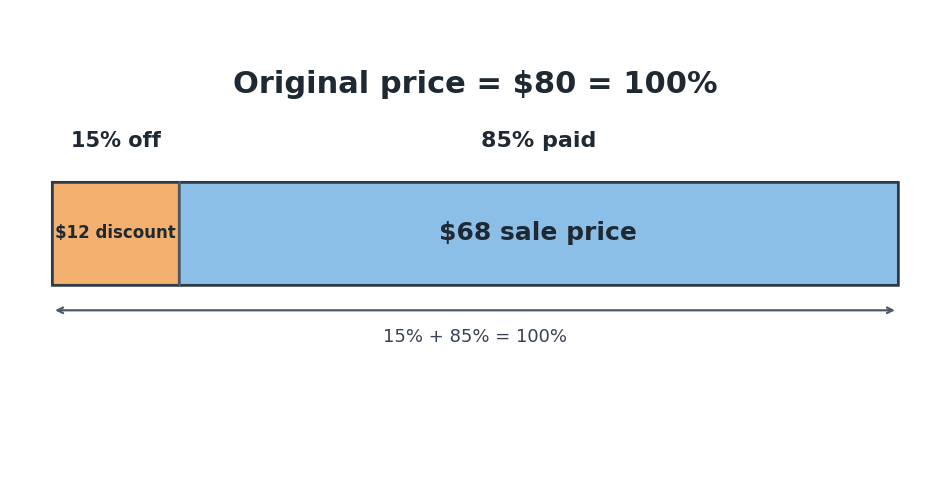
Let's walk through an example. A jacket is priced at $80 and the store is running a 15% off sale.
Step 1 — Discount amount:
The discount saves us $12.
Step 2 — Sale price:
We pay $68 for the jacket. That's it — one quick multiplication and one subtraction.
Method 2: The Remaining-Percent Shortcut
Here is another way to think about the same problem. If a store takes 15% off, that means we are paying the remaining 85% of the price. We can jump straight to the sale price in a single step by multiplying the original price by that remaining percent.
Using the same $80 jacket:
We land on $68 right away, matching our earlier answer. This shortcut is especially handy when you only need the final price and don't care about the dollar amount saved separately.