Organizing Sample Spaces
Introduction
Great to see you at the final lesson of Sharpening Probability Basics! Over the previous three lessons, we built a solid toolkit: calculating single-event probability, applying the complement rule, and using the multiplication principle to count outcomes in multi-step processes. Now we take the next natural step and learn how to organize and display every outcome of a two-step experiment, so that we can spot exactly which outcomes meet a given condition.
Beyond Just Counting
In the previous lesson, we used the multiplication principle to find the total number of outcomes without writing them all down. That shortcut is powerful, but sometimes the total alone is not enough. If someone asks, "How many outcomes include at least one Heads?" or "Which combinations feature a vegetarian option?", we need to see each outcome individually to answer the question.
This is where an organized sample space becomes essential. A sample space is the complete set of all possible outcomes for an experiment. For two-step experiments, we can build it systematically using an ordered list or a table, ensuring nothing is skipped or repeated.
Think of the multiplication principle as telling you the size of the puzzle, and an organized sample space as laying out every piece so you can examine them one by one.
Building a Sample Space with an Ordered List
Organizing Outcomes in a Table
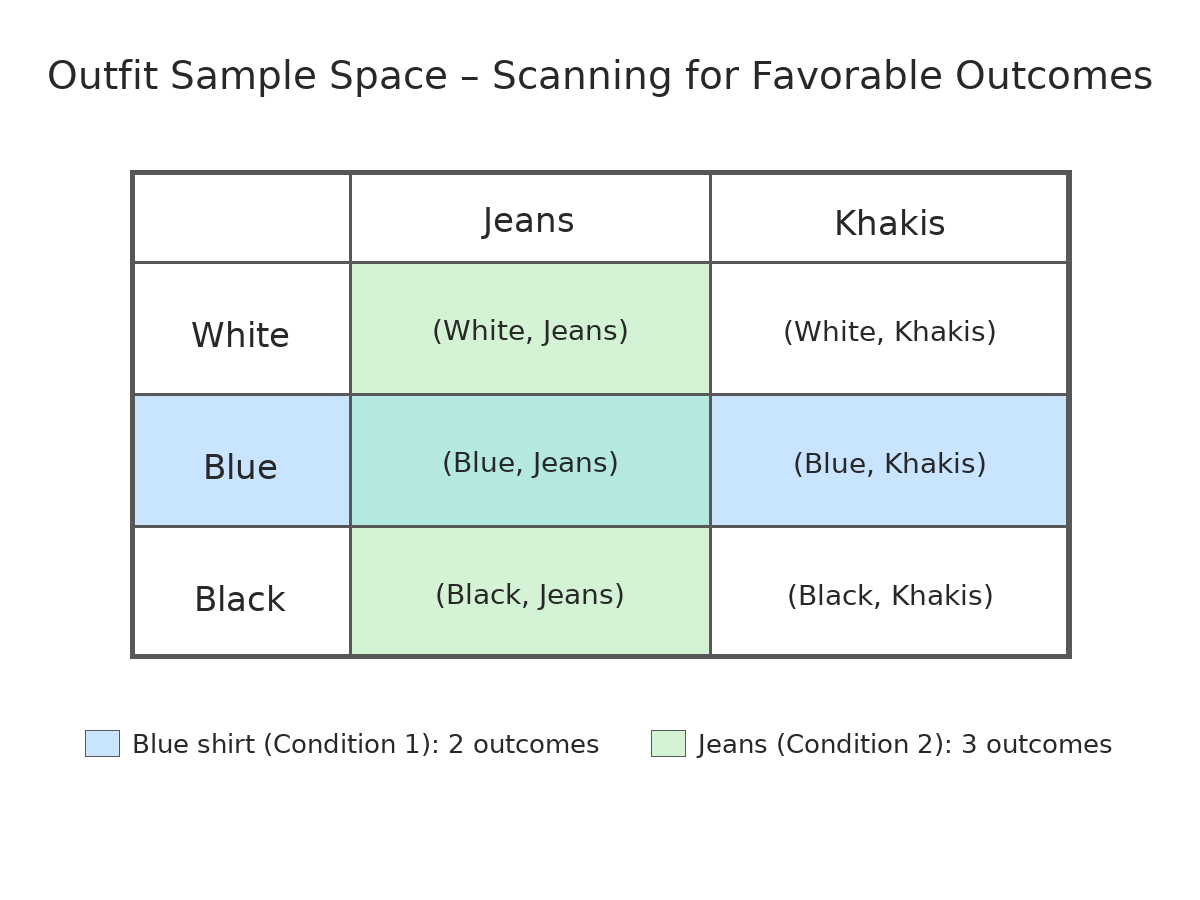
For two-step experiments, a table (or grid) can be even more convenient than a list. We place the options for one step along the rows and the options for the other along the columns. Each cell then represents one unique outcome.
| Red | Blue | Green | |
|---|---|---|---|
| H | (H, Red) | (H, Blue) | (H, Green) |
| T | (T, Red) | (T, Blue) | (T, Green) |
The same 6 outcomes appear, but now they are arranged so we can scan an entire row or column at a glance. This visual layout will prove especially handy when we need to find outcomes that satisfy a specific condition.
Why might you prefer a table over a list? A table makes patterns jump out. Need every outcome that includes "Blue"? Just read down the Blue column. Need every outcome starting with "H"? Read across the H row. With a plain list, you would have to check each entry one at a time.
Using the Sample Space to Count Favorable Outcomes
Connecting Counts to Probability
Conclusion and Next Steps
In this lesson, we moved from merely counting outcomes to listing every single one using organized methods. Whether we choose an ordered list or a table, the core strategy is the same: fix one step, cycle through the other, and make sure every combination appears exactly once. Once the full sample space is laid out, finding outcomes that meet a condition and computing their probability becomes a simple matter of scanning and dividing.
Up next, the practice exercises will have you completing partially built tables, constructing sample spaces from scratch for real-world scenarios like café orders and commute plans, and using those spaces to count favorable outcomes and compute probabilities. This is your chance to turn the strategy into a habit — jump in and see how organized thinking makes two-step probability feel almost effortless!