Welcome back to Sharpening Probability Basics! You have already covered two of the four lessons in this course. In the first lesson, we reviewed how to calculate single-event probability by comparing favorable outcomes to total outcomes. In the second, we learned the complement rule for finding the probability that an event does not happen. Now, in this third lesson, we shift gears and tackle a question that sits behind many probability calculations: how do we count the total number of possible outcomes when a process has more than one step?
By the end of this lesson, you will be able to use the multiplication principle to quickly determine outcome totals for multi-step processes. You will also see why those totals can get surprisingly large with just a few added steps.
From One Step to Many
So far, our examples have involved a single action: rolling one die, drawing one card, or picking one raffle ticket. In those cases, listing every outcome was straightforward. But real life is rarely a single step.
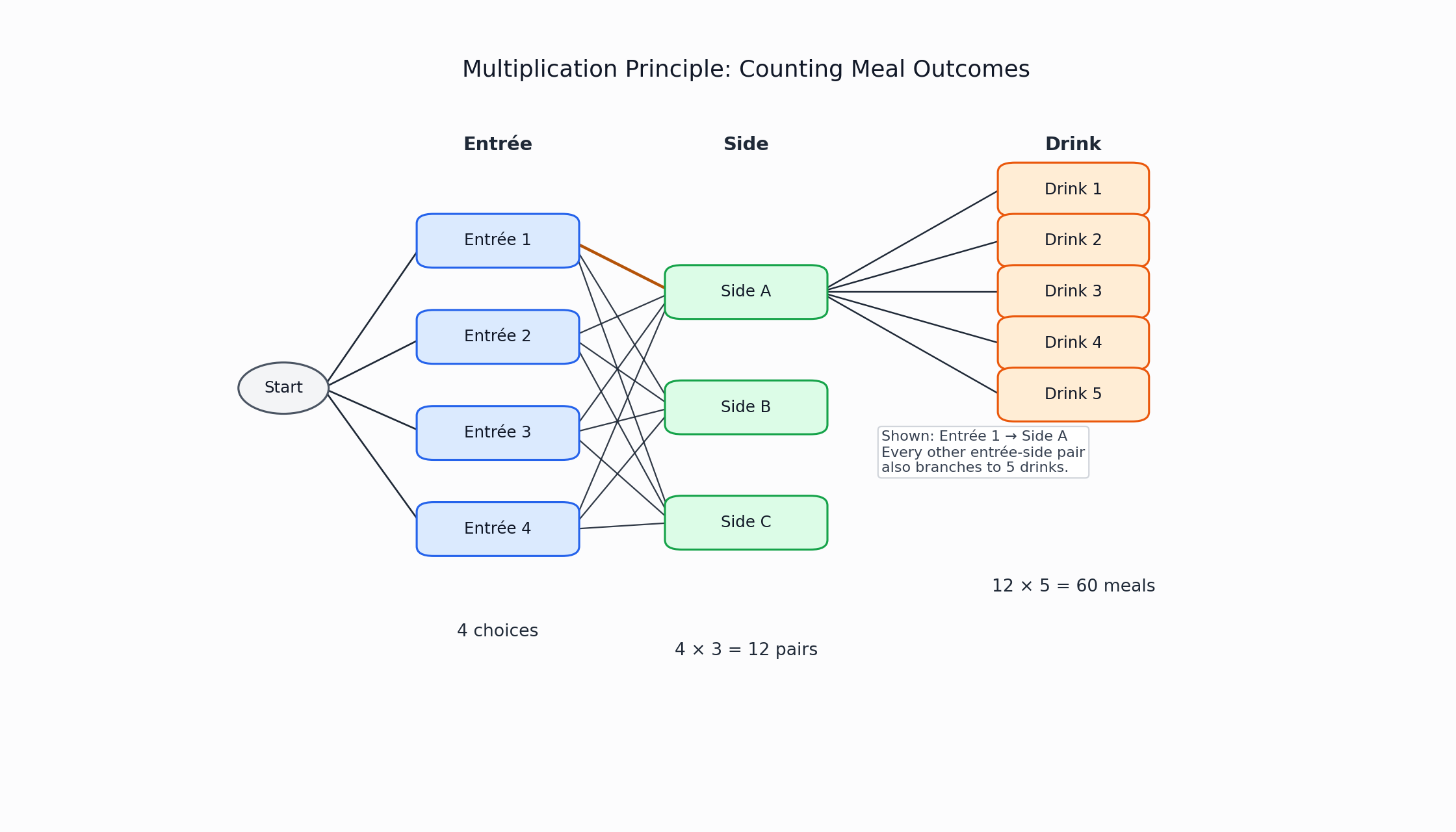
Think about ordering a meal at a restaurant: you might choose an entrée, then a side, and then a drink. Each choice is its own step, and the combination of all three choices forms one complete outcome. If a restaurant offers 4 entrées, 3 sides, and 5 drinks, how many different meals are possible?
We could try listing every combination by hand, but that gets tedious fast. We need a counting shortcut — and that is exactly what the multiplication principle provides.
Be a part of our community of 1M+ users who develop and demonstrate their skills on CodeSignal
The idea is refreshingly simple. If a process consists of a sequence of steps, and the number of options at each step does not depend on what was chosen in previous steps, we find the total number of outcomes by multiplying the option counts together.
For a process with k steps where step 1 has n1 options, step 2 has n2 options, and so on:
Total outcomes=n1×n2×⋯×nk
Back to our restaurant example with 4 entrées, 3 sides, and 5 drinks:
Total meals=4×3×5=60
That's 60 distinct meals from just three modest menus — no lengthy list required.
This is the point that trips people up most often, so let's spend a moment on it. You might wonder: "Why not just add? There are 4 entrées plus 3 sides plus 5 drinks, so isn't that 12 options?" The answer is no, because each meal is a combination of one choice from every step, not a single choice from one step.
Picture it this way. For each of the 4 entrées, there are 3 possible sides. That gives us 4×3=12 entrée-side pairs. Then, for each of those 12 pairs, there are 5 drink options, producing 12×5=60 complete meals. Every step fans out the possibilities from the previous step, which is why the counts multiply rather than add.
Step
Options at this step
Running total of combinations
Entrée
4
4
Side
3
4×3=12
Drink
5
12×5=60
Let's try a different kind of scenario. Suppose you need to create a 4-digit PIN where each digit can be anything from 0 to 9. Each digit position is one step, and each step has 10 options (the digits 0 through 9):
Total PINs=10×10×10×10=104=10,000
There are 10,000 possible 4-digit PINs. Now imagine we switch to a 5-digit PIN. We simply add one more step:
Total PINs=105=100,000
One extra digit multiplied the total by 10, jumping from 10,000 to 100,000. That single additional step did not add 10 more outcomes — it made the count ten times larger. This is a perfect illustration of why the multiplication principle produces such rapid growth.
This rapid growth is one of the most important takeaways from the multiplication principle. Each new step multiplies the entire previous total by the number of options in that step. Even small numbers at each step can combine into very large totals.
Consider a simple true/false quiz. Each question has only 2 possible answers:
Number of questions
Total answer sequences
1
2
2
2×2=4
3
23=8
5
25=32
10
210=1,024
20
220=1,048,576
A 20-question true/false quiz has over one million possible answer sequences — and each question only offers 2 choices! This kind of multiplicative growth is why counting by hand quickly becomes impossible for multi-step processes, and why the multiplication principle is so valuable.
As you may recall from earlier lessons, probability is calculated as the number of favorable outcomes divided by the total number of equally likely outcomes. The multiplication principle gives us a reliable way to find that total when the experiment involves more than one step.
For example, if all 10,000 four-digit PINs are equally likely and we want the probability that a randomly generated PIN is exactly "0419," we get:
P(PIN is 0419)=10,0001
Without the multiplication principle, we would have had to list all the PINs just to know the denominator. In the next lesson, we will take this further and learn how to systematically organize multi-step sample spaces, but for now the key skill is computing the size of those spaces.
As you practice applying this principle, keep these pitfalls in mind:
Adding instead of multiplying. This is by far the most common error. If each combination includes one choice from every step, we multiply. We add only when we are choosing from one step or another (a topic for a later course).
Forgetting a step. In a rush, it is easy to overlook one of the stages in a process. Make sure to identify all steps before multiplying.
Assuming every step must have the same number of options. The multiplication principle works perfectly well when each step has a different count. A process with 3 options, then 7 options, then 2 options gives 3×7×2=42 total outcomes.
Let's recap. The multiplication principle tells us that the total number of outcomes for a multi-step process equals the product of the option counts at each step: n1×n2×⋯×nk. We multiply because each step fans out every existing combination into new ones. This means outcome totals grow very quickly — even when individual steps offer only a few choices — and knowing this total is essential for computing probabilities in multi-step experiments.
Up next, you will put the multiplication principle to work across a variety of hands-on tasks, from building lunch combos and business packages to cracking PIN codes and busting common misconceptions about how outcome counts grow. Time to see just how far one simple rule can take you!