Distinguishing Learned Skills and Innate Talents
Welcome to the Course
Welcome to Self-Assessment: Know Your Professional Self, a course designed to help you build the most important foundation in any career journey — a deep, honest understanding of who you are as a professional. Whether you're considering a pivot, seeking growth in your current role as a people manager, or simply wanting to be more intentional about your career direction, this course gives you the structured tools to get there.
Throughout this course, you will explore four key dimensions of your professional identity. You'll start by uncovering your core strengths and natural talents, or the things you do effortlessly well. From there, you'll dig into your values and interests to understand why certain work energizes you and other work drains you. Next, you'll examine your personality and work style preferences to identify the environments where you truly thrive. Finally, you'll pull everything together into a cohesive professional profile that serves as your compass for every career decision ahead.
Distinguishing Learned Skills and Innate Talents
Before you can map your career direction, you need to understand a critical distinction: learned skills and innate talents are not the same thing, even though they often get lumped together. A skill is something you've been trained to do. You've practiced it, studied it, and developed competence over time. An innate talent, on the other hand, is a natural pattern of thinking, feeling, or behaving that you can productively apply. It's the thing that feels almost automatic to you, the thing others struggle with but you find strangely easy.
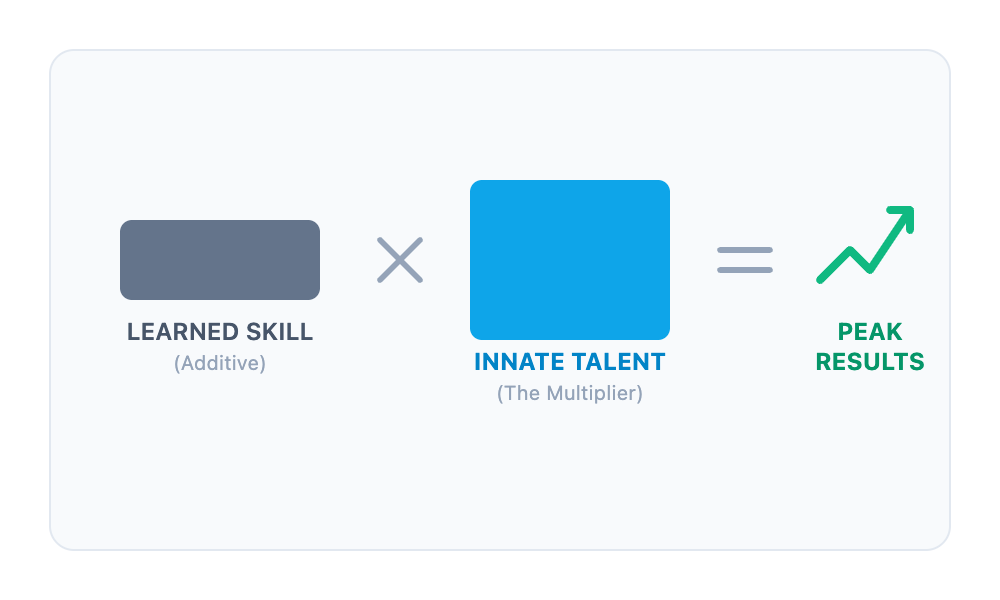
Why does this matter? Because talents are your multipliers. When you invest skill development on top of a natural talent, you get exponential returns. When you invest time building a skill in an area where you have no underlying talent, you get competence at best. The goal isn't to ignore skills — it's to know which of your abilities are powered by something deeper.
Here's a quick test you can apply. Ask yourself: "Did I have to be taught this, or did I just start doing it?" If a colleague once said something like "How do you always know exactly when someone on the team is about to burn out?" — that's a signal pointing toward talent, not training. Pay particular attention to compliments that confuse you, the ones where you think, "Doesn't everyone do that?" Those moments of surprise are often your hidden talents revealing themselves.
To see this distinction in action, consider the following conversation between two people managers reflecting on their strengths during a development workshop:
- Natalie: I've been thinking about what to put on my strengths list, and honestly, I keep going back to stakeholder management. I've gotten really good at it over the years.
- Ryan: That's solid. But let me ask you something — did you have to work hard to learn that, or did it come naturally?
- Natalie: Oh, I definitely had to learn it. Early on I had no idea how to manage competing priorities from different directors. I took a course, got a mentor, practiced a lot.
- Ryan: See, for me it's the opposite. I've always been able to walk into a room and just sense where the tension is — who's frustrated, who's checked out. Nobody taught me that.
- Natalie: That's true, you do that effortlessly. So stakeholder management is my learned skill, and your emotional radar is more of an innate talent?
- Ryan: Exactly. And knowing the difference helps me figure out where to double down.
Notice how Natalie and Ryan arrive at the distinction together. Natalie's stakeholder management ability is valuable, but it was built through training and practice — a learned skill. Ryan's ability to read a room's emotional dynamics, on the other hand, was never taught — it's an innate talent. Both are important, but recognizing which is which helps each of them understand where their greatest natural leverage lies. Once you learn to spot this difference in your own experience, you'll have a much clearer picture of where your greatest professional potential resides.
