Integrating Your Self-Assessment Profile
Integrating Your Self-Assessment Profile
Over the previous three lessons, you've done significant introspective work. You identified your core strengths and natural talents, clarified the values and interests that drive your motivation, and defined the work style preferences that determine where and how you perform at your best. Each of those exercises produced valuable — but separate — insights. A list of strengths sitting in one document, a set of prioritized values in another, and a work style snapshot in a third doesn't yet give you a usable professional identity. This final unit is about integration: pulling all three dimensions together into a single, coherent profile that you can use to evaluate opportunities, communicate who you are, and make career decisions with clarity and confidence. You'll learn how to synthesize your findings into a unified narrative, identify the non-negotiable conditions that any role must meet, and turn your self-assessment into a practical baseline for the market research and exploration that comes next.
The challenge of synthesis isn't that you lack information — it's that the information can feel fragmented or even contradictory until you look at it holistically. Your strengths tell you what you do exceptionally well. Your values and interests tell you why certain work feels meaningful. Your work style preferences tell you how you need to operate day-to-day. A coherent professional profile weaves all three layers into a single story that makes sense, both to you and to anyone evaluating whether you're a fit for a role.
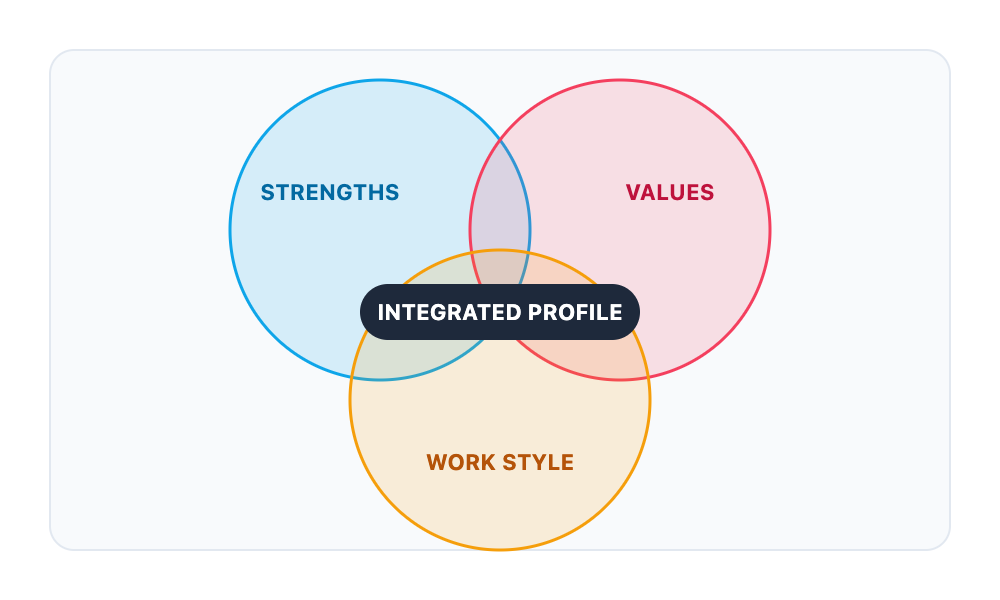
Start by placing your findings side-by-side to create a composite profile. Combining strengths like coaching and strategy with values of autonomy and a preference for introversion reveals a professional who excels at shaping direction independently through 1:1 development. This unified image is far more actionable than isolated data points.
Synthesis also reveals alignment—where dimensions like autonomy and independence reinforce each other—and tension—where they conflict, such as valuing high impact while preferring introversion. Tension isn’t a flaw; it’s a design constraint. It guides you toward roles that honor both sides of your profile, such as achieving impact through written strategy and coaching rather than high-visibility public presentations.
To see how synthesis works in practice, consider this exchange between two professionals reviewing each other's self-assessment findings:
- Jessica: Okay, so I've got my three lists in front of me. My top strengths are coaching and relationship-building, my core values are impact and security, and my work style is extroverted, structured, and collaborative. It all feels pretty aligned — I want to be around people, and my strengths are people-oriented.
- Dan: That's solid alignment. Mine's messier. My top strength is strategic thinking, and I value impact above everything else. But my work style came back heavily introverted and independent. So the thing I value most — impact — usually requires the kind of visibility and cross-functional work that drains me the fastest.
- Jessica: That sounds like real tension. Does that mean you're in the wrong kind of role?
- Dan: Not necessarily. It means I need to find a role where impact doesn't require me to be in every room. Last year I drove our biggest retention initiative almost entirely through async strategy docs and one-on-one coaching — huge impact, zero town halls.
- Jessica: So the tension isn't a flaw in your profile. It's a design constraint for the kind of role you look for next.
- Dan: Exactly. And I wouldn't have seen that if I'd only looked at one dimension at a time.
This exchange highlights the core purpose of synthesis. Jessica's profile dimensions naturally reinforce each other, which makes her path forward relatively straightforward. Dan's profile contains genuine tension between his values and his work style, but rather than treating that as a problem, he reframes it as a design constraint — a specific condition that narrows his search toward roles where impact is achieved through channels that match how he's wired. That reframe is only possible when all three dimensions are visible at the same time.
To test your own synthesis, try articulating your profile in a single statement. Something like: "I'm a professional who excels at coaching individuals and thinking strategically. I'm driven by making a measurable impact and need the autonomy to lead my way. I do my best work in flexible environments where I can process independently before collaborating." If reading it back produces a sense of recognition rather than resistance, your synthesis is on track. If a piece feels forced, revisit the underlying assessment.
Identifying "Deal-Breakers" in Career Selection
Use your profile to identify deal-breakers—non-negotiable conditions that, if absent, ensure role failure. Unlike preferences, deal-breakers are essential for evaluating trade-offs. Values are the primary source: if you value autonomy, a micro-managed environment is fundamentally incompatible. Violating these values leads to a slow erosion of motivation and performance.
Work style preferences also create boundary conditions for success. If you require structure, a chaotic environment is exhausting rather than exciting. To make this actionable, create two lists: "Must Have" (3–5 non-negotiable needs) and "Must Avoid" (3–5 known obstacles). For example, a "Must Have" could be "autonomy over core processes," while a "Must Avoid" might be "decisions by committee." Run every opportunity against these lists to filter out mismatched roles before you invest time in applications or interviews.
Creating a Baseline for Market Research and Exploration
Your integrated profile and deal-breaker lists form a baseline for evaluating every opportunity. Without this lens, you scan the market blindly; with it, you assess alignment with clarity. To make this practical, translate your findings into evaluation criteria: use qualitative questions for strengths and culture, and binary "yes/no" filters for deal-breakers. This dual approach lets you filter roles quickly while maintaining nuance.
This baseline protects you from two traps: opportunistic drift (settling for a role just because it’s available) and identity amnesia (forgetting your needs during a stressful search). Your documented criteria act as an anchor, allowing you to objectively verify whether a role is a genuine fit rather than relying on a recruiter’s pitch or emotional impulse.
As you move into the next phase of your career development, you'll be researching industries, analyzing specific roles, and evaluating organizational cultures — your self-assessment baseline will be the foundation for every comparison you make. You won't just be asking "Is this a good job?" You'll be asking "Is this a good job for me, given what I know about my strengths, my values, and how I work best?"
In the upcoming role-play, you'll put all of this together by practicing your Professional Identity pitch — a concise, confident summary of who you are as a professional, delivered in sixty seconds. This is where your self-knowledge becomes a communication skill, so get ready to articulate your integrated profile clearly and compellingly.
