Dividing in Scientific Notation
Introduction
You have reached the final lesson of Scientific Notation in Real Life — welcome to Lesson 6! Across the first five lessons, we built up a complete reading-and-writing toolkit: converting between standard form and scientific notation, comparing values at a glance, and multiplying large or small numbers with ease. Now we round out the course with the last essential operation: division.
Division in scientific notation comes up whenever we need a rate, a per-unit cost, or an average drawn from large-scale data. The good news is that the technique mirrors what we already learned for multiplication, so the learning curve is gentle. Let's dive in.
From Multiplication to Division
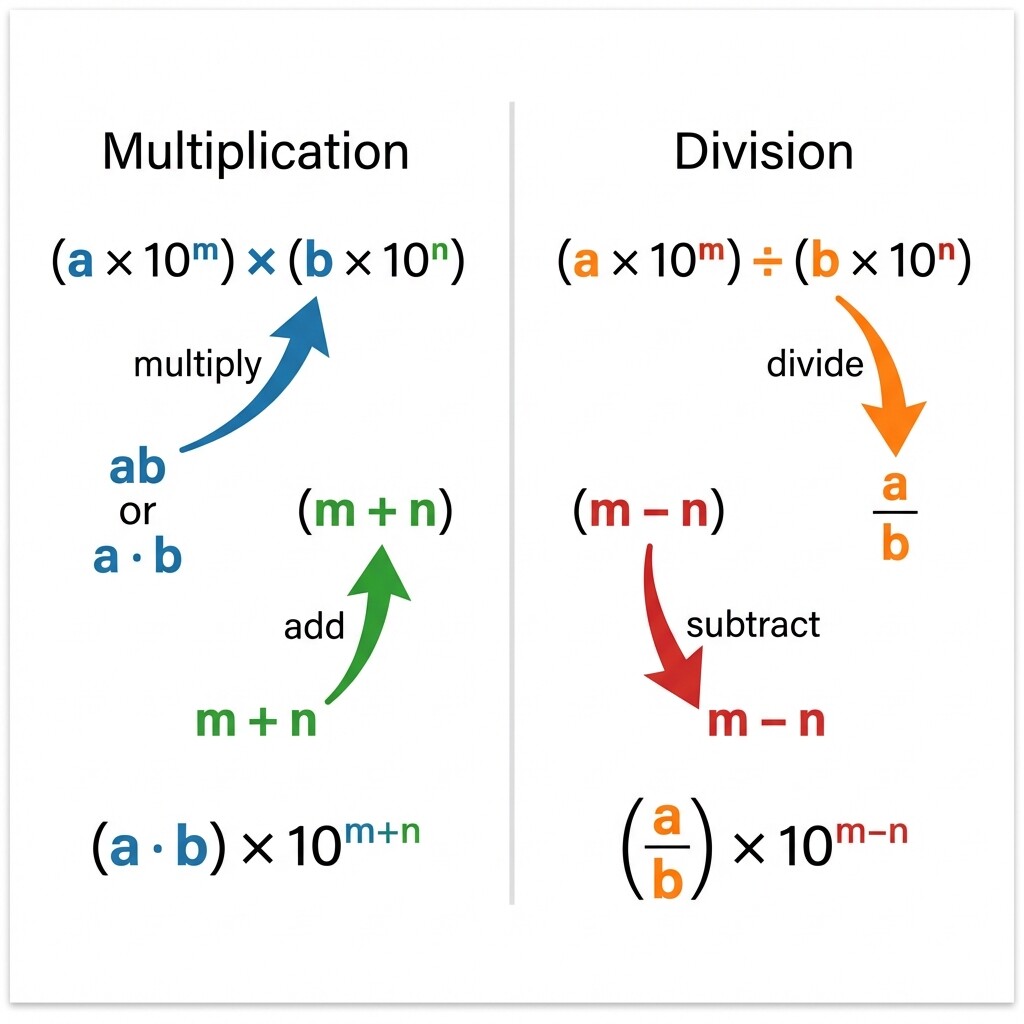
In the previous lesson, we saw that multiplying in scientific notation means multiplying the coefficients and adding the exponents. Division follows the same logic in reverse: we divide the coefficients and subtract the exponents. If multiplication felt manageable, division will feel equally comfortable.
Think about the kinds of questions that call for division. What is a country's debt per person? How much does a single pixel on a television screen cost? How long does sound take to cover a given distance? All of these are "big number divided by another number" problems, and scientific notation keeps the arithmetic quick and readable.
The Division Rule
In the earlier course on exponent rules, we learned that dividing two powers of the same base means we subtract the exponents:
Every number in scientific notation has the form . When we divide two such numbers, we handle the coefficients and the powers of ten separately:
So the procedure is: divide the coefficients and subtract the exponents. That is the heart of the method — a clean mirror image of the multiplication rule.
A Straightforward Example
Let's walk through a division where the result lands neatly in proper form:
- Divide the coefficients:
- Subtract the exponents:
- Combine:
Since is between 1 and 10, the result is already in proper scientific notation. That is , and we found it without writing a single long number.
Here is one more:
Coefficients: . Exponents: . Result: . The coefficient sits comfortably in range, so no extra work is needed.
When the Coefficient Needs Adjusting
Sometimes the quotient of the two coefficients drops below . Recall that proper scientific notation requires the coefficient to be at least 1 and less than 10. When the quotient breaks that rule, we need one extra step.
Consider:
- Divide the coefficients:
- Subtract the exponents:
- Combine:
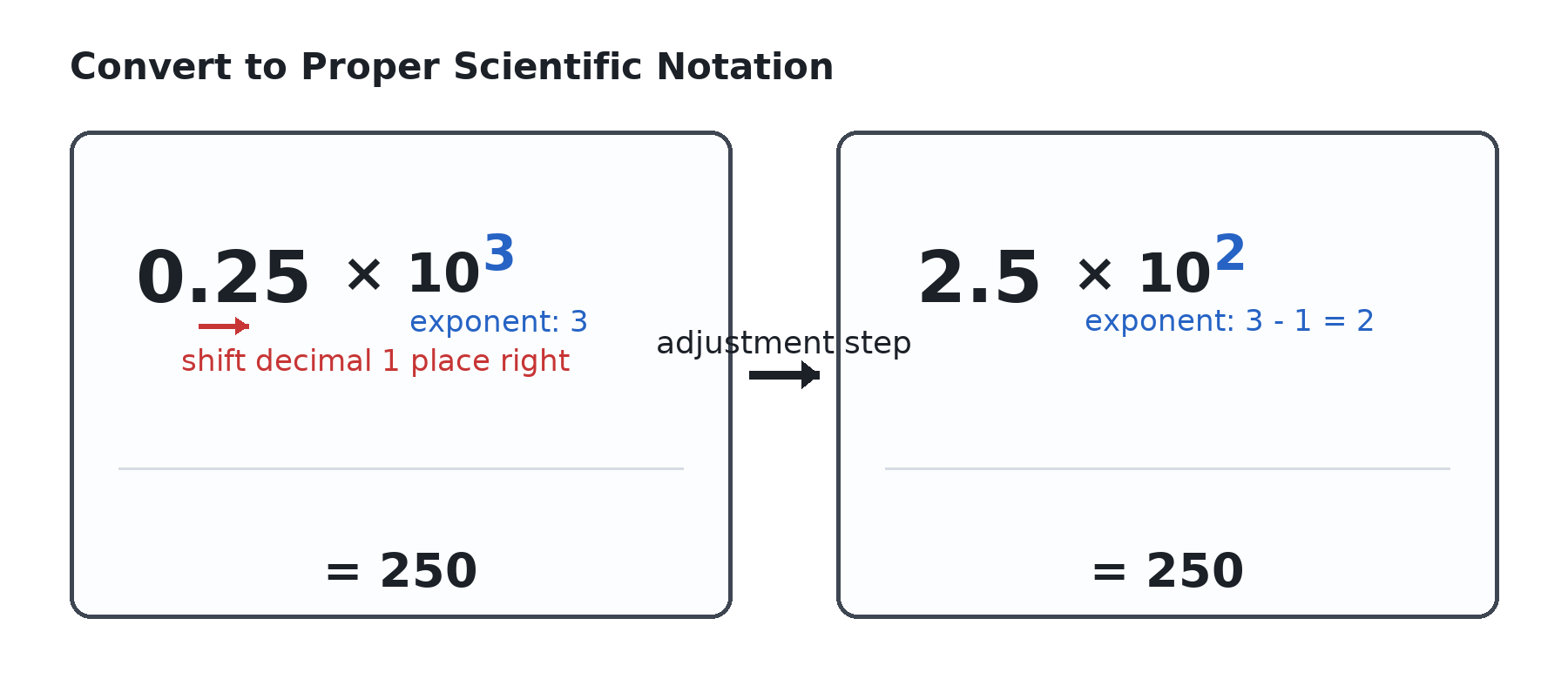
The coefficient is too small, so this is not proper form yet. To fix it, we move the decimal point one place to the right, turning into , and subtract 1 from the exponent to compensate:
Why does this work? Because , and . We are simply rewriting the same value in proper form.
Now let's try an example where the exponent difference itself turns out negative:
Coefficients: . Exponents: . Intermediate result: . Since , we shift the decimal one place right and decrease the exponent by 1:
Notice that the final exponent is negative. As we learned in Lesson 3, a negative exponent simply means the number is very small — here, .
A helpful observation: since both original coefficients are between 1 and 10, their quotient always falls between 0.1 and 10 (exclusive). The quotient can dip below 1, but it can never reach 10 or above. So unlike multiplication, where we sometimes shifted the decimal left, in division the only adjustment we ever make is shifting the decimal right by one place.
The Complete Method at a Glance
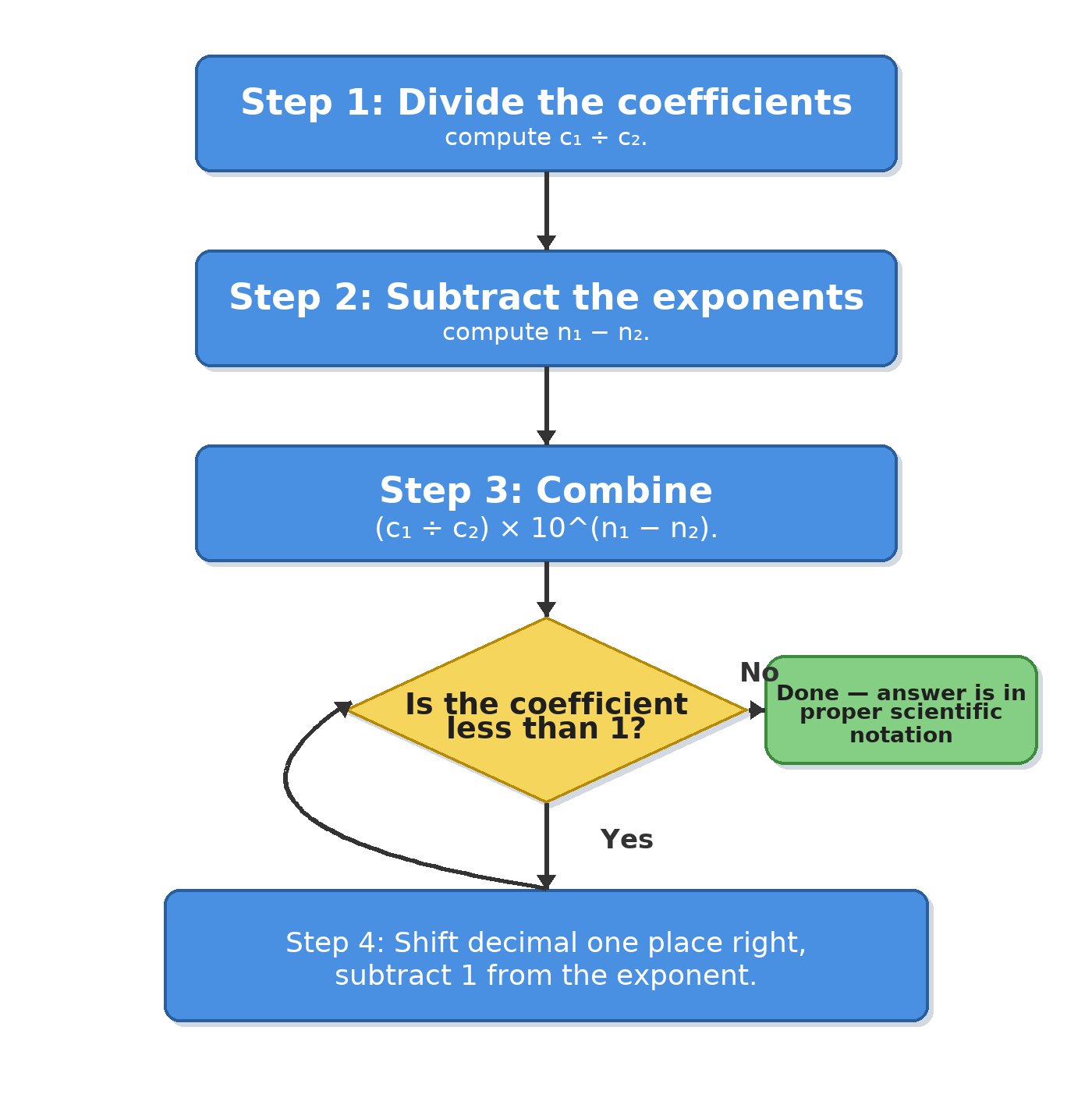
Here is the complete method in four steps:
- Divide the coefficients ().
- Subtract the exponents ().
- Combine the results: .
- If the quotient is less than 1, move the decimal one place right and subtract 1 from the exponent.
The table below shows three divisions side by side so we can compare straightforward and adjustment cases:
| Problem | Coefficient Quotient | Exponent Difference | Needs Adjustment? | Final Answer |
|---|---|---|---|---|
| No | ||||
| Yes | ||||
| Yes |
A Real-World Example: Speed of Sound
Let's apply the method to a practical question. The distance from New York to Los Angeles is roughly meters. The speed of sound in air is about meters per second. How long would it take a sound wave to travel that distance?
Time equals distance divided by speed:
- Coefficients:
- Exponents:
- Result: seconds
Since is between 1 and 10, no adjustment is needed. That works out to about 13,000 seconds, or roughly 3.6 hours. Scientific notation kept the calculation compact while the raw numbers involved millions and hundreds.
Common Pitfalls
A few common mistakes are worth watching for as you start practicing:
- Subtracting in the wrong order. Always subtract the denominator's exponent from the numerator's: , not . Reversing the order flips the sign and changes the answer dramatically.
- Dividing the exponents instead of subtracting. The quotient rule says . Make sure you subtract, not divide.
- Forgetting to adjust the coefficient. If the quotient of the coefficients drops below 1, the answer is not in proper scientific notation yet. Always check that the coefficient is at least 1.
- Confusing the adjustment direction with multiplication. In multiplication, a coefficient of 10 or above gets shifted left (exponent goes up by 1). In division, a coefficient below 1 gets shifted right (exponent goes down by 1). Keeping this contrast in mind prevents mix-ups.
Conclusion and Next Steps
In this lesson, we learned how to divide two numbers in scientific notation: divide the coefficients, subtract the exponents, and adjust the result into proper form when the new coefficient falls below 1. We also saw that the exponent difference can turn negative — producing a very small result — and we estimated how long sound would take to cross the United States.
With division in place, your scientific notation toolkit is now complete: reading, writing, comparing, multiplying, and dividing. Head into the practice exercises next, where you will apply your division skills to everything from guided step-by-step problems to real-world scenarios involving national debt and consumer electronics. You have got this!
