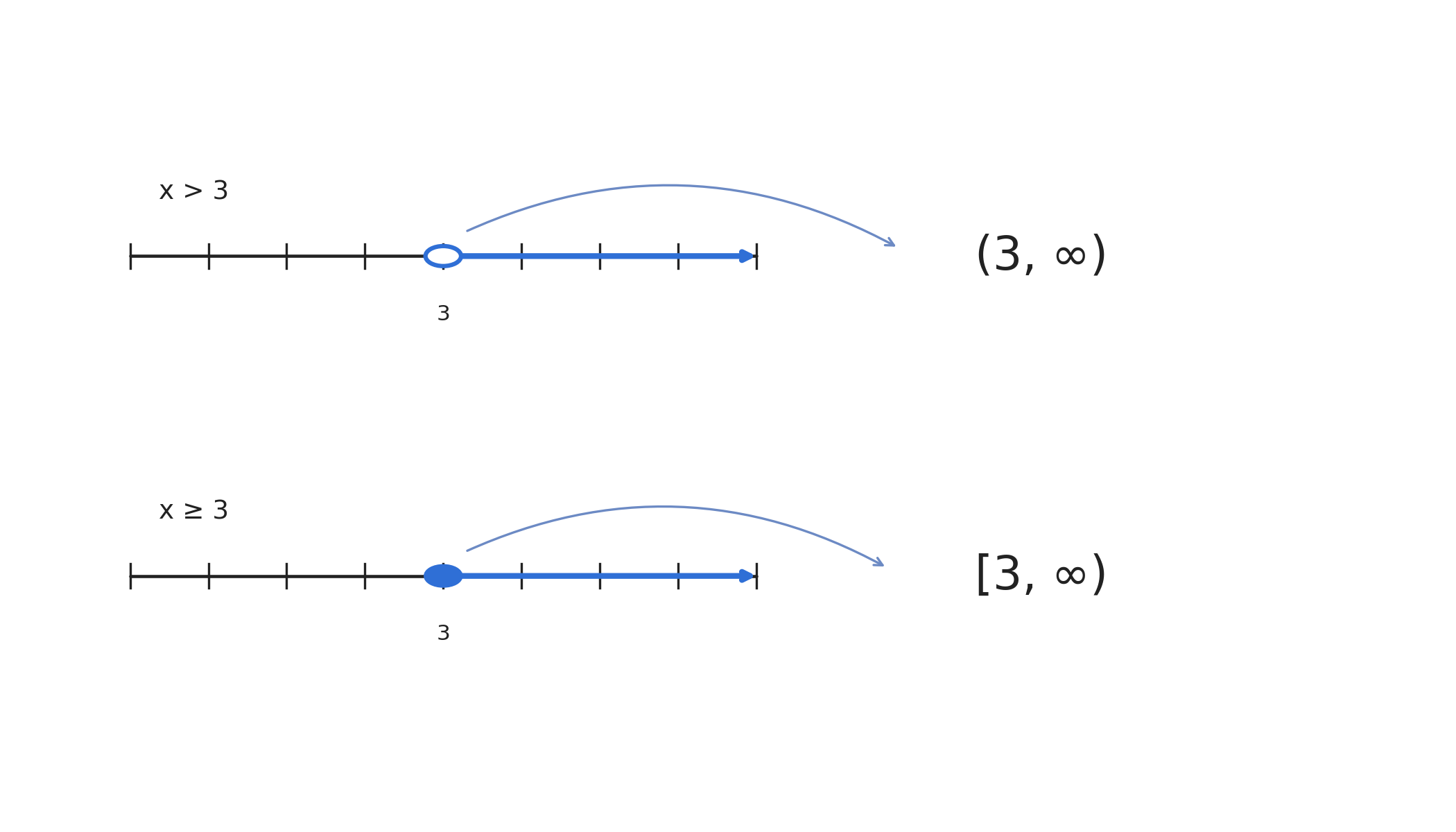
Welcome to Representing and Interpreting Solutions, the fourth course in your learning path! Over the previous three courses, you built a solid toolkit: you learned what inequalities mean, how to solve them in one step or many steps, and how to handle special cases like no solution or all real numbers. Now it is time to focus on how we express and communicate those solutions. In this first lesson, we will learn interval notation, a compact and widely used format for writing solution sets.
From Number Lines to a Shorthand
As you may recall from earlier units, we can represent an inequality like x>3 by shading a region on a number line with an open circle at 3. That visual approach works well, but writing or typing a number-line drawing is not always convenient — imagine trying to include one in a text message, a spreadsheet, or a line of code.
Interval notation gives us a text-based shorthand that captures the same information: which values are included, which endpoint is a boundary, and which direction the solutions extend. Think of it as translating the picture into a precise, portable label that anyone familiar with the convention can read instantly.
Parentheses Versus Brackets
The single most important choice in interval notation is the symbol at each endpoint. The rule is straightforward:
A parenthesis ( or ) means the endpoint is not included (strict inequality, < or >).
A bracket [ or ] means the endpoint is included (inclusive inequality, ≤ or ≥).
This lines up directly with what we already know about number-line graphs. An open circle corresponds to a parenthesis, and a closed circle corresponds to a bracket.
Inequality symbol
Endpoint included?
Interval symbol
Number-line dot
< or >
No
Parenthesis
Open circle
≤ or ≥
Yes
Bracket
Closed circle
The Role of Infinity
Most solved inequalities have solutions that extend forever in one direction. To represent "keeps going without end," we use the infinity symbol∞ for the positive direction and −∞ for the negative direction.
One essential rule to remember: infinity always gets a parenthesis, never a bracket. Because ∞ and −∞ are not actual numbers, we can never "reach" or "include" them. Every interval that involves infinity will have a parenthesis on that end — no exceptions.
Join the 1M+ learners on CodeSignal
Be a part of our community of 1M+ users who develop and demonstrate their skills on CodeSignal
Four Core Patterns
Bounded Solution Sets
Two Special Cases: All Real Numbers and No Solution
With parentheses, brackets, and infinity in hand, we can write any one-sided inequality solution — one whose values run off toward infinity in a single direction. Here are the four patterns that cover every one-sided single-variable inequality:
Inequality
Interval notation
Meaning
x>a
(a,∞)
All values greater than a, not including a
x≥a
[a,∞)
All values greater than or equal to a
x<a
(−∞,a)
All values less than a, not including a
x≤a
(−∞,a]
All values less than or equal to a
Notice the structure: the smaller value always goes on the left and the larger value on the right, with a comma between them. Since −∞ is less than any real number and ∞ is greater than any real number, they naturally sit at the far left or far right. These four cover the one-sided rays — but not every solution set. In the next two sections we handle the remaining kinds: solutions bounded on both ends, and the two special cases.
Not every solution stretches off to infinity. Sometimes a value is trapped between two numbers, as in the compound inequality 2≤x<5, which you met when working with compound inequalities earlier in the path. A set like this has a real number on both ends, so its interval notation carries two real bounds instead of an infinity symbol.
The endpoint rule works exactly the same on each side: use a bracket for an included endpoint and a parenthesis for an excluded one. So 2≤x<5 becomes [2,5) — a bracket at 2 because it is included, and a parenthesis at 5 because it is not. As always, the smaller value sits on the left.
Compound inequality
Interval notation
1<x<6
(1,6)
−3≤x≤4
[−3,4]
0≤x<10
[0,10)
Once in a while, solving an inequality produces a statement that is always true (such as 5>2) or never true (such as 5<2). These lead to two special solution sets:
All real numbers. If every value makes the inequality true, the solution set covers the entire number line. We write it as (−∞,∞), with a parenthesis on each end because both sides are infinity.
No solution. If no value can ever make the inequality true, the solution set is empty. We write it with the empty-set symbol∅ (sometimes written as {}).
Keep these two forms in your back pocket; you will meet inequalities that simplify to one of them, and interval notation gives each a clean, standard label.
Let's apply the patterns step by step.
Example 1: Write x≥−4 in interval notation.
The boundary is −4, and the inequality symbol ≥ means −4 is included, so we use a bracket. The solutions extend to the right forever, so the other end is ∞ with a parenthesis:
[−4,∞)
Example 2: Write x<10 in interval notation.
Here the boundary is 10, and the strict < means 10 is excluded, giving us a parenthesis. The solutions stretch to the left, so we begin with −∞:
(−∞,10)
Example 3: Suppose you are checking whether a warehouse temperature stays at or below −3 degrees Celsius. After solving the inequality, you arrive at x≤−3. Write the solution in interval notation.
The value −3 is included (≤), earning a bracket, and the solutions go left toward −∞:
(−∞,−3]
Each time, the process is the same: identify the boundary, choose parenthesis or bracket, and then pair it with the correct infinity direction.
As with any new notation, a few errors come up often. Keeping these in mind will save you trouble:
Bracketing infinity. Writing [−∞,5] or [3,∞] is incorrect. Infinity is never a reachable value, so it always takes a parenthesis.
Reversing the order. The left value must be smaller. Writing (5,−∞) instead of (−∞,5) is not valid.
Confusing parentheses and brackets. A strict inequality (< or >) means the boundary is not part of the solution, so it needs a parenthesis. Double-check the original inequality symbol before writing.
Mishandling the special cases. No solution is the empty set ∅, not () or [], and all real numbers is (−∞,∞), never with a bracket on either infinity.
In this lesson, you learned how to translate inequality solutions into interval notation by choosing parentheses for excluded endpoints, brackets for included endpoints, and always pairing ∞ or −∞ with a parenthesis. You also learned to write bounded two-endpoint intervals and the two special forms: (−∞,∞) for all real numbers and ∅ for no solution. These simple conventions give us a clean, universal way to express any solution set — one that is easier to type, share, and read than a number-line sketch.
Up next, you will put this knowledge into action with a set of practice exercises. You will start by identifying whether endpoints need parentheses or brackets, then progress to filling in missing parts of intervals, and finally write complete interval notation on your own — building confidence and fluency one interval at a time!