Welcome to Recognize Patterns That Aren't There, a course designed to sharpen the way you think about chance, randomness, and the conclusions you draw from uncertain information. In this lesson, you will learn to:
Read a probability claim and know exactly what event it is describing.
Compare how likely different outcomes are by placing them on a common likelihood scale.
Tell apart events that truly influence each other from events that only seem connected.
These skills matter more than you might expect. Every day you encounter statements like "there is a 30% chance of rain" or "this product has a 99% reliability rate." Misreading those claims, or assuming one random outcome somehow affects the next, leads to poor decisions. Let's build a clear foundation so that doesn't happen.
Why Randomness Feels Strange 😵💫
Our brains are pattern-finding machines. This ability is genuinely useful in many situations: spotting a predator in tall grass, recognizing a friend's face in a crowd, or noticing that traffic is always worse on Fridays. The trouble is that the same instinct fires even when there is no real pattern to find.
When we flip a coin and get heads five times in a row, something inside us whispers, "Tails is due." When a coworker wins the office raffle twice in a year, we suspect the draw is rigged. These reactions feel logical, but they often conflict with how randomness actually works.
Before you can spot these traps, you need to understand three things:
What probability claims really mean
How to compare them
How independent random events behave
Those are the three building blocks for this lesson.
What a Probability Claim Actually Says 💬
Independent Events vs. Connected Events 🔗
Your Probability Claim Checklist ✅
Let's tie the three ideas from this lesson into a short checklist you can use whenever you encounter a claim about chance:
Identify the exact event. What outcome is the probability describing? What situation does it apply to?
Place it on the likelihood scale. Is this a 1-in-a-million event or a 50-50 shot? Calibrate your intuition before reacting.
Check for independence. Does an earlier outcome change the conditions for the next one? If not, previous results tell you nothing about what comes next.
These three steps sound simple, but applying them consistently will protect you from a surprising number of reasoning errors. Try running through the checklist the next time you hear a weather forecast, read a product guarantee, or wonder whether a lucky streak means anything.
Conclusion and Next Steps
In this lesson, you explored what probability claims really mean, how to compare likelihoods on a common scale, and how to distinguish independent events from dependent ones. The most important insight is the no-memory principle: when outcomes are independent, no streak, pattern, or history changes what happens next.
Up next, you will put these ideas to work in a set of hands-on practice tasks. You will read real-world probability statements, rank likelihoods, judge whether events are truly connected, and even generate your own random sequences to see the no-memory principle in action.
Be a part of our community of 1M+ users who develop and demonstrate their skills on CodeSignal
A probability is a number between 0 and 1 (or equivalently between 0% and 100%) that describes how likely a specific outcome is in a specific situation. When a weather app says "40% chance of rain tomorrow," it is making a precise claim: out of many days with similar atmospheric conditions, roughly 40 out of 100 would produce measurable rain at your location.
The key habit to build is pausing to identify the exact event a claim refers to before doing anything else with the number. Consider these two statements:
"There is a 1 in 1,000 chance this smoke detector will fail to alert during a fire."
"There is a 1 in 1,000 chance of a house fire this year."
Both use the same number, but they describe completely different events. Mixing them up could lead you to dramatically overestimate or underestimate your actual risk.
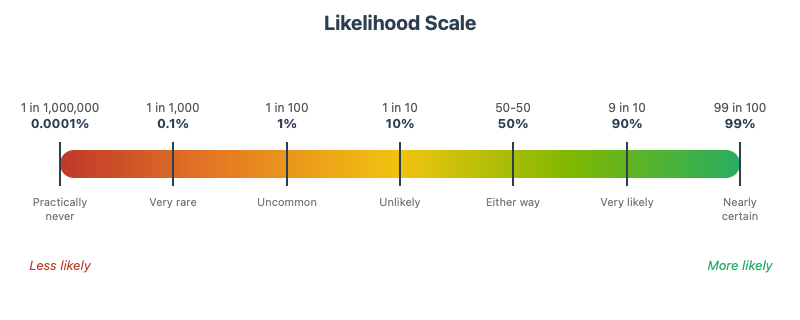
Once you know exactly what event a probability describes, the next step is developing a feel for how large or small that probability is. Below is a reference that maps common probability expressions to an intuitive likelihood scale.
Expression
Probability
Intuitive Feel
1 in 1,000,000
0.0001%
Practically never happens
1 in 1,000
0.1%
Very rare
1 in 100
1%
Uncommon but not shocking
1 in 10
10%
Unlikely, yet worth watching
50-50
50%
Could go either way
9 in 10
90%
Very likely
99 in 100
99%
Nearly certain
Placing every probability claim on this kind of mental scale helps you compare risks, promises, and forecasts on equal footing. A delivery service that guarantees "99% on-time arrival" is making a much stronger promise than one claiming "9 in 10 packages arrive on time," even though both sound pretty good at first glance. Training yourself to convert expressions like these into a position on the scale is one of the most useful everyday reasoning habits you can build.
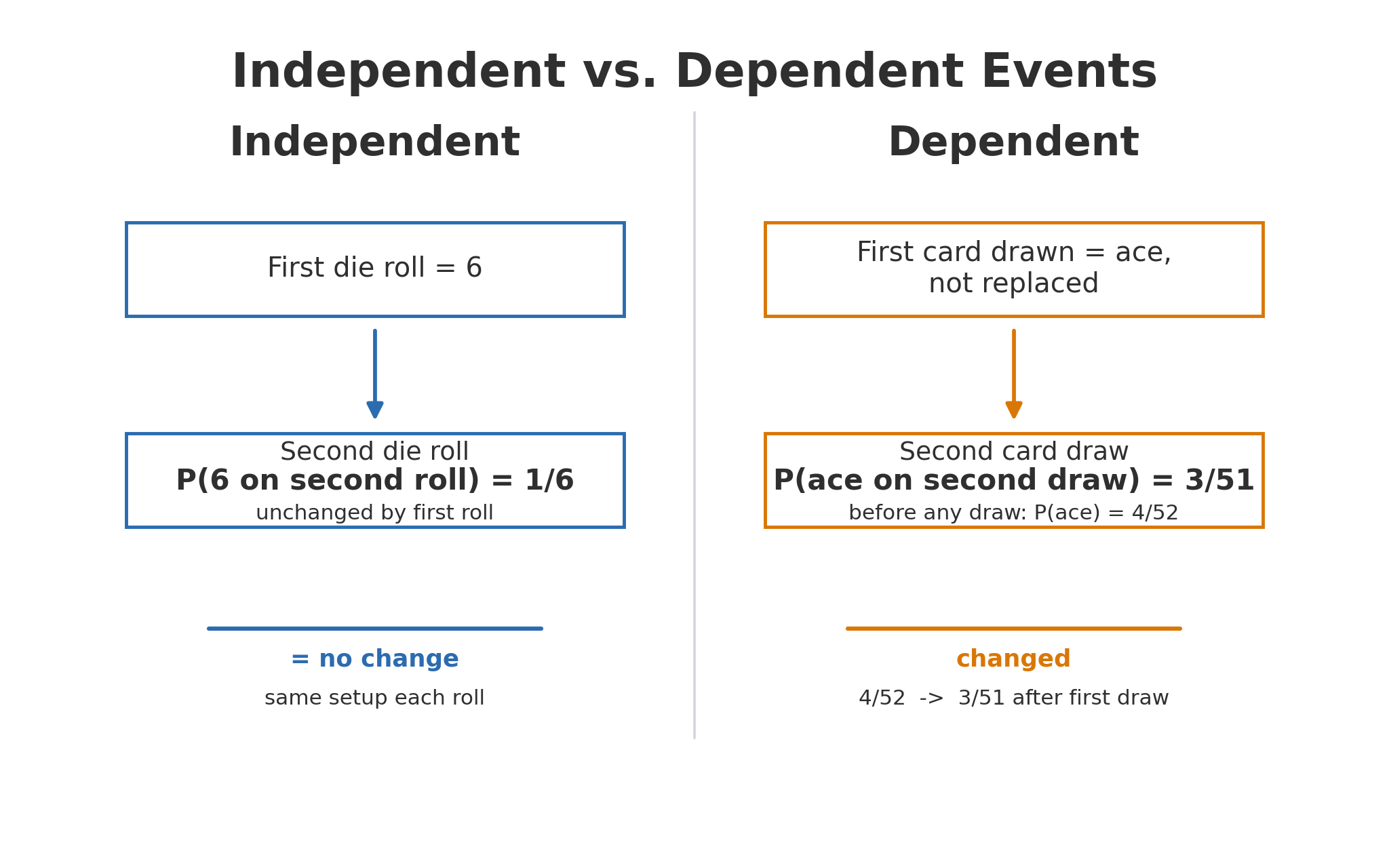
One of the most important ideas in the entire course is independence. Two events are independent when the outcome of one has absolutely no effect on the probability of the other. Two events are dependent (or connected) when knowing the outcome of one genuinely changes the probability of the other. This distinction matters because it determines whether past results can tell you anything useful about future ones.
Here are a few examples to sharpen the distinction:
Independent: You roll a die and get a 6, then roll the same die again. The chance of getting a 6 on the second roll is still 61. The die does not remember what happened last time.
Independent: Two unrelated people in different cities each buy a lottery ticket. One person's win or loss has zero effect on the other's result.
Dependent: You draw a card from a standard deck and do not put it back. If the first card was an ace, the probability of drawing another ace drops from 524 to 513. The first draw physically changed what is left in the deck.
Dependent: A factory machine wears down with use. If it produced a defective part this hour, it is more likely to produce another defective part next hour because its condition has worsened.
The practical test is straightforward: ask yourself, "Does the first outcome change the physical setup or the available information for the second outcome?" If yes, the events are dependent. If nothing changes, they are independent.
This leads you to a powerful rule: independent random processes have no memory. This single idea will come up again and again throughout the course, so it is worth stating clearly.
When events are independent, the probability of the next outcome stays exactly the same regardless of what happened before. If a fair coin has landed on heads ten times in a row, the probability of heads on the eleventh flip is still:
P(heads)=21
The coin does not "owe" you a tails. It does not track its own history. Each flip is a fresh start.
This applies equally to lottery draws, roulette spins, and any other process where past results do not alter the mechanism producing future results. Believing otherwise is one of the most common reasoning errors people make. For now, the core takeaway is simple: if the process resets each time, the past does not matter.