Constructing Square Corners
Introduction
Welcome back to Real-World and 3D Applications! With two lessons already under your belt, you have built a solid toolkit: you can test any three side lengths for a right triangle using the converse of the Pythagorean theorem, and you can spot Pythagorean triples — like the famous 3-4-5 — on sight. Now it is time to take that knowledge off the page and into the physical world.
In this lesson, we will learn how to use the 3-4-5 rule to construct and verify true 90-degree corners in practical settings like carpentry, landscaping, and room framing. The best part? All we need is a tape measure and some string.
Why Square Corners Matter
Before we get into the method, let's think about why a perfect right angle is so important in everyday building tasks. Picture a rectangular garden bed, a deck frame, or even a tiled floor. If the corners are not truly square, the entire structure ends up crooked — boards will not line up, tiles will taper, and fence lines will drift. A small error at the corner grows larger the further out we go.
Professional builders use specialized tools like framing squares and laser levels, but these are not always available. The 3-4-5 rule gives us a simple, tool-free way to create or check a right angle using nothing more than measured lengths. It has been used for thousands of years, and it works every time.
The 3-4-5 Rule Explained
We already know that 3-4-5 is a Pythagorean triple because , or . The converse of the Pythagorean theorem tells us that if three lengths satisfy , they must form a right triangle. The 3-4-5 rule simply applies this fact in a hands-on way: lay out sides of 3 and 4 units from a corner, then measure the diagonal between their endpoints.
Here is the key idea in one sentence: the diagonal of 5 proves the corner is square. If the diagonal is longer than 5, the angle is too wide (obtuse). If it is shorter than 5, the angle is too narrow (acute). Only an exact match of means a perfect right angle.
Step-by-Step Layout Procedure
Let's walk through the full process with a concrete example. Suppose we are staking out the corner of a rectangular patio and want to make sure it is perfectly square.
- Start at the corner point. Place a stake or mark at the spot where the two edges of the patio will meet.
- Measure 3 feet along one edge. From the corner, measure exactly ft along one side and place a mark.
- Measure 4 feet along the other edge. From the same corner, measure exactly ft along the adjacent side and place a second mark.
- Measure the diagonal between the two marks. Stretch a tape measure from the -ft mark to the -ft mark.
- Check the diagonal. If the diagonal is exactly ft, the corner is square. If not, adjust the edges and re-measure until the diagonal reads ft.
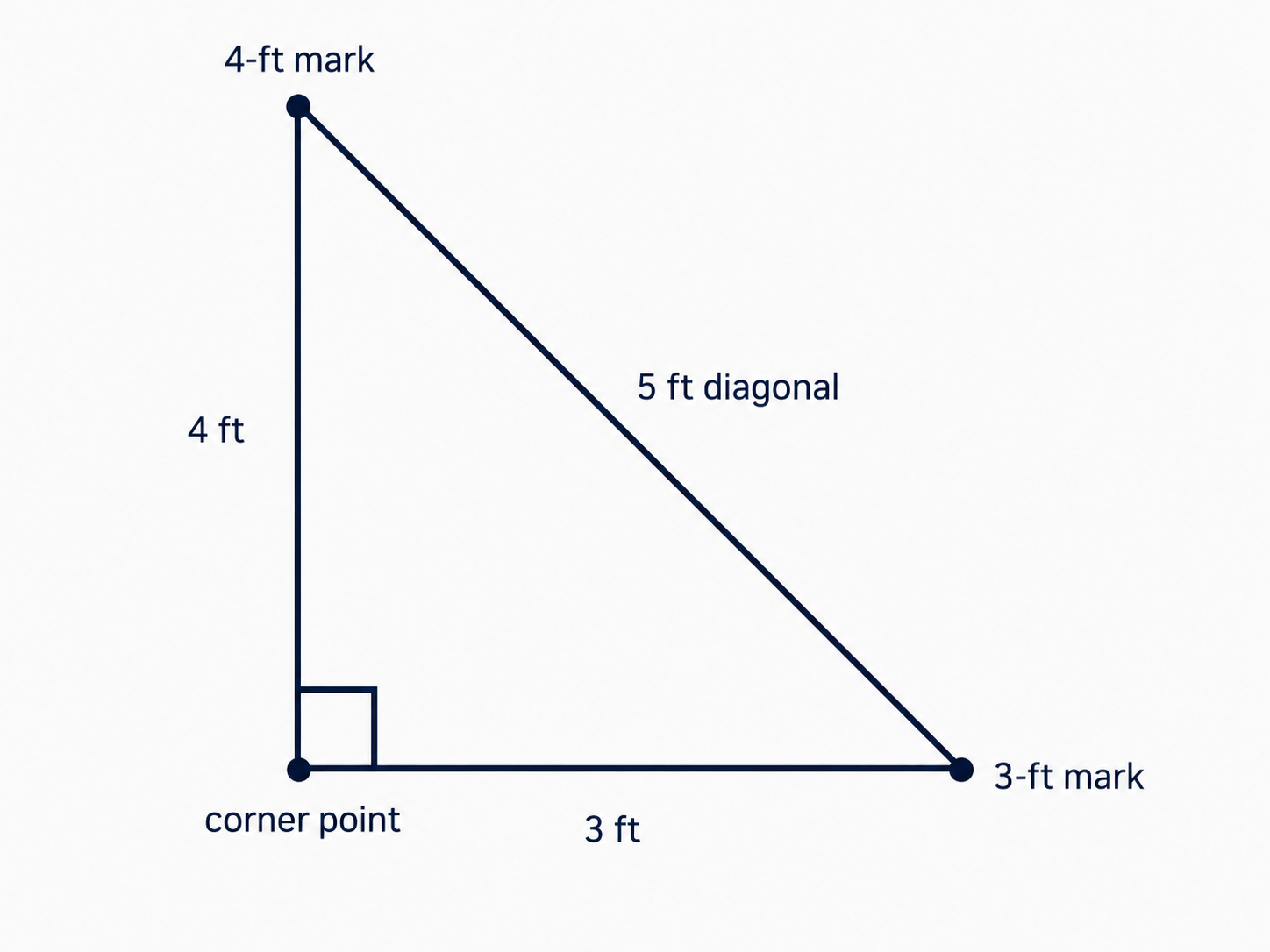
That is the entire method. Five straightforward steps, and we have a verified right angle with no special equipment.
