Welcome back to Reading Everyday Measurements! This is our fifth and final lesson in the course, and you have come a long way. We started by breaking any measurement into its value, unit, and attribute, then moved through nutrition labels, clothing size charts, and pressure gauges. Each lesson has asked us to read a number, understand its context, and make a practical decision.
In this lesson, we apply that same pattern to one of the most important everyday readings: medication dosage directions. We will learn how to pull key details from a dosage label, calculate how much medicine to take in a day, and handle the concentration and weight-based math that comes up with liquid medications.
Why Getting the Dose Right Matters
Most over-the-counter medications are safe and effective when taken as directed. Problems arise when someone misreads a label, skips a qualifier like an age or weight limit, or confuses milligrams with milliliters. Unlike a tire that is a couple of PSI low, a dosing error can have real health consequences.
The good news is that the math involved is straightforward. If we can read a nutrition label and scale a per-serving value to what we actually ate (as we did in Lesson 2), we already have the core skill. Medication dosing simply adds a few new pieces of context — dosing intervals, liquid concentrations, and weight-based guidelines — that we will work through step by step.
Anatomy of a Dosage Label
Every medication package includes a Drug Facts panel (on over-the-counter products in the US) or a printed insert with dosing directions. Three pieces of information appear on virtually every label:
Dose amount — how much to take at one time (e.g., 2 tablets or 10 mL).
Dosing interval — how often to take it (e.g., every 4 to 6 hours).
Qualifiers — conditions that change the dose, such as age ranges, weight ranges, or special warnings (e.g., children under 12: ask a doctor).
Here is a simplified example of what a dosage table might look like on a box of adult acetaminophen tablets, where each tablet contains 500 mg:
Age
Dose
Interval
Daily Maximum
Adults and children 12 years and over
2 tablets (1,000 mg)
Every 6 hours
6 tablets (3,000 mg)
Children under 12 years
Do not use
—
—
When we read a label like this, we first identify which row applies to the person taking the medicine. A 15-year-old falls in the first row; an 8-year-old is told not to use this product at all. Qualifiers act as filters, and we must check them before anything else.
Computing Daily Totals
Working with Liquid Concentrations
Weight-Based Dosing
From Label to Final Answer: A Complete Example
Common Mistakes to Avoid
A few errors come up often with medication doses. Keeping them on your radar will help you stay safe:
Confusing mg and mL. A dose of 200 mg is not the same as 200 mL. Milligrams measure the amount of drug; milliliters measure the volume of liquid. The concentration links the two.
Ignoring qualifiers. Taking the adult dose for a child, or using the standard dose when a weight-based chart applies, can lead to over- or under-dosing.
Forgetting the daily cap. Even if the math says we could take 6 doses in 24 hours, the label may limit us to 4 or 5. The stated maximum always wins.
Skipping unit checks on concentration. Some labels list concentration as mg per 5 mL while others use mg per mL. As we practiced in our very first lesson, always confirm the unit before computing.
Conclusion and Next Steps
In this lesson, we learned how to read the key parts of a medication dosage label — dose amount, interval, and qualifiers — and then built up from single-dose-to-daily-total calculations, through liquid concentration conversions, to full weight-based dosing problems that chain several steps together. These are practical skills that matter every time you reach for a bottle of medicine at home.
Now it is time to put your skills to the test! In the upcoming practice exercises, you will extract dosing details from realistic labels, compute daily totals, convert milligrams to milliliters, and work through a complete weight-based scenario for a children's medication. Let's see you handle these doses with confidence!
Be a part of our community of 1M+ users who develop and demonstrate their skills on CodeSignal
Once we know the single dose and the interval, we can calculate the maximum daily total. The key relationship is:
Doses per day=interval in hours24 hoursDaily total=single dose×doses per day
For example, suppose an ibuprofen label says to take 200 mg every 6 hours. First we find how many doses fit in a day:
624=4 doses per day
Then we multiply by the single dose:
200 mg×4=800 mg per day
When the interval is given as a range, like every 4 to 6 hours, use the shortest interval to find the maximum number of doses and the largest possible daily intake. With a 4-hour interval:
424=6 doses per day⇒200×6=1,200 mg per day
That is why many labels also include an explicit daily maximum (e.g., do not exceed 1,200 mg in 24 hours). Always compare your computed total against any stated cap on the label — the stated cap wins.
Liquid medications add one extra step. Instead of swallowing a pre-measured tablet, we need to measure out a volume of liquid that delivers the right number of milligrams. The bottle label tells us the concentration, such as:
160 mg per 5 mL
This means every 5 mL of liquid contains 160 mg of the active ingredient. If a dose calls for 160 mg, we simply take 5 mL. But what if the required dose is 240 mg? We set up a proportion:
5 mL160 mg=x mL240 mg
Cross-multiplying gives us:
x=160240×5=1601,200=7.5 mL
A quick general formula worth remembering:
Volume (mL)=Concentration (mg per mL)Desired dose (mg)
In the example above, the concentration expressed as mg per mL is 5160=32 mg/mL, so 32240=7.5 mL. Both approaches give the same answer; use whichever feels more natural.
Children's medications often base the dose on the child's body weight rather than age alone, because children of the same age can vary widely in size. A dosing chart might look like this for a children's ibuprofen liquid (concentration: 100 mg per 5 mL):
Child's Weight
Single Dose
Volume per Dose
24–35 lb (11–15 kg)
100 mg
5 mL
36–47 lb (16–21 kg)
150 mg
7.5 mL
48–59 lb (22–26 kg)
200 mg
10 mL
60–71 lb (27–32 kg)
250 mg
12.5 mL
If the chart provides the volume directly, we simply match the child's weight to the correct row. But sometimes a label or a pediatrician's note gives a per-kilogram guideline instead, such as:
Give 5 mg per kg every 6 hours.
For a child who weighs 30 kg, the single dose is:
5 mg/kg×30 kg=150 mg
If the liquid concentration is 100 mg per 5 mL (which is 20 mg/mL), the volume we need is:
20 mg/mL150 mg=7.5 mL
And the daily total at every 6 hours:
150 mg×624=150×4=600 mg per day
Notice how this calculation chains together three skills: a weight-based multiplication, a concentration conversion, and a daily-total computation. Each step on its own is simple, but getting the final answer right means completing every step carefully.
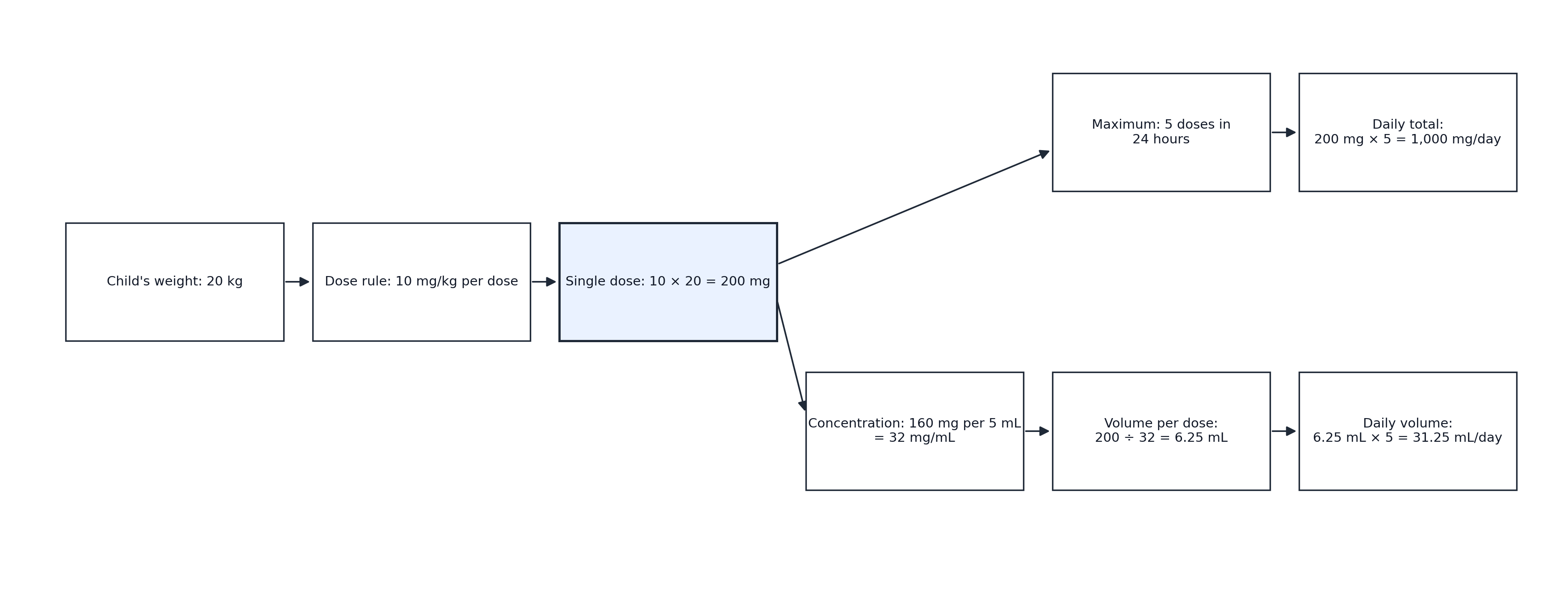
Let's walk through a full, realistic scenario from start to finish. Imagine we have a bottle of children's acetaminophen liquid with the following label information:
Concentration: 160 mg per 5 mL
Dosing guideline: 10 mg per kg per dose
Interval: Every 4 to 6 hours as needed
Maximum: 5 doses in 24 hours
Child's weight: 20 kg
Step 1 — Find the single dose in mg:
10 mg/kg×20 kg=200 mg
Step 2 — Convert to mL using the concentration:
160 mg per 5 mL200 mg=160200×5=6.25 mL
Step 3 — Find the maximum daily total:
The label caps intake at 5 doses per day, so:
200 mg×5=1,000 mg per day
In milliliters, that is 6.25×5=31.25 mL per day. Every answer traces back to reading the label accurately, choosing the right qualifier, and carrying the arithmetic through one step at a time.