Interpolation vs Extrapolation
Introduction
You have reached the fourth lesson of Reading and Using Regression Lines, and you are almost at the finish line for this course. So far, you have learned to read slopes, interpret intercepts, and substitute values into a regression equation to produce predictions. That last skill — computing a predicted — is powerful, but it comes with an important caveat we have not yet explored: not every prediction deserves the same level of confidence.
In this lesson, we will draw a clear line between two types of predictions — interpolation and extrapolation — and examine why stepping outside the data that built the model can lead us astray.
Not All Predictions Are Equal
A regression equation will happily accept any value you give it. You could plug in , , or , and the arithmetic will always produce an answer. But just because the math works does not mean the prediction is trustworthy.
The reason is that a regression line is built from a specific set of data, and that data only covers a certain span of values. The linear pattern we see in the scatter plot is confirmed only within that span. Once we move beyond it, we are assuming the same straight-line trend continues — an assumption that may or may not hold in the real world. This simple but powerful idea is the foundation of everything we cover in this lesson.
The Observed Range
Before we can evaluate any prediction, we need to identify the observed range of the explanatory variable. This is the interval from the smallest value in the data to the largest.
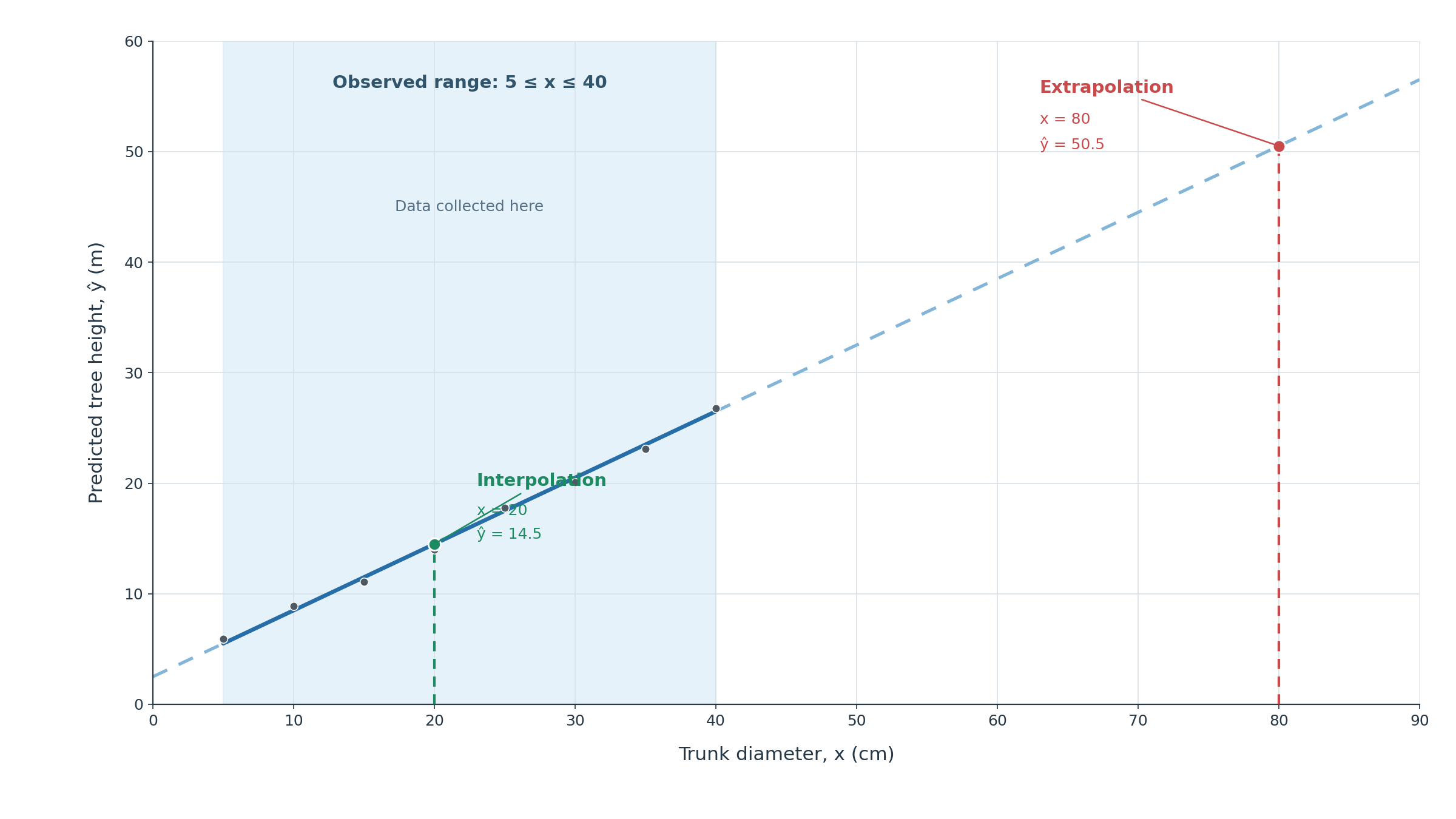
For example, suppose a researcher studies trees, measuring trunk diameter in centimeters () and tree height in meters (). If the trunk diameters in the data set run from cm to cm, then the observed range of is . Every prediction we make with this model should be evaluated against that window.
Interpolation: Predicting Within the Range
When we use the regression line to predict for an value that falls inside the observed range, we are performing interpolation. The prefix inter means "between," which is a helpful way to remember the term.
Returning to our tree example, suppose the regression equation is:
If we predict the height of a tree with a trunk diameter of cm, we substitute :
Since falls between and , this is interpolation. We are predicting within the territory the data actually covers, so the linear pattern observed in the data directly supports this prediction.