Seeing Team Strengths
Welcome to the Course
The previous course turned the lens inward; you mapped your own Strengths, biases, and emotional patterns. Now you flip the lens outward. Reading your team accurately is the difference between assignments that light people up and assignments that quietly drain them, between feedback that lands and feedback that bruises, between a team that speaks up and one that goes silent in the meeting and vents in the DMs.
By the end of this course, you'll be able to:
- Observe and interpret each team member's dominant Talent Themes from everyday behavior
- Adapt how you assign work, give feedback, and communicate based on likely Strengths profiles
- Map intrinsic motivators for each direct report and design experiments to test your hypotheses
- Flex between Analytical, Driver, Amiable, and Expressive communication styles in real time
- Lay the foundation of psychological safety so your team can dissent, take risks, and learn out loud
This first unit is about reading Strengths in others without sliding into the trap of labels.
Reading the Cues
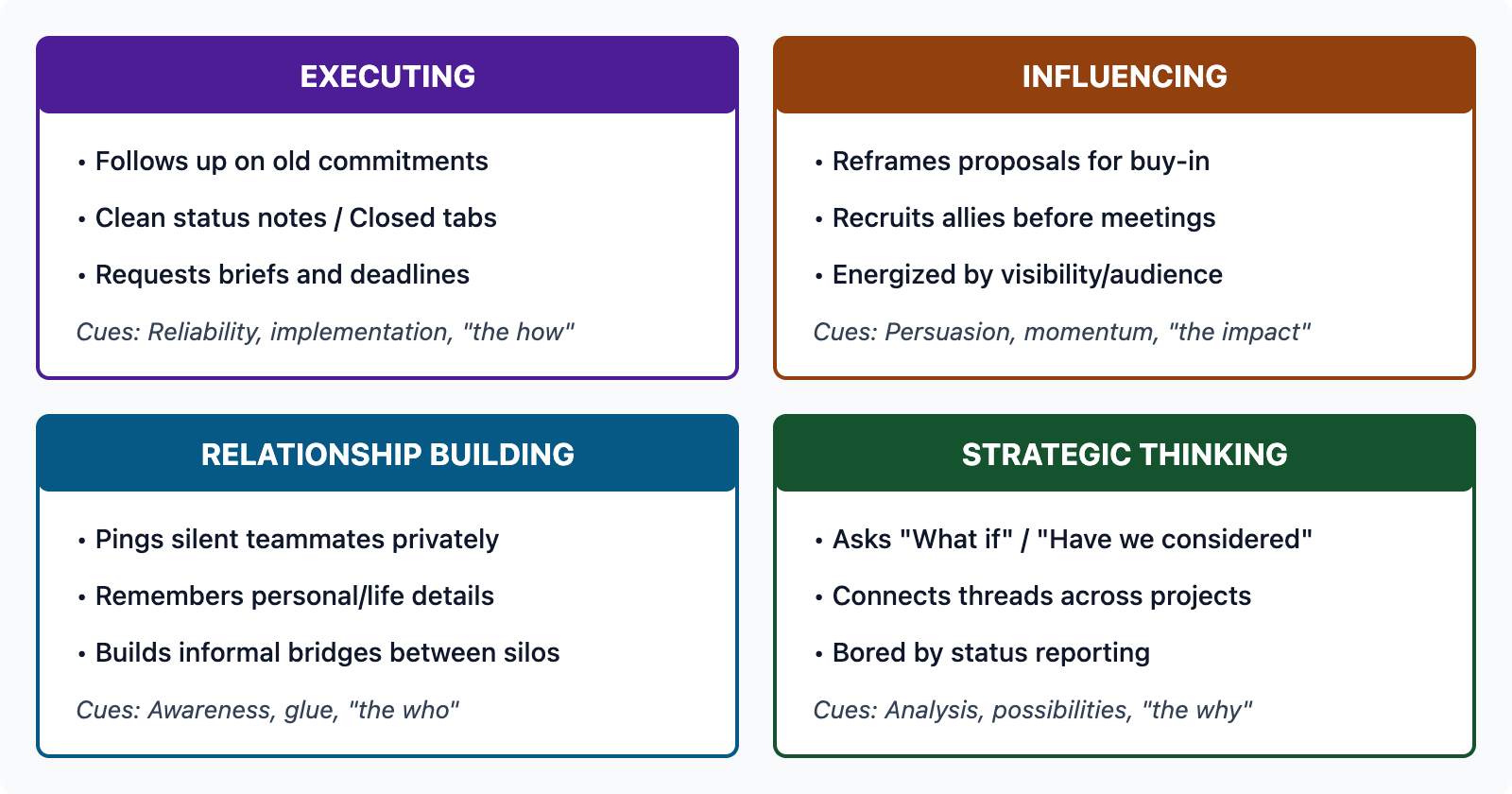
You already know the four CliftonStrengths Domains: Executing, Influencing, Relationship Building, and Strategic Thinking. The shift now is learning to spot them in motion, in the small behaviors that surface across standups, Slack threads, and 1:1s.
Strategic Thinking shows up as questions before answers. The teammate keeps asking "what if we" and "have we considered" while the rest of the room is converging. They generate options, connect threads from unrelated projects, and get visibly bored when a meeting becomes status reporting. Executing looks different: closed tabs, clean status notes, the person who follows up on a commitment from three weeks ago without being prompted. They want the brief and the deadline, and they trust you to handle the strategy.
Influencing shows up at the moment of stakes. The teammate who reframes a proposal so the exec actually buys it, who recruits allies before the meeting even starts, who is energized by audience and visibility. Relationship Building is quieter. It's the person who notices the new hire is silent and pings them privately, who remembers your kid was sick, who builds informal bridges between two engineers who've stopped talking.
The cues you're hunting for are consistent: what energizes them, what they volunteer for, what they actively avoid, and what vocabulary they reach for under stress. You're not diagnosing personality. You're noticing patterns.
Adapting Your Approach
Once you've noticed a pattern, the question is what to do with it. A teammate showing strong Strategic Thinking will thrive on autonomy and exploration, but if their Executing is lower, they'll need scaffolding you don't impose on others: milestone check-ins, a templated Friday status, a shared doc that forces decisions to the surface. A strong Executing teammate wants the opposite. Over-frame the discovery and you'll suffocate them; give them the target, the constraints, and the date, and step back.
Feedback flexes the same way. An Influencing-dominant teammate will hear "your impact in that meeting was X" louder than "your code was clean." A Relationship Building teammate will hear feedback through the lens of who was affected and how. The content can be identical; the framing has to flex.
- Natalie: I'm not loving the new sprint. Three of the six tickets are vague. I don't know what "good" looks like.
- Jake: Fair. You're flagging the spec gap, not the work itself, right?
- Natalie: Correct. If you can get me the acceptance criteria by Wednesday, I can plan the back half.
- Jake: Done. I'll send the criteria Wednesday morning. And for Milo's discovery ticket, I'm leaving that one open on purpose, he runs better with room. Different scaffolding for different people.
- Natalie: Makes sense. As long as my pieces are tight.
Notice what just happened: same sprint, two different scaffolding choices, and Jake named it out loud so Natalie didn't read Milo's autonomy as preferential treatment. That transparency is the move.
Observation, Not Label
Here's where managers get into trouble, and where you'll catch yourself most often: the slide from observation into label. "Milo missed two commitments in the last sprint" is an observation. "Milo is the scattered one" is a label. The first stays alive and updateable. The second hardens into a story that filters everything you see next.
Labels feel efficient. They give you and your peers a quick shorthand at the coffee machine: "the difficult one," "the messy one," "the rockstar." But once a label sticks, you stop seeing the person. You only see confirmations of the label, which is confirmation bias dressed up as pattern recognition. Worse, labels travel. The story you tell about a teammate at lunch with another manager becomes the story their next manager inherits.
The discipline is small but constant. When you catch yourself reaching for a label, translate it back into the underlying behavior. "He's flaky" becomes "he's missed two of the last four commitments." "She's a control freak" becomes "she's reviewed every PR personally for the last month." The translation isn't softer, it's sharper. And it leaves the door open for the person to change.
The single takeaway of this unit: behavior is data, labels are stories, and your team deserves to be read as data first. With that in mind, the next practice is a quick pattern-spotting drill where you'll match observable cues to the Strengths domain each one most likely signals. Treat it as a calibration check before you start applying any of this in a live conversation.
