Communication Style Flex
The Communication Style Flex
The motivation map told you what each teammate is running on underneath. This unit handles a different problem: even when you know what someone is motivated by, you can deliver the same message in two ways and only one will land. A teammate who's intrinsically motivated by mastery can still tune you out if you open with vision when she wants data. The flex isn't cosmetic. It's whether the message you intended is the message they actually heard.
The Four Styles, and The cues That Give Each One Away
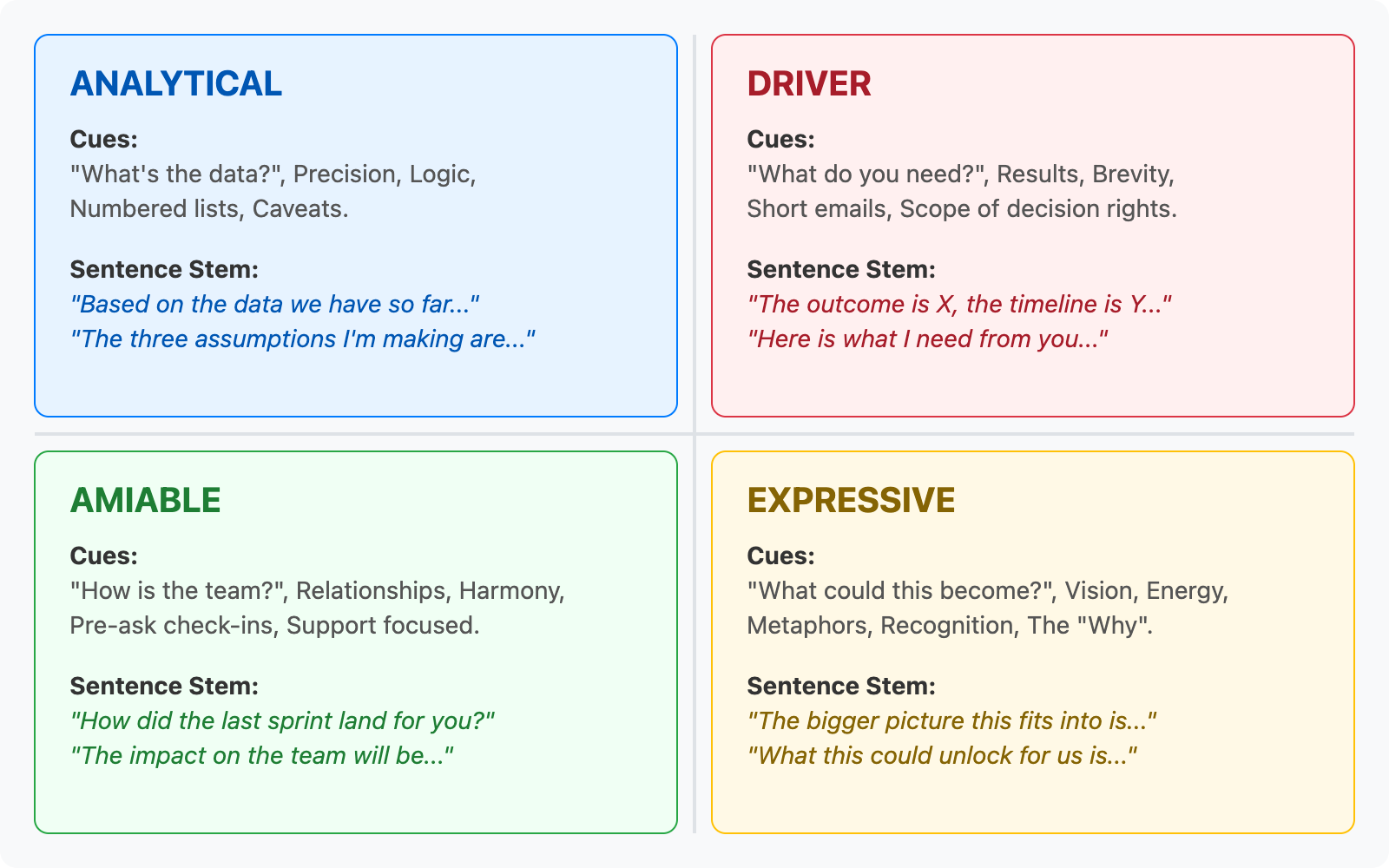
The simplest working model is the Four Communication Styles: Analytical, Driver, Amiable, and Expressive. Analyticals run on data, precision, and logic. They want sources, dependencies, and the assumptions you're making explicit. Drivers run on results, brevity, and control. They want the bottom line, the deadline, and a clear scope of decision rights. Amiables run on relationships, harmony, and support. They want to know how this lands for the team and where they fit in the new picture. Expressives run on vision, energy, and recognition. They want the bigger story, the why-this-matters, and a sense that their contribution will be seen.
You read style from cues, not from job titles. Listen for what they ask first. The Analytical asks "what's the data behind that?" The Driver asks "what do you need from me, and by when?" The Amiable asks "how is the team doing with this?" The Expressive asks "what could this become?" Watch their email length too: Drivers send three lines, Analyticals send a numbered list with a caveat, Expressives send a paragraph that opens with a metaphor, Amiables send a check-in before the ask. None of these are personality verdicts. They're tendencies you observe across multiple moments, the same way you treated OCEAN.
- Jessica: I want to flag something on the timeline. The dependency on the data team isn't pinned down, and we're committing to a partner date in eight weeks.
- Ryan: Yeah but think about what we unlock if this lands. This could be the thing that gets us the platform conversation we've been wanting for two years.
- Jessica: That's not the question I asked.
- Jake: Jessica, you're asking whether the dependency risk is actually accounted for. Ryan, you're seeing the upside if we hit. Both are real. Jessica, the three risks I want your read on are the data handoff, the staging environment, and the fallback plan if either slips.
Notice the manager doesn't try to pick a winner. The move is to name what each person is actually asking for, then route the next sentence to the style that's currently underserved.
Sentence Stems and Pacing That Match the Style
Once you can spot the style, you need actual moves. For Analyticals, open with structure and constraint: Based on the data we have so far..., The three assumptions I'm making are..., Here's what we don't yet know, and here's how we'll find out. Pace yourself slower. Leave silence after a question. Resist filling the air with energy, because to an Analytical, energy reads as a substitute for rigor.
For Drivers, lead with the headline: Here's the outcome, here's the timeline, here's what I need from you. Cut adjectives. Confirm decision rights early. Drivers disengage from preamble, so the relationship-building line you'd put up front for an Amiable goes at the end with a Driver, not the beginning.
For Amiables, slow down at the start. Open with the human frame: Before we get into the plan, I want to check in on how the last sprint landed for you. Acknowledge the team impact before the task ask. Amiables hear abrupt asks as relational signals, so your brevity will read as coldness unless you build a small bridge first.
For Expressives, open with the why and the canvas: Here's the bigger picture this fits into., Here's what this could unlock if we get it right. Match their energy in the opening minute, then gently steer toward the concrete. Expressives need to feel the vision was met before they'll commit to the sprint.
The rule of thumb across all four: stems and pacing are levers you pull deliberately, not impressions you perform. Pick two stems before each conversation and use them on purpose.
Flexing in Real Time When The Room is Mixed
Most of your conversations aren't single-style. A 1:1 can swing from Driver to Expressive in two minutes when a teammate gets excited. A team meeting has all four styles in the room at once. The flex is reading the shift and responding without losing the thread.
Watch for three signals that someone has shifted: pace acceleration (energy rising, sentences shortening), vocabulary swap (data words to vision words, or the reverse), and what they're now asking for (results to possibility, or possibility to results). When you spot a shift, name it briefly, match it briefly, then bridge: Love the vision. For this sprint, the result we need is X. That stem honors the energy without flattening it.
In a mixed room, sequence matters. Open with the Analytical and Driver content first, because if those needs aren't met, those people stop listening and you can't recover them. Then bring the Amiable framing and the Expressive vision. You don't have to hit every style in every sentence; you have to hit each one somewhere in the meeting.
The single takeaway: same message, four deliveries, and the flex is a practiced move, not a personality trait.
This is where it gets concrete. First a quick pattern-spotting round where you match short verbal and email samples to the style they signal, then two live conversations where you'll feel exactly how much your delivery has to shift, including a teammate who swings styles mid-meeting. Pick your stems before you walk in.
