Fractions to Terminating Decimals
Introduction
Welcome to Rational Numbers as Decimals, the sixth course in our learning path! In the previous five courses, we built strong skills in multiplying and dividing signed numbers, including integers and rational numbers. Now we begin a new chapter: expressing fractions as decimals. This is the first lesson in the course, and it focuses on converting fractions to terminating decimals using long division. By the end, we will be able to take any fraction whose decimal form terminates and carry the division all the way to a zero remainder.
Connecting Fractions and Decimals
As we may recall from earlier courses, a fraction like is really just another way to write . Every fraction represents a division problem, and we can actually perform that division to get a decimal number — the kind we see on price tags, digital scales, and measuring tools every day.
A gas pump might read per gallon, or a machinist might measure a part at inches. These are decimals that started life as fractions, and long division is the bridge between the two forms. Learning to cross that bridge gives us a powerful tool for interpreting and comparing quantities in everyday situations.
Setting Up the Long Division
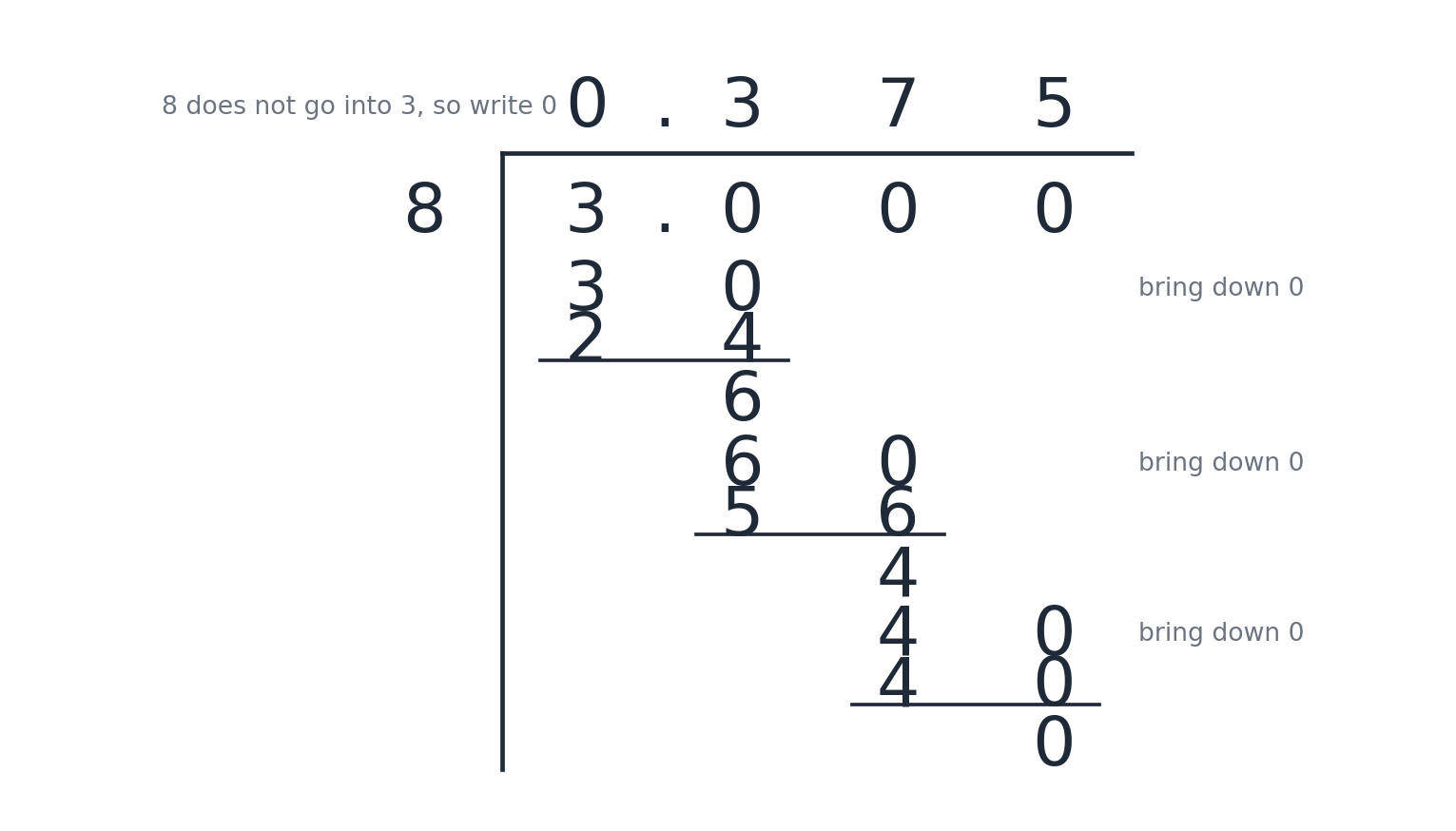
To convert a fraction to a decimal, we divide the numerator (top number) by the denominator (bottom number). Let's set up , which means .
Since is smaller than , it does not divide evenly at the whole-number level, so the whole-number part of our answer is . To keep going, we place a decimal point after the and append zeros, giving us . The decimal point in our answer lines up directly above this decimal point. Now we can divide digit by digit, just like the long division we already know.
Note: Continue to bring down a zero and divide as long as you have a remainder. If you reach a remainder of zero, the process terminates.
Walking Through the Division: Example
Let's carry out the division step by step.
- Tenths place: Bring down the first zero to make . Since , we write 3 above and get a remainder of .
- Hundredths place: Bring down the next zero to make . Since , we write 7 above and get a remainder of .
- Thousandths place: Bring down the next zero to make . Since , we write 5 above and get a remainder of .
The remainder has reached zero, so we stop. Our result is:
Because the division ends cleanly with no leftover, we call a terminating decimal. The word terminating simply means the decimal comes to a definite end — it does not go on forever.
