Fractions to Repeating Decimals
Introduction
Welcome back to Rational Numbers as Decimals! This is the second of four lessons in the course, so you are making solid progress. In the previous lesson, you used long division to convert fractions into terminating decimals — divisions that ended neatly once the remainder hit zero. This time, we tackle fractions whose decimals never stop. You will learn to recognize repeating patterns in these decimals and record them cleanly with bar notation.
When the Remainder Never Reaches Zero
Imagine splitting a $10 restaurant bill equally among three friends. Each person owes dollars. You might punch into long division and notice the answer is — the after the decimal point never stops. What is going on?
When you divide by , the only possible remainders are , , and . If the remainder never becomes , it must eventually repeat one of the nonzero values it already produced. The moment a remainder reappears, every subsequent division step copies the earlier cycle, and the quotient digits repeat right along with it. This is the heart of a repeating decimal: a cycling remainder forces a block of digits to cycle forever.
Walking Through Example
Let's slow down and trace one step at a time, keeping a close eye on each remainder.
- does not go into , so we write and bring down a to work with .
- with a remainder of . Quotient so far: .
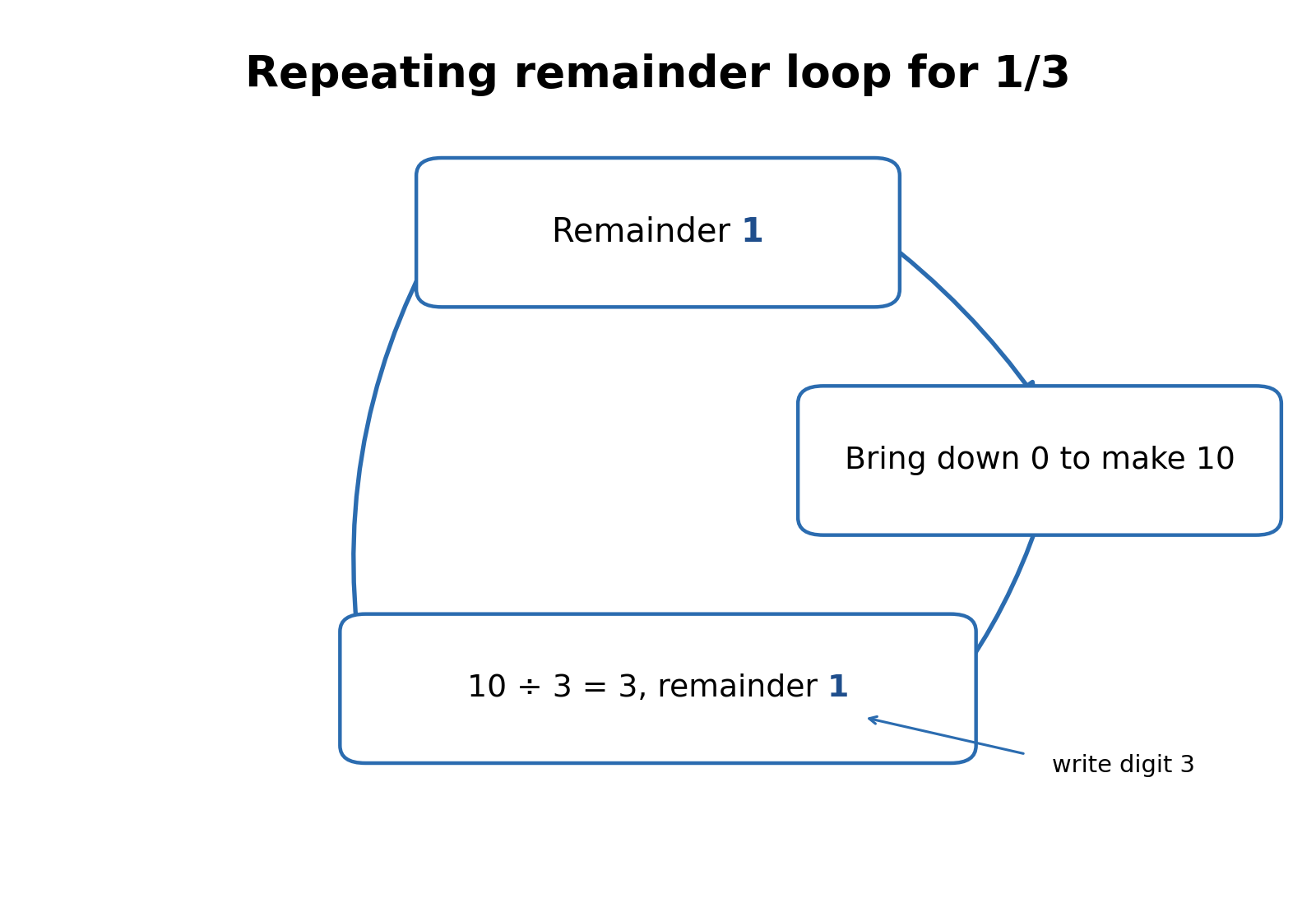
- Bring down a to get again.
- with a remainder of . We are right back where we started in step 2.
Because the remainder keeps returning, the digit repeats forever:
Notice the loop: the same remainder produces the same division, which yields the same quotient digit, which returns us to the same remainder. That self-reinforcing cycle is the signal that we have found a repeating decimal.
Recording Repeating Decimals with Bar Notation
