Terminating Decimals as Fractions
Introduction
Welcome back to Rational Numbers and Terminating Decimals! You have reached the third and final lesson in this course, so give yourself credit for the ground you have covered. In Lesson 1, we defined rational numbers as values that can be written as a fraction of two integers with a nonzero denominator. In Lesson 2, we used long division to convert fractions into decimals, discovering that every fraction's decimal expansion must either terminate or repeat.
Now we reverse direction. Given a terminating decimal, we will learn to express it as a fraction in simplest form. The method has just two steps: use place value to write the decimal over a power of ten, then reduce. By the end of this lesson, you will be able to handle any terminating decimal — short or long — with confidence.
From Decimals Back to Fractions
In the previous lesson we converted into by performing long division until the remainder reached zero. But suppose someone hands you and asks, "What fraction is that?" You need a reliable way to go backward.
The good news is that the decimal system itself gives us everything we need. Each digit to the right of the decimal point occupies a specific place, and that place corresponds to a particular power of ten. This connection between place value and powers of ten is the entire foundation of the conversion method we are about to explore.
Place Value and Powers of Ten
Every position after the decimal point has a name and a matching fraction:
| Position | Place Name | Denominator |
|---|---|---|
| 1st | Tenths | |
| 2nd | Hundredths | |
| 3rd | Thousandths | |
| 4th | Ten-thousandths |
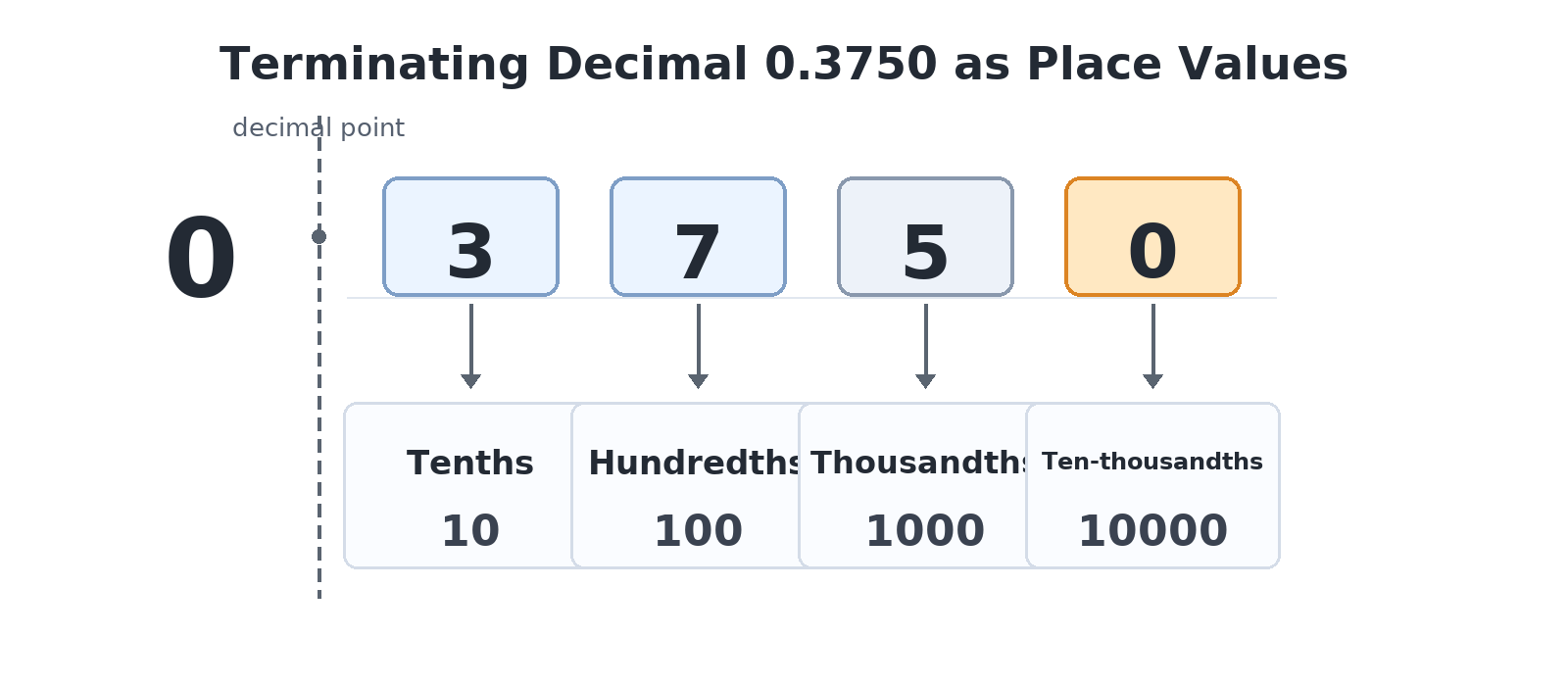
The key insight is straightforward: the last digit of a terminating decimal tells you which place value to use, and that place value becomes your denominator. For example, in the last digit sits in the hundredths place, so you can immediately write:
Read it aloud and you can hear the fraction: "thirty-five hundredths." The decimal and the fraction say exactly the same thing.
The Two-Step Method
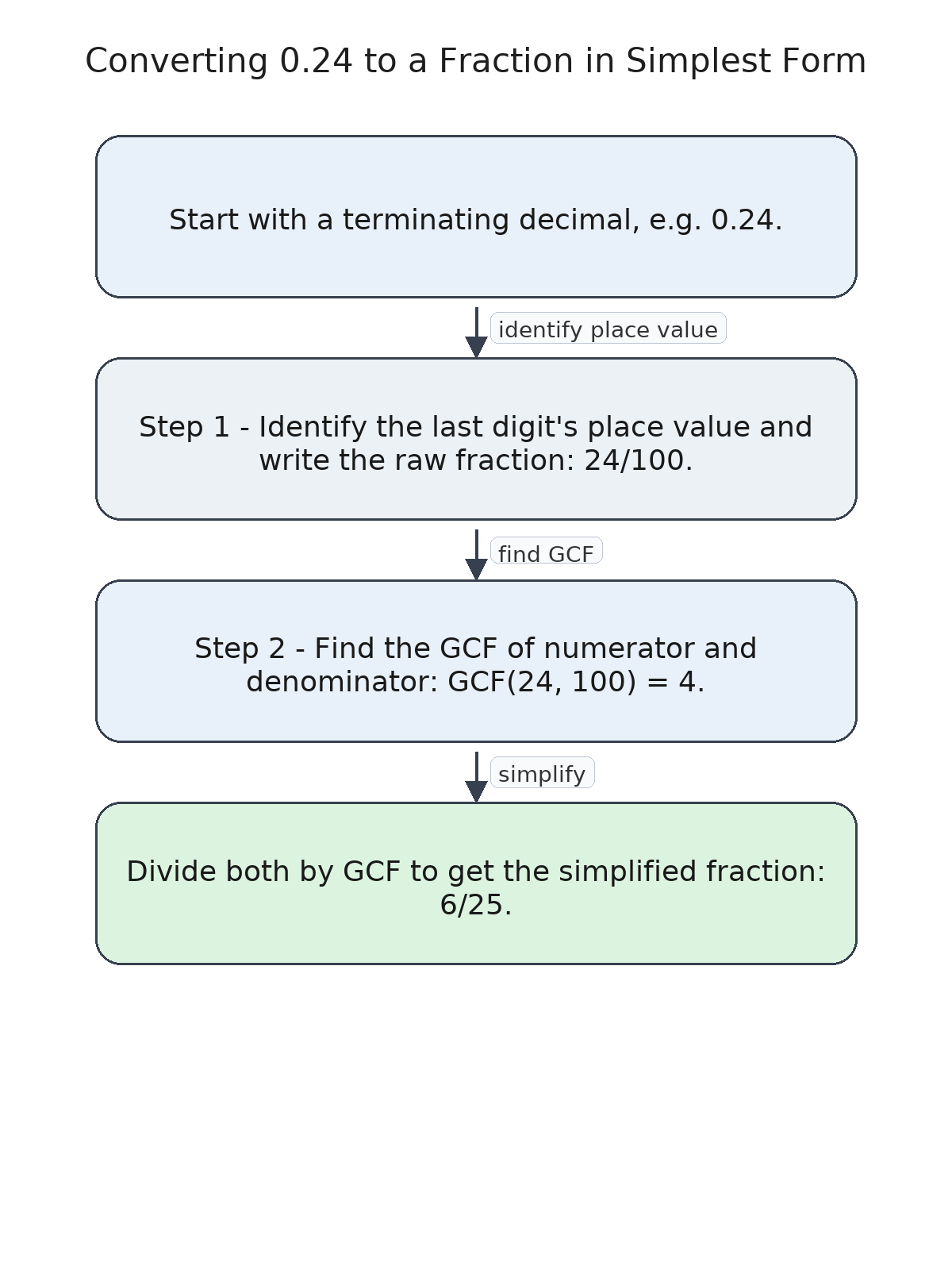
Converting a terminating decimal to a fraction in simplest form takes two steps:
- Write the raw fraction. Remove the decimal point and place the resulting whole number over the power of ten that matches the last digit's place.
- Reduce to lowest terms. Divide both the numerator and the denominator by their greatest common factor (GCF) — the largest whole number that divides evenly into both.
Let's apply this to .
Step 1 — The last digit is in the hundredths place, so we write:
Step 2 — We need the GCF of and . One reliable way to find it is to list the factors of each number. The factors of are , and the factors of are . The largest value appearing in both lists is , so we divide:
That's it: in simplest form.
Building Fluency with Short Decimals
Let's practice with a few one- and two-place decimals so the two-step pattern becomes second nature.
Example 1: The last digit is in the tenths place, so . The GCF of and is :
Example 2: The last digit is in the hundredths place, so . The GCF of and is :
Notice that the zero right after the decimal point in does not change the procedure. You still count positions to determine the last digit's place, write the raw fraction, and reduce. The leading zero simply means the numerator () is smaller relative to its denominator (), which is perfectly fine.
Working with Longer Decimals
The same two-step method works when the decimal extends to three or four places. The denominator simply becomes a larger power of ten, and finding the GCF may take a bit more thought. A helpful strategy here is prime factorization: since every power of ten factors neatly into s and s, you only need to check whether the numerator shares any of those prime factors.
Example 3: The last digit is in the thousandths place, so . Breaking each number into prime factors gives and . The shared part is , so:
This confirms what we saw in Lesson 2, where long division showed that . Working backward, , and indeed .
Example 4: The last digit is in the ten-thousandths place, so . Since and , the GCF is :
Even with a four-digit denominator, the process stays the same. The prime-factorization shortcut makes spotting the GCF quick and reliable, especially when the numbers are large.
A Real-World Connection: Money
Decimals and fractions meet naturally whenever we work with money. A price of $0.75 means cents, or hundredths of a dollar:
The GCF of and is , so:
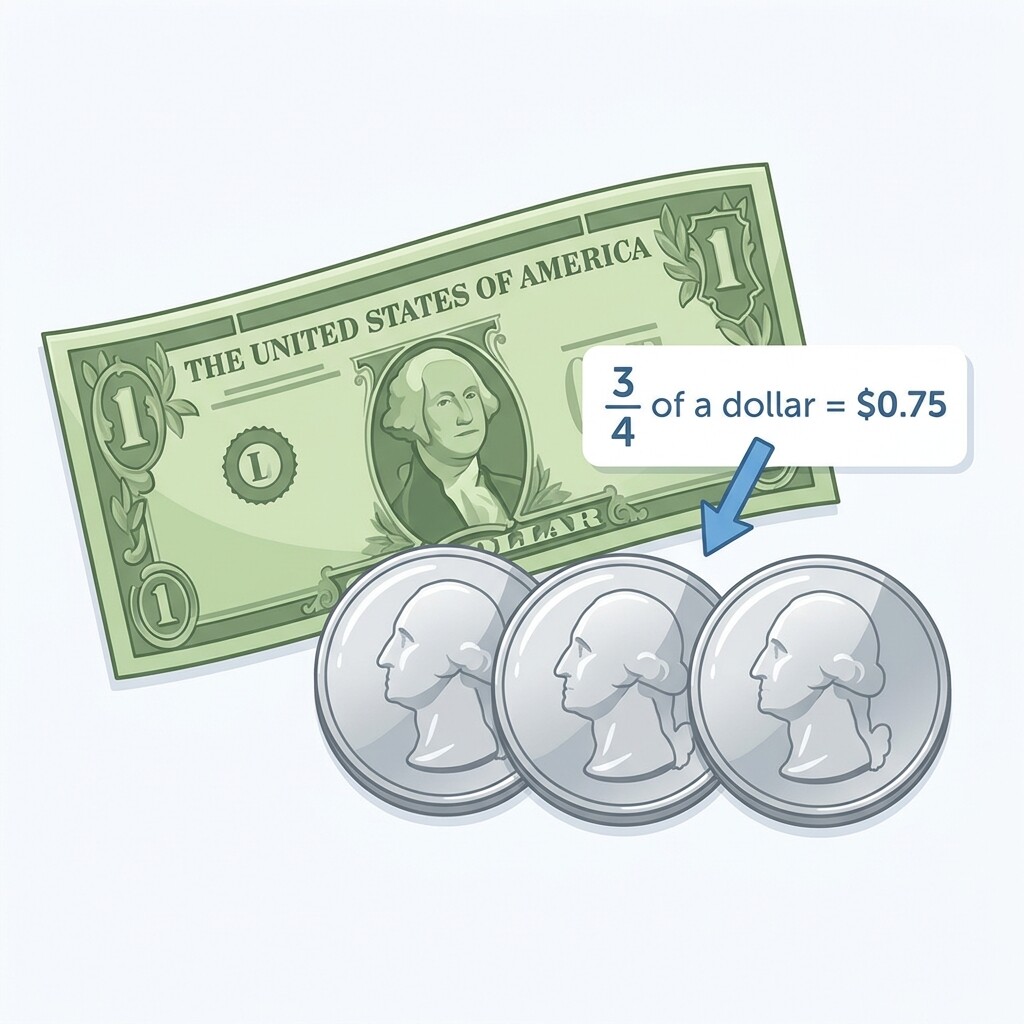
This tells us that $0.75 is exactly of a dollar — which makes perfect sense: three quarters! Whenever you see a price expressed as a decimal, you can find the exact fraction of a dollar it represents using the same two-step process. Being able to explain why the conversion works, not just perform it, is a valuable skill in everyday reasoning.
Conclusion and Next Steps
In this lesson, you learned to convert any terminating decimal into a fraction in simplest form. The method rests on two clear steps: use place value to write the decimal over the correct power of ten, then divide both the numerator and the denominator by their greatest common factor. Whether the decimal has one digit after the point or four, the approach stays the same.
With this skill in hand, the full round trip is now complete — fractions to decimals via long division, and decimals back to fractions via place value. Up next, the practice exercises will let you apply this across a range of conversions, from quick two-digit decimals to longer four-place values and even a real-world money scenario. Time to make it stick!
