Psychology of Problem Recognition
Welcome to the Course
Demand generation works not because of clever channels or well-timed ads, but because it changes how buyers think and feel about their own situation. If you want to build a demand function that creates markets rather than just harvesting forms, you have to understand the psychology underneath the buying decision. This course gives you that foundation.
By the end of this course, you'll be able to:
- Identify the cognitive triggers that move a content buyer into active problem-seeking
- Diagnose the awareness gaps that keep a latent problem invisible
- Read the emotional drivers hiding beneath a buyer's stated business rationale
- Translate personal, professional, and organizational pressures into messaging that lands
- Architect a psychology-based demand funnel built on trust and credibility markers
This first unit begins where demand itself begins: the moment a buyer stops accepting "good enough" and starts looking for something better.
The Cognitive Triggers That Move Buyers from Contentment to Problem-Seeking
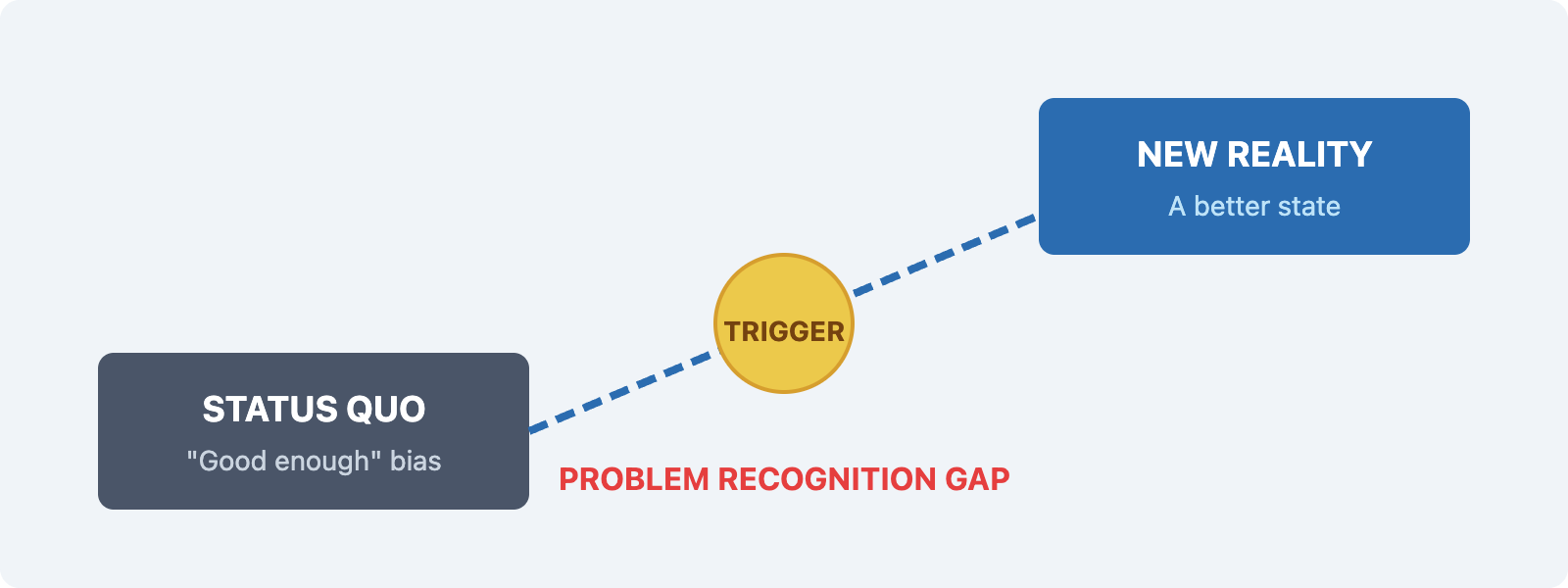 Most of your target buyers are not searching for you. They are content, and contentment is the default human state. Behavioral psychology calls this status quo bias: people overvalue their current situation and discount the benefits of change, because change carries perceived risk and effort. A buyer who believes their process is "fine" will not respond to your best offer, because they see no problem worth solving.
What breaks contentment is a cognitive trigger: a moment that opens a gap between the buyer's current reality and a better state they had not been picturing. Triggers take a few reliable forms. A trigger event (a missed target, a competitor pulling ahead, a new regulation) disrupts the assumption that things are fine. A visible gap between "what we settled for" and "what's now possible" creates dissatisfaction. And social proof, seeing a respected peer operate differently, makes the buyer question their own norm. Each one shifts the buyer from passive acceptance to active problem-seeking.
- Chris: Our whitepaper traffic is huge, but nobody's requesting a demo. Why?
- Natalie: Because they don't think they have a problem yet. They're content.
- Chris: So we push the product features harder?
- Natalie: No. Features answer "which solution." First we have to make them feel the gap between what they've settled for and what's actually possible.
- Chris: So the trigger isn't the product at all. It's the realization that "good enough" is quietly costing them.
Notice that Natalie doesn't reach for a better offer. She reaches for the trigger. That sequencing is the whole discipline: recognition before consideration.
Diagnosing Gaps in Buyer Awareness
If a trigger is what you need to create, an awareness gap is what stands in the way. Contentment persists because of specific things the buyer does not yet know or perceive, and your job is to diagnose those gaps precisely rather than assuming the buyer is simply uninterested.
A clean way to structure the diagnosis is to separate what the buyer does not yet believe, feel, or notice. The belief gap is intellectual: the buyer does not accept that their current approach carries a real cost. The feeling gap is emotional: even if they concede a cost exists, they feel no urgency or risk about it. The notice gap is perceptual: they simply do not see the compounding, day-to-day impact because it has faded into background noise. Each gap blocks recognition for a different reason, so each demands a different message. Confusing them is why generic "pain point" lists rarely move anyone: you cannot fix a feeling gap with a statistic, or a notice gap with a fear appeal.
Designing Demand Messages That Make Latent Problems Feel Worth Solving
Once you know which gap you're closing, the message almost writes itself. To close a belief gap, you make the hidden cost credible with specifics the buyer recognizes from their own world. To close a feeling gap, you connect that cost to something they personally experience, a late decision, a stale number in a leadership meeting, so the risk becomes felt rather than abstract. To close a notice gap, you make the compounding effect visible: what one delay looks like over a quarter, or a year.
The discipline here is surfacing a real problem, not manufacturing a fake one. Overstated urgency triggers the buyer's skepticism and destroys the trust you'll need later. Strong demand messaging feels like an honest observation the buyer half-suspected already, prompting a quiet "huh, maybe this is costing us more than I thought."
The core insight to carry from this unit: demand doesn't start with your solution, it starts with the buyer recognizing a problem they had been living with. This is where it gets concrete. Next you'll work through a quick pattern-spotting check to sharpen your eye for which trigger actually moves a content buyer, then build toward diagnosing and messaging real awareness gaps yourself.
