Quantifying Your Beliefs
Introduction
Welcome to Probability as a Degree of Belief, the first course in our Bayesian reasoning learning path! Since this is our very first lesson together, we are starting right at the foundation. By the end of this lesson, you will be able to take a vague feeling of confidence and turn it into a number — the essential first step for everything that follows in this course.
Most of us use probability language every day without thinking much about it. We say things like "I'm pretty sure the meeting got moved to Thursday" or "There's no way it rains today." These statements carry a sense of how strongly we believe something, but they are fuzzy. Our goal here is to make that fuzziness precise.
Beliefs Live on a Scale
Before we talk about formulas or rules, let's start with a simple idea. Imagine someone asks you: "Do you think your favorite team will win tonight?" You might answer "probably," "maybe," or "I doubt it." Each of those words reflects a different strength of belief.
The core insight of this lesson is that we can represent that strength with a single number. Think of it like a volume knob on a speaker. Turned all the way down means silence; turned all the way up means maximum volume. Belief works the same way: you can place your confidence somewhere along a smooth range from no confidence at all to complete certainty.
The 0-to-1 Probability Scale
In probability, that "volume knob" runs from 0 to 1:
- A probability of means you are certain the claim is false.
- A probability of means you are certain the claim is true.
- Everything in between reflects some degree of uncertainty.
For example, saying "there is a 70% chance this email is spam" is the same as assigning a probability of to the specific claim "this email is spam." You are not saying the email definitely is or is not spam. You are saying your belief sits at on the scale — closer to confident than to doubtful.
A quick note on format: probabilities can be written as decimals (), fractions (), or percentages (70%). They all mean the same thing. Throughout this course we will mostly use the decimal form, since it keeps the math clean and reminds us that probability lives between and .
Mapping Everyday Language to Numbers
We already use words that hint at probabilities. The table below shows how common phrases roughly line up with regions on the -to- scale:
| Phrase | Approximate Range |
|---|---|
| "Almost no chance" | near (roughly –) |
| "Doubtful" / "Unlikely" | below (roughly –) |
| "Could go either way" / "Even odds" | around |
| "Fairly sure" / "Likely" | above (roughly –) |
| "Almost certain" | near (roughly –) |
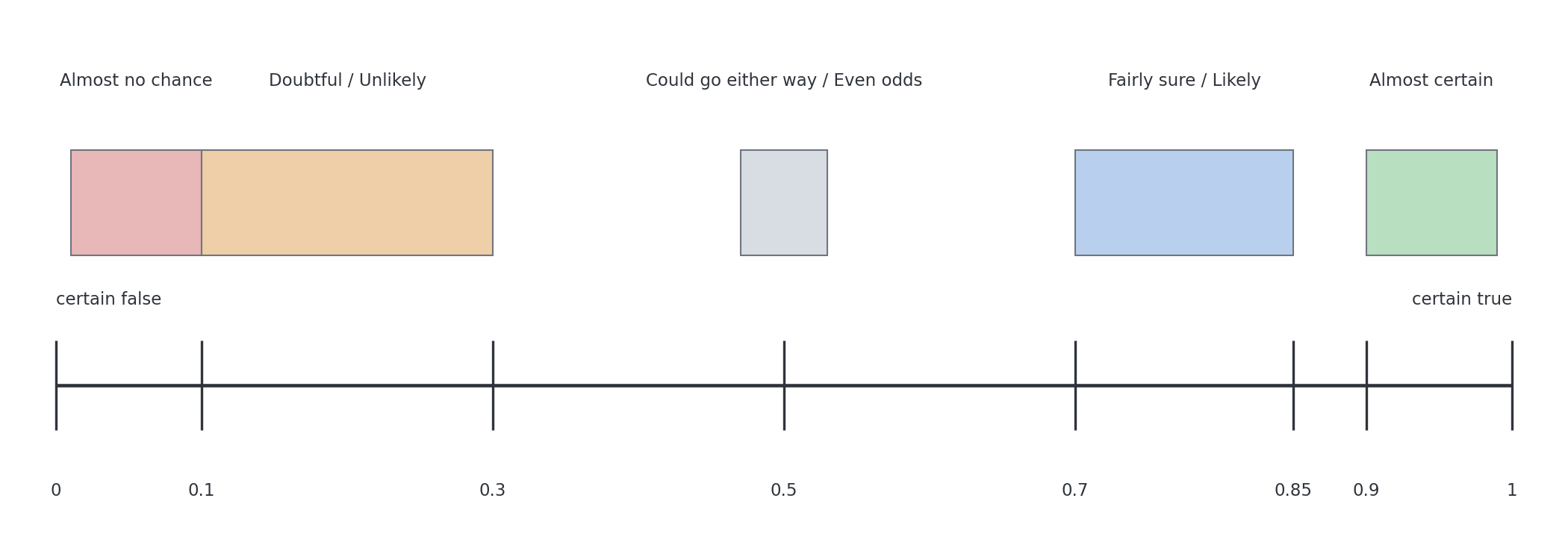
Notice that these are ranges, not exact points. Two people who both say "fairly sure" might mean and respectively, and neither is wrong. The purpose of assigning a number is not to pretend you have perfect precision — it is to be more precise than a vague word alone.
Beliefs Attach to Specific Claims
So far we have a scale and a vocabulary for it, but there is one more piece: a probability always belongs to a specific, uncertain claim. Compare these two statements:
- "I'm 80% sure my package arrives today."
- "A standard die has six faces."
The first statement expresses a degree of belief about a particular uncertain outcome. The second is just a fact about how dice are built; there is nothing uncertain to believe more or less. When you assign a probability, you need a clear claim whose truth you are not yet sure of.
Good belief statements usually sound like: "I think there is a [number] probability that [specific thing happens]." If the claim is already known to be true or false, or if no particular outcome is identified, then you are not really expressing a degree of belief.
From Gut Feeling to a Number
Let's walk through a quick example to tie everything together. Suppose you hear thunder in the distance while getting ready for work. You might think:
- Claim: "It will rain during my commute."
- Gut feeling: "Fairly likely."
- Numeric belief:
That single number, , captures your personal confidence right now. Someone living in a desert might assign to the same claim after hearing distant thunder, while someone in a tropical city might go as high as . All three numbers are valid because each one honestly represents a person's own belief given what they know.
Notice we are not yet talking about how to change that number when new evidence comes in — that is a topic for later in the course. For now, the skill is simply turning an informal sense of confidence into a number on the -to- scale, attached to a clear uncertain claim.
Conclusion and Next Steps
Here are the key ideas from this lesson. Probability can represent how strongly you believe a specific uncertain claim, not just how often something happens in the long run. The scale runs from (certain it is false) to (certain it is true), and everyday phrases like "doubtful" or "almost certain" map onto broad regions of that scale. Every probability you assign should point at a particular claim whose outcome you do not yet know for sure.
Up next, you will put these ideas into action with a set of practice exercises. You will sort belief statements from plain facts, match confidence phrases to numeric ranges, and assign your own probabilities to real-life uncertain claims — let's see how well your intuition translates into numbers!
