Identifying Base Rates
Introduction
Welcome back to Probability as a Degree of Belief! This is the fifth and final lesson of the course, so you are about to cross the finish line. Over the previous four lessons you learned to place beliefs on the -to- scale, compared belief-based probability with long-run frequency, used evidence as a filter to compute conditional probabilities, and discovered that flipping the direction of a conditional changes the answer — sometimes dramatically. Today we turn our attention to a piece of the puzzle that was quietly doing important work in every example so far: the base rate.
Remember the medical test scenario from the last lesson? The disease affected only 50 out of 10,000 people, and that tiny proportion was the reason ended up at roughly 8% even though the test itself was 90% accurate. The share of the population that has the disease before anyone is tested is exactly what we mean by a base rate. In this lesson, we will give that idea a clear name, learn how to spot it in new scenarios, and understand why it is a separate, essential ingredient in any reasoning about evidence.
The Belief You Hold Before Looking
Imagine you are about to open your email inbox. Before you see a single subject line or sender name, you already have a rough sense of how much of your mail is spam. Maybe past experience tells you that about 20% of incoming messages are junk. That 20% is your starting belief about any given email being spam, and it exists entirely independent of whatever clues a particular message might contain.
This is the core intuition behind a base rate: it is the probability you assign to a hypothesis before any new evidence enters the picture. Think of it as the default setting on a dial. Evidence will later turn that dial up or down, but the dial has to start somewhere. Without that starting point, evidence alone cannot tell you where to land.
Defining the Base Rate
The base rate (also called the prior probability or simply the prior) is the probability of a hypothesis being true in the relevant population or situation, measured before considering any new evidence. In notation, if stands for the hypothesis, the base rate is simply:
For example, if 3 out of every 1,000 manufactured parts are defective, then for any single part picked at random:
That 0.003 is the base rate of the "defective" hypothesis. It tells us what we should believe about a part before we run any quality test on it. Notice that this number says nothing about how good or bad any test might be — it is purely about how common the condition is in the first place.
Spotting the Base Rate in a Scenario
Real-world problems rarely label a number with the words "base rate." Instead, the prior is usually embedded in a background fact stated early in the problem. Here are some phrases that signal you are looking at a base rate:
- "1% of the population has this condition."
- "Roughly 5 out of every 100 transactions are fraudulent."
- "About 30% of applicants meet the minimum requirement."
- "One in 500 bags contains a prohibited item."
The common thread is that each statement describes how frequent the hypothesis is in general, with no mention of test results, symptoms, or other observed evidence. A useful test: if you can state the number without knowing anything about a specific observation, it is probably the base rate.
Let's revisit the medical scenario from the previous lesson to see this in action. The problem told us that 50 out of 10,000 people have the disease. Converting that to a probability:
The test's detection rate () and its false-alarm rate () are not base rates. They describe how the test result behaves once we already know the disease status. The base rate stands alone: 0.5% of the population, no test required.
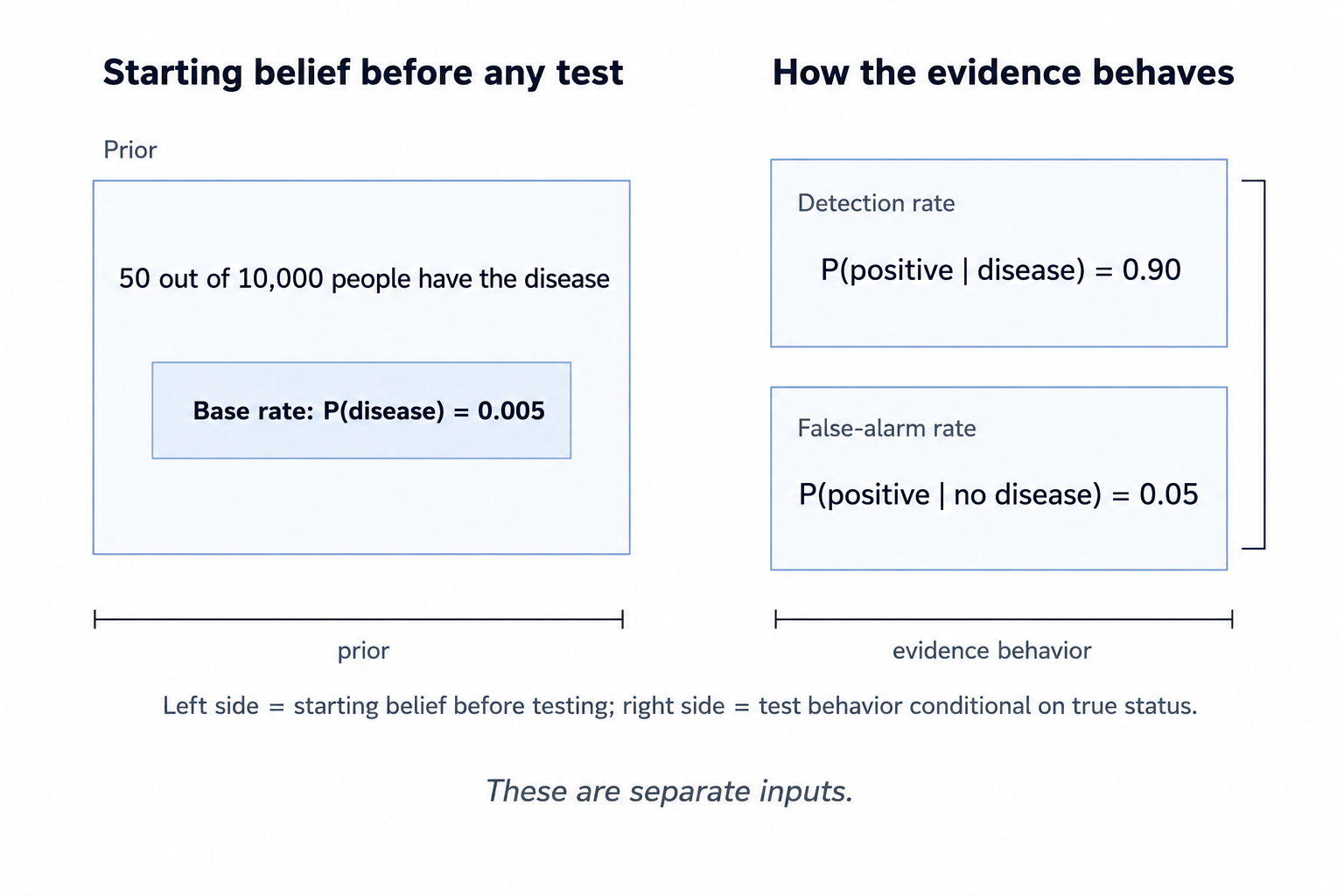
The Base Rate Is a Separate Input
Why insist that the base rate is its own ingredient? Because two scenarios with identical tests but different base rates lead to very different conclusions. Consider a quick comparison using the same counting method we practiced in the previous lesson.
| Scenario | Base rate | Detection rate | False-alarm rate | |
|---|---|---|---|---|
| Rare disease | 0.90 | 0.05 | ||
| Common disease | 0.90 | 0.05 |
The test has not changed at all — same detection rate, same false-alarm rate. The only difference is how common the disease is before testing. In the rare-disease scenario, a positive result means roughly an 8% chance of actually being sick. In the common-disease scenario, that same positive result means about an 82% chance. The base rate alone moved the answer from "unlikely" to "very likely."
This is why treating the prior as just background decoration is dangerous. If we ignore it and focus only on how accurate the test is, we will badly misjudge the situation every time the hypothesis is especially rare or especially common.
Base Rates in Everyday Thinking
Base rates are not limited to medical tests or factory defects. They appear whenever we evaluate a claim against background frequency.
Fraud detection. A bank's algorithm flags unusual transactions. If only 0.1% of all transactions are truly fraudulent, that 0.001 is the base rate. Even a clever algorithm with a low false-alarm rate will generate many false alerts simply because legitimate transactions vastly outnumber fraudulent ones. Knowing the base rate keeps expectations realistic and helps the bank design a sensible review process.
Hiring decisions. Suppose 10% of résumés in a stack come from candidates who will perform well in the role. Before reading a single résumé, . A screening tool might help identify promising applicants, but interpreting its recommendations sensibly requires knowing that starting 10%.
In each case, the base rate is the number you would quote if someone asked, "How likely is this hypothesis before I look at any specific evidence?" It is always there, whether the problem states it loudly or buries it in a single sentence.
Conclusion and Next Steps
The base rate, or prior probability , is the belief we assign to a hypothesis before any new evidence is considered. It is a standalone number that reflects how common or rare the hypothesis is in the relevant population. As we saw, changing the base rate while keeping everything else the same can shift a conclusion from "unlikely" to "very likely." Recognizing and quantifying this starting belief is the critical first step in every updating process you will meet in the next course, where we build Bayes' theorem from the ground up.
Now it is time to put this knowledge into action. In the upcoming exercises you will pick out base rates from realistic scenarios, extract their numeric values, and explain in your own words why the prior deserves its own seat at the reasoning table. Let's finish this course strong!
