Delivering a Compelling Pitch
Making Your Pitch
You've prepared your case, gathered feedback, and now it's time to present. The HBR Guide to Building Your Business Case by Raymond Sheen says this is where your preparation becomes a compelling narrative that moves decision makers. As Sheen notes, some stakeholders focus on ROI, others on collaboration or risk. Your challenge is to address these priorities while keeping your presentation focused and engaging.
Presenting isn't just about slides or numbers; it's about connecting your solution to your audience’s strategic priorities. The best presenters guide stakeholders through a journey that leads to a logical conclusion. Be sure to emphasize being brief yet comprehensive, confident but open to feedback, and ready to pivot when challenged. With limited time—sometimes just minutes—start strong, engage personally, and handle resistance with grace. Your delivery can make or break your proposal.
Opening with Business Need Explicitly Tied to Strategic Priorities
Your first moments are crucial. If stakeholders don’t see a real business need tied to strategic priorities, they’ll stop listening. Start directly with the problem and its strategic impact, not background. For example, instead of, “Today I’ll discuss inventory management,” say, “We’re losing $3 million annually due to inventory misalignment, threatening our goal of operational excellence.” Tell this as a story—real people, real pain, and clear strategic stakes. This frames your entire case as necessary and urgent.
After establishing strategic importance, make your case personal and credible. You can do this effectively by involving beneficiaries and highlighting expert endorsements. Invite a stakeholder to share their experience: “Sarah, can you describe what happened during last week’s system crash?” This brings authenticity and urgency. Referencing expert validation (ex: “Marcus from Finance confirmed these projections”) adds credibility and shows organizational buy-in. These voices turn your proposal into a shared cause, not just your idea.
Handling Naysayers by "Inviting the Lions In" and Addressing Concerns Directly
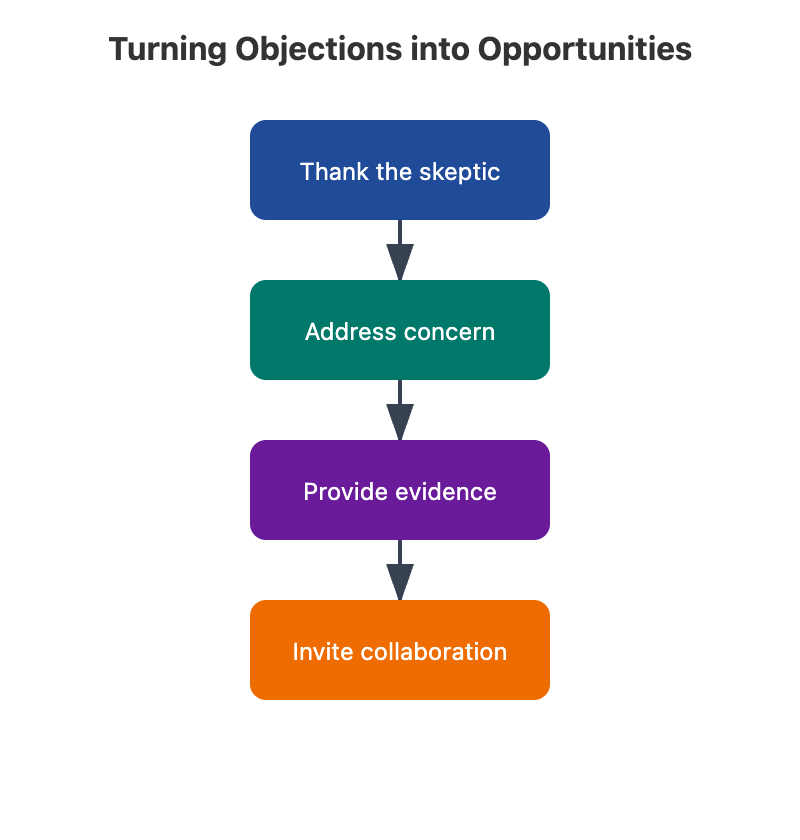
Resistance is inevitable. One effective approach is to “invite the lions in” by thanking skeptics and engaging them directly. This demonstrates confidence and can turn adversaries into allies. Before we look at a real-world example, review the diagram below. It illustrates the process of turning objections into opportunities by engaging skeptics, addressing their concerns, and inviting their expertise into the solution:
Now, let’s look at a brief example of how this can play out in a real pitch:
- Jessica: We're proposing a $2.5M investment in automated quality control to cut defects by 40% in 18 months.
- Milo: We spent $3M on automation last year and saw little improvement. Why is this different?
- Jessica: Good point, Milo. Last year’s system automated end-of-line testing, but most defects happen during assembly. Want to see how this targets those?
- Milo: How do we know your 40% isn’t optimistic?
- Jessica: Ryan, you led the pilot—can you share the results?
- Ryan: We saw a 43% reduction in three months.
Jessica’s approach of thanking Milo, addressing his concern, and bringing in Ryan for validation demonstrates how to turn objections into opportunities for deeper engagement. As seen in this example, addressing skepticism by shifting to methodology, admitting gaps if needed, and showing support from those who will execute. Engaging objections directly demonstrates leadership and often wins over the room.
Now that you understand these critical techniques—opening with strategic alignment, personalizing through stakeholder involvement, and skillfully handling objections—you’re ready to put them into practice. In the upcoming role-play sessions, you’ll experience firsthand what it feels like to command a room from your opening statement, orchestrate meaningful stakeholder participation, and transform challenges into productive discussions that strengthen your case.
